







In the competitive landscape of digital publishing, the greatest challenge for any WordPress site owner is not just creating content—it is creating the right content. For years, bloggers and site owners have relied on a combination of intuition, keyword research tools, and Google Analytics to guess what their audience wants. But these methods often leave a critical gap: they tell you what people clicked on, but they rarely tell you what people were searching for and failed to find.
Enter "Site Brain," a pioneering experiment from the team behind OpenClaw. By integrating an always-on AI agent directly into a WordPress environment, Site Brain seeks to bridge the chasm between visitor intent and editorial output. This isn’t just a chatbot; it is a diagnostic tool that turns every unanswered visitor question into a data-driven opportunity for growth.
The Core Concept: Moving Beyond Static Content
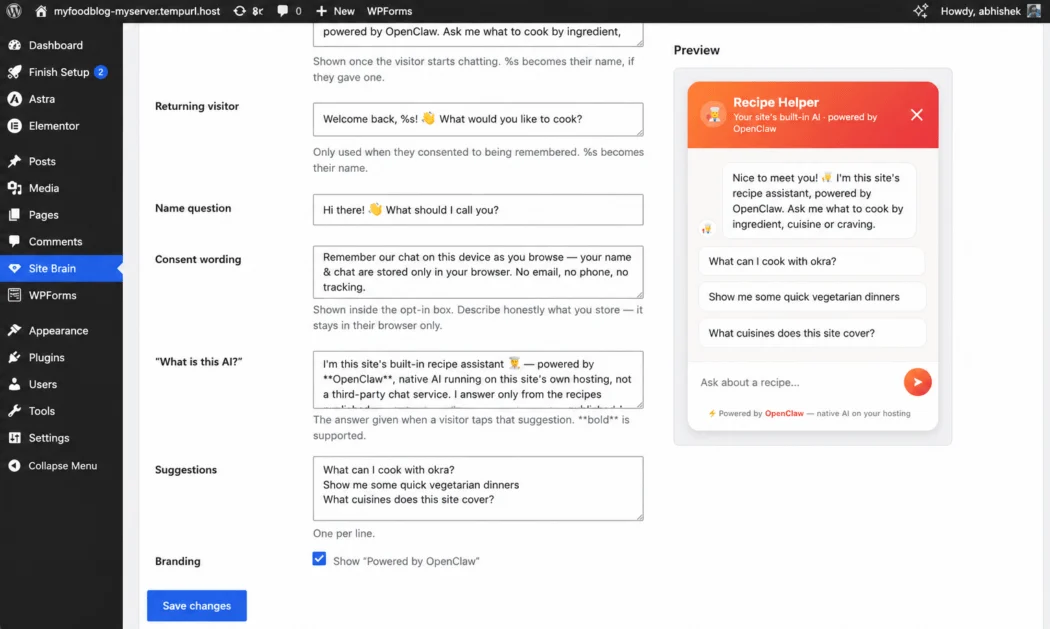
At its heart, Site Brain is an interactive AI assistant that lives in the corner of a website. While many chatbots are designed simply to deflect support tickets or provide basic customer service, the Site Brain experiment is built with a different purpose: to serve as a bridge between the site’s existing archive and the user’s specific, nuanced needs.

The Mechanism of Discovery
The system utilizes a sophisticated technical stack—OpenClaw, OpenAI embeddings, and the Qdrant vector database—to process the site’s entire content library. When a visitor asks a question, the AI doesn’t just scan for keywords; it understands the semantic meaning behind the query. If a visitor asks, "What can I cook with these leftover potatoes?", the assistant scans the site’s recipes and provides tailored, actionable links.
This creates an immediate value proposition for the user: they find what they need, and the site owner gains a higher engagement rate. But the real "magic" happens behind the scenes, where the AI shifts from a front-facing assistant to an analytical engine.
Chronology: From Concept to Implementation
The journey of Site Brain began with a simple, provocative question: What if a visitor’s unanswered question could become the blueprint for a new article?

- The Pilot Phase (Testing on a Food Blog): The team deployed the "Recipe Helper" prototype on a live food blog. By monitoring real-time interactions, they observed how users queried the site.
- The Analytical Phase: The AI began logging queries that the site’s current content could not address. It categorized these as "unmet needs."
- The Synthesis Phase: The agent took these unmet needs and cross-referenced them with the existing taxonomy of the site. It then generated a list of potential article topics that would fill the gaps in the user experience.
- The Optimization Phase: The final stage involved identifying "orphan posts"—valuable articles that had no internal links—and generating a strategic plan to integrate them into the site’s ecosystem.
Supporting Data and Technical Architecture
The success of Site Brain relies on three primary technical pillars working in concert:
- OpenClaw Agent: The orchestration layer that manages the AI’s interaction with the WordPress database.
- OpenAI Embeddings: This converts textual content into mathematical vectors, allowing the system to understand the meaning of content rather than just matching characters.
- Qdrant Vector Database: This acts as the "searchable memory" of the site. It allows for lightning-fast retrieval of relevant content, ensuring the AI can provide accurate, context-aware answers to complex queries.
In the prototype testing, the AI successfully flagged specific recipes that were buried in the archives with zero inbound links. By automatically suggesting where these links could be placed within existing, high-traffic articles, the system provided a roadmap for improving site structure without requiring the owner to manually audit thousands of pages.
Official Insights: The Role of Human Oversight
One of the most critical aspects of the Site Brain project is the firm commitment to human-in-the-loop control. While the AI is capable of generating editorial plans, identifying link opportunities, and summarizing user behavior, it is explicitly configured not to publish content autonomously.

According to the developers, the goal is to augment the site owner’s decision-making process, not to replace it. The agent presents its findings—such as a list of five high-potential article topics—and waits for the human editor to review, approve, or discard the suggestions. Furthermore, the system was configured to index only public-facing content, ensuring that drafts, private pages, and sensitive user data remain strictly off-limits to the AI’s learning model.
This design philosophy acknowledges that while AI is an exceptional tool for data analysis and discovery, the nuance of editorial voice and content strategy remains a uniquely human domain.
Implications for the Future of Content Strategy
The implications of the Site Brain experiment for the broader WordPress ecosystem are profound. It represents a fundamental shift from a "publish and pray" strategy to a "listen and pivot" strategy.

1. The Death of the "Orphan Post"
Every veteran blogger has dealt with the issue of orphan posts—high-quality articles that fall into a black hole of poor navigation. Site Brain transforms this from a tedious manual task into an automated audit. By identifying where contextually relevant links should exist, the tool ensures that every piece of content on a site has a fighting chance of being discovered.
2. Evidence-Based Editorial Calendars
Instead of relying on broad, competitive keyword tools that might be irrelevant to a specific niche, Site Brain provides an editorial calendar rooted in the actual desires of your visitors. When a user arrives on a site and asks for a "quick vegetarian dinner," they are providing first-party intent data that is far more valuable than any third-party search volume estimate.
3. Strengthening the Visitor-Site Relationship
By providing a helpful, immediate answer, the site moves from being a collection of static pages to an interactive resource. This increases session duration, reduces bounce rates, and fosters a sense of trust between the site owner and the reader.

Expanding the Scope: Beyond Food Blogs
While the initial experiment was conducted on a food blog, the potential applications for this technology are vast.
- Technical Documentation: A software company could use this to identify which parts of their documentation are confusing or missing entirely, based on user queries.
- Travel and Lifestyle: A travel site could use the agent to connect readers with specific, niche destination guides that they might otherwise miss.
- Educational Platforms: For e-learning sites, the system could identify which concepts students are struggling to understand, providing the instructor with a direct path to creating supplemental learning materials.
Conclusion: A New Era of Site Ownership
The Site Brain experiment is a testament to the power of combining traditional content management systems like WordPress with modern, agentic AI. It provides a clear, actionable path toward a more efficient and responsive website.
For site owners, the message is clear: the future of content is not just about writing more; it is about writing better. By listening to the needs of the audience—through the lens of an AI that never sleeps—you can build a site that is not only more discoverable but more valuable to everyone who visits it.

As we move forward, the integration of these tools into standard web hosting environments like WPMU DEV’s OpenClaw suggests that the "smart site" will soon be the industry standard. Whether you are managing a small personal blog or a massive repository of technical information, the ability to turn raw visitor data into a refined editorial plan is a capability that no serious publisher can afford to ignore.
Could you imagine your site "thinking" along with you? The technology is here, the framework is open, and the potential to revolutionize your content strategy is waiting.