In the rapidly evolving landscape of digital marketing, the transition from traditional search engine optimization (SEO) to Generative Engine Optimization (GEO) has been swift and unforgiving. For years, brands have obsessed over ranking on the first page of Google. Today, that goalpost has shifted. The new battleground is not a list of ten blue links, but the definitive, synthesized answer provided by AI models like ChatGPT, Gemini, Perplexity, and Claude.
However, a dangerous misconception has taken hold in the industry: that knowing whether a model "mentions" your brand is the same as knowing if it "recommends" your brand. As recent research—notably from industry expert Lily Ray—has demonstrated, a brand can appear in a "best of" list, only to be completely bypassed by the model the moment it formulates a specific recommendation. In the world of AI, share of citation is a vanity metric; it looks impressive on a slide, but it rarely translates to bottom-line business impact.
To bridge this gap, Social Beat has developed GEO Pulse, an AI visibility tool designed to tackle the "harder half" of the AI search equation: intent-based recommendation frequency and accuracy.
The Core Philosophy: Moving Beyond Static Snapshots
Traditional SEO tools often rely on keyword volume data that is, at best, an educated guess in the context of Large Language Models (LLMs). Because LLMs do not function like traditional index-based search engines, there is no "reliable volume" for a prompt in the way there is for a keyword.
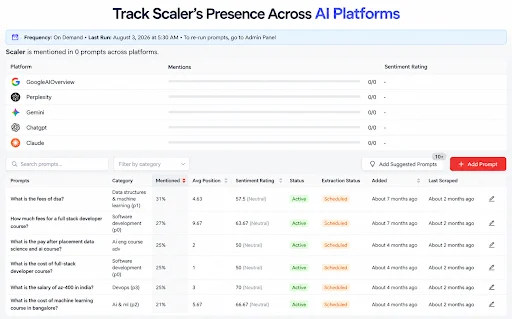
GEO Pulse rejects the "one-and-done" approach. Instead, it tracks brand presence across major AI surfaces by running hundreds of buyer-intent prompts per brand, multiple times a day, averaging results over a seven-to-ten-day window. This methodology is rooted in the reality of LLM stochasticity. Research from SparkToro and Gumshoe.ai, which involved 600 volunteers testing nearly 3,000 identical prompts, revealed less than a 1% chance that two identical prompts would return the exact same brand list.
A single, isolated run provides nothing more than a snapshot of variance. Citation frequency across thousands of runs, however, provides a signal. That signal is the only metric that matters.
Four Pillars of GEO Pulse: Data with Direction
Social Beat’s approach to GEO is built on four functional pillars that transform raw AI data into actionable business strategy.
1. Longitudinal Visibility Trends
Rather than a one-time snapshot, GEO Pulse provides a trend line of share-of-voice and mention share. Crucially, it offers category-level splits. For instance, a mutual fund brand does not need to see an aggregate score; they need to see how they perform in "SIP prompts" versus "tax-saving prompts." By separating these distinct intent pools, brands can identify exactly where their messaging is resonating and where it is being ignored.
2. Source Influence Mapping
Every cited URL is tracked, sorted by competitor, and mapped by page depth. This is the "real work" phase of the operation. If a model consistently cites four community forums and two trade publications when discussing a specific category, the brand’s PR, content, and community budget can be surgically reallocated to those specific sources.
3. Accuracy and Regulatory Compliance
One of the most overlooked risks of AI search is the hallucination of brand facts. If an AI incorrectly reports a brand’s pricing, coverage, or eligibility, the consequences are not merely marketing-related—they are regulatory. With the Digital Personal Data Protection (DPDP) Act and evolving consumer protection rules, "the AI said it" will not serve as a legal defense. GEO Pulse runs continuous accuracy checks to ensure that the facts being fed to consumers are compliant and correct.
4. Measurable Business Impact
Finally, the tool correlates mention share with hard metrics like branded search volume, direct traffic, and homepage visits, pulled directly from Google Search Console. By linking AI visibility to actual site performance, brands can finally prove the ROI of their GEO efforts.
Case Studies: Two Different Worlds, Two Different Problems
To understand the necessity of a tailored GEO strategy, one must look at how different industries encounter AI.
The "No-Ads" Dilemma: Mental Health Providers
In ad-restricted categories—such as mental health, insurance, or finance—paid media is frequently prohibited on AI surfaces. For one mental health provider, organic citation was the only viable growth channel.
The strategy focused on "source placement": getting the brand mentioned in the community forums and guest posts that the AI models were already citing as authoritative. Simultaneously, the site architecture was restructured to ensure the LLMs could "lift" clean, precise passages from the site. Between January and May 2026, the brand saw a 61% increase in conversions with zero paid spend, despite a decrease in raw click-through rate. The traffic was lower in volume, but significantly higher in quality.
The Technical Pivot: Global Technology Consultancy
In contrast, a global technology consultancy faced a purely technical barrier. Their AI visibility was hampered by broken links, duplicate pages, and a lack of "hub-and-spoke" content structures that LLMs prefer. By optimizing the site architecture for AI retrieval across US, UK, and Indian markets, the firm saw a 55% rise in AI Overview keywords and a 54% increase in organic visits over six months.
The lesson is clear: one brand required off-site PR and source authority, while the other required on-site technical rigor. A generic dashboard would have prescribed the same solution to both.
The Future of GEO: Why Dashboards Are Not Enough
The industry is reaching a point of commoditization. As of August 2026, Google has integrated AI performance reports directly into Search Console. Simultaneously, Google is implementing measures to prevent third-party scraping.
This creates a precarious situation for many "AI SEO" tools. Any product that positions itself solely as a "citation counter" is living on borrowed time. When the data is handed out for free by the platform itself, the value of the third-party middleman evaporates. Furthermore, AI visibility is "rented," not owned. A change in the default model—such as the shift in August 2026 that caused Reddit citations to plummet by 88%—can wipe out a strategy overnight.
The Road Ahead
Social Beat argues that the next phase of GEO is not about building a bigger dashboard; it is about building a better "action layer."
- Model Drift Monitoring: Reporting on the impact of model version shifts as a standard part of the engagement, rather than an excuse for poor performance.
- Multilingual Retrieval: India is a top-three market for AI usage. A dashboard that only tracks English queries is essentially blind to the majority of the market’s actual buyer intent. GEO Pulse is engineered to track Hindi, Tamil, and Marathi, ensuring brands capture the local conversation.
- The Action Layer: The data is only as good as the content, PR, and site architecture work that follows it.
The bottom line for any brand executive: if your agency is handing you a vanity dashboard and calling it "AI strategy," ask them two questions. First, what does the model recommend when it is not recommending you? Second, what is it saying that is factually wrong about your business?
If they cannot answer those, the dashboard is not helping you—it is merely distracting you from the real work of influencing the machine.
Frequently Asked Questions
What is Generative Engine Optimization (GEO)?
GEO is the practice of ensuring your brand is consistently cited and accurately recommended when users interact with AI models like ChatGPT, Gemini, and Perplexity. Unlike traditional SEO, which optimizes for a list of links, GEO optimizes for the model’s synthesized answer.
How does GEO Pulse differentiate itself?
Most tools check for a single mention. GEO Pulse runs thousands of prompts over a ten-day cycle to account for AI variance. It also conducts ongoing accuracy audits and links data to business metrics, rather than just providing a static rank.
Do I need a separate agency to use GEO Pulse?
No. GEO Pulse is a proprietary tool utilized by Social Beat. It is integrated into the agency’s broader content and technical SEO work, ensuring that insights lead directly to implementation.
How long does it take to see results?
The initial 90 days are dedicated to establishing a baseline. Significant movement in mention share and organic traffic typically follows, as the necessary content and PR adjustments gain authority within the AI’s training and retrieval datasets.
Why is regional language support important?
With India being a primary market for AI interaction, a significant portion of user queries occur in regional languages. If your visibility tool only tracks English, you are effectively ignoring the majority of your potential customer base.