







In an era where the digital landscape functions as the primary gateway to commerce, healthcare, and civic participation, the internet has become the modern town square. Yet, for the 1.3 billion people globally living with disabilities, this square remains largely gated. As digital accessibility moves from a niche technical concern to a boardroom imperative, companies are grappling with a dual challenge: the escalating threat of litigation and the untapped potential of a massive, underserved market.
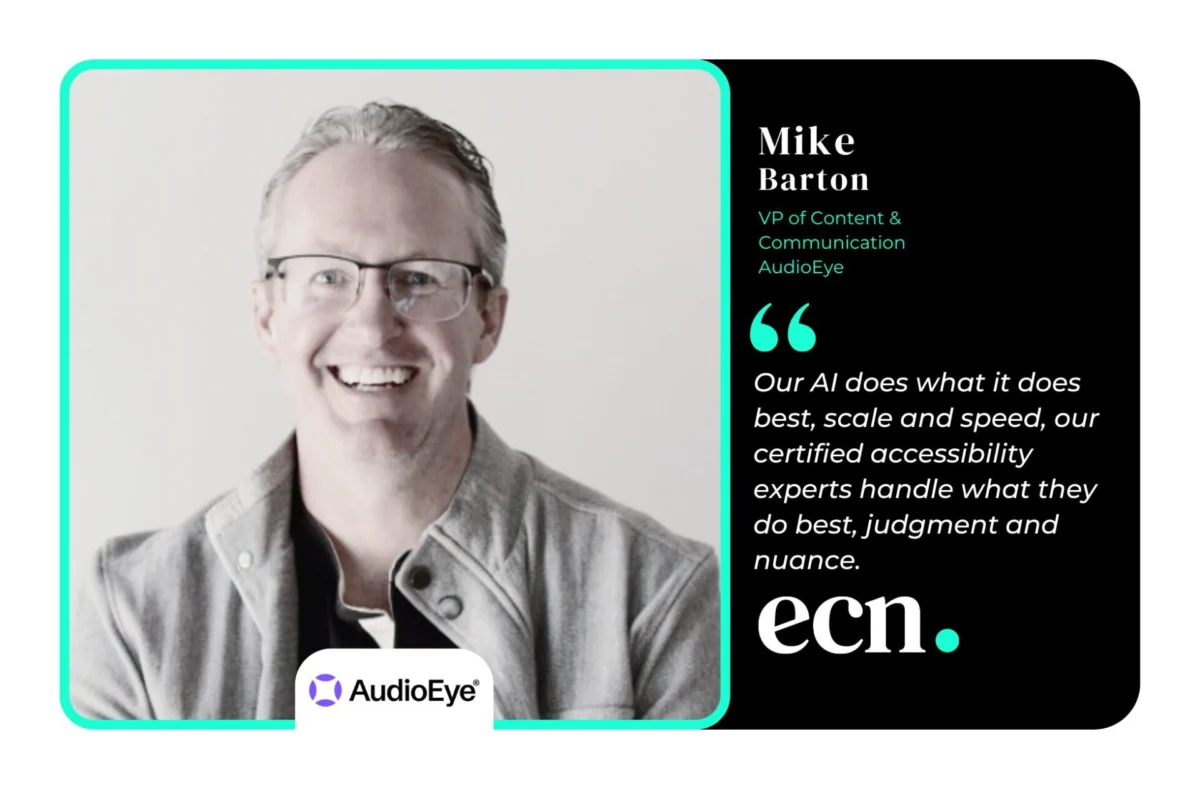
Leading the charge in bridging this divide is AudioEye, a digital accessibility platform that has spent nearly two decades refining the intersection of artificial intelligence and human oversight. To understand the shifting landscape of the web, we sat down with Mike Barton, VP of Content Marketing and Communications at AudioEye, to discuss how the company is transforming digital inclusion from an afterthought into a universal default.
The Evolution of a Digital Necessity
Digital accessibility was once dismissed as a "nice-to-have" or a box-ticking exercise for compliance departments. Today, that perspective has fundamentally shifted. The convergence of strict global regulations—such as the European Accessibility Act (EAA)—and a staggering rise in litigation has placed the issue firmly on the desks of CEOs and legal counsels.
"Digital accessibility was a niche concern when AudioEye started," says Barton. "Most companies treated it as a checkbox or ignored it entirely. What’s changed is that the stakes have caught up to the principle. Lawsuits have doubled in the last five years, and AI is fundamentally changing how websites are built and how users find them."
Since its founding, AudioEye has evolved by recognizing that neither pure automation nor pure human labor is sufficient. The company has doubled down on a hybrid philosophy: automation provides the necessary scale to handle thousands of pages in real-time, while human expertise provides the nuance required to solve complex accessibility barriers that algorithms often miss.
Defining the Digital Accessibility Gap
At its core, digital accessibility is the practice of designing digital environments—websites, mobile apps, and software—so that they are usable by everyone, regardless of physical or cognitive ability. For many, this means ensuring compatibility with assistive technologies like screen readers, which translate visual text into audio or braille.
The business implications of ignoring this are profound. People with disabilities represent an estimated $18 trillion in global spending power. Yet, research suggests that seven out of ten individuals with disabilities will abandon a website if they encounter barriers to access.
"For businesses, this isn’t a side issue anymore," Barton explains. "It’s a revenue, legal, and brand issue at the same time. Most people with disabilities will only shop where they know they can. The companies treating accessibility as a checkbox are the ones getting caught off guard. The companies treating it as table stakes—or a growth engine—are winning."
How the AudioEye Platform Operates
AudioEye’s solution is designed to be as frictionless as possible for enterprise teams. The platform deploys via a single line of JavaScript, similar to a standard cookie banner or marketing pixel. Once installed, the system immediately begins a dual-layered process of remediation:
- AI-Driven Automation: The platform scans the rendered page against the Web Content Accessibility Guidelines (WCAG) standards. According to a 2026 study by Adience, AudioEye’s AI detects up to 2.5 times more issues than competing solutions, with nearly half of these issues resolved automatically in real-time.
- Expert Human Validation: Because machines lack "lived experience," AudioEye utilizes certified accessibility specialists—including professionals with disabilities—to perform manual audits. These experts tackle the "gray areas" of design, such as intent and context, which are invisible to automated scanners.
The result is a closed-loop system where approximately 97% of issues are resolved before a company’s internal development team is ever required to intervene.
The Case for a Hybrid Approach
The debate between automated widgets and manual, developer-led remediation has often polarized the industry. AudioEye argues that the dichotomy is a false choice.
"Accessibility isn’t a problem you can solve with technology alone, and it isn’t one you can solve with humans at scale," Barton asserts. "Automation handles the volume. AI can detect things like missing alt text or broken form labels in milliseconds. But around half of accessibility issues require human judgment. They depend on what a button is supposed to do, or what a user is trying to accomplish. That combination is why our legal protection rates are three to four times higher than other solutions."
This hybrid methodology is not just about functionality; it is a shield against the growing volume of demand letters and ADA-based litigation. By providing a documented, proactive approach to accessibility, AudioEye enables companies to move from reactive crisis management to a state of continuous compliance.
Industry Impact and Regulatory Climate
While the entire digital economy faces accessibility obligations, certain sectors are feeling the pressure more acutely. E-commerce leads the pack, with 78% of accessibility-related lawsuits targeting online retailers. Healthcare, financial services, and government entities are similarly exposed due to the sensitive nature of their digital services.
"We’re trusted by over 127,000 organizations," says Barton. "What makes that possible is a model built to scale from the smallest local shop to the largest global enterprise. Every business has customers it can’t afford to leave out, and lawsuits it can’t afford to lose."
AudioEye’s commitment to legal protection is a significant pillar of its service. The company provides expert debunk reports when claims arise and works directly with client legal counsel. Notably, AudioEye is one of the few vendors to document successful courtroom dismissals, moving beyond the "warranty" language often found in the industry to offer tangible legal support.
Beyond Compliance: The Conversion Engine
Perhaps the most compelling argument for accessibility is the return on investment (ROI). Beyond avoiding litigation, accessible sites are demonstrably better for business.
"Accessibility is a conversion lever," Barton notes. "Removing barriers means higher conversion rates and lower bounce rates. There’s a newer angle, too: AI agents are starting to navigate the web on behalf of users. These agents read your site’s accessibility tree to find information. If your site isn’t accessible, you are effectively invisible to the next generation of AI-driven discovery."
In this context, accessibility is no longer just a civil rights issue; it is a fundamental requirement for SEO and AI-readiness in the modern digital economy.
The Road Ahead: Global Regulations and AI Challenges
Looking toward the future, the landscape of digital accessibility is poised for a major shift. The enforcement of the European Accessibility Act (EAA) in 2025 has forced a global re-evaluation of digital infrastructure. Companies that once ignored international standards because they were only focused on U.S.-based ADA compliance are finding that the world has become a smaller, more interconnected place.
Simultaneously, the rise of generative AI introduces a paradox. While AI is a powerful tool for fixing the web, it is also being used to create content at an unprecedented pace. Much of this AI-generated code is being trained on an existing, inaccessible web, effectively automating the proliferation of inaccessible digital spaces.
"Solving that gap is one of the most important problems in our industry," Barton concludes. "Accessibility and AI discovery are going to be the same conversation in a few years, and we want to be the ones leading it. The internet should work for everyone who uses it. Our job is to make sure it does."
As businesses continue to navigate the complexities of the digital age, AudioEye’s vision serves as a roadmap: by merging the speed of machines with the empathy and nuance of human experience, a truly open, inclusive, and accessible internet is not just a dream—it is an inevitable, necessary reality.