








Editor’s Note: Welcome to the latest edition of What’s !important, your comprehensive fortnightly briefing on the cutting-edge developments, tooling updates, and architectural discussions driving the modern CSS and web development ecosystem.
As the digital landscape transitions into a new seasonal cycle, the velocity of web platform innovations shows no signs of slowing down. Over the past couple of weeks, browser vendors, spec writers, and community thought leaders have rolled out a flurry of proposals and implementations designed to solve age-old front-end headaches. From eliminating accidental tooltip triggers to introducing native HTML elements for geolocation and optimizing grid-driven interactions, this edition dives deep into the most significant breakthroughs shaping the future of web development.
Main Facts: A Paradigm Shift in Native Web Capabilities
The defining trend of this development cycle is the ongoing convergence of native HTML elements, advanced CSS APIs, and progressive enhancement strategies. Rather than relying on heavy JavaScript libraries to polyfill behavior, modern web standards are increasingly baking sophisticated interactions directly into the browser engine.
Key developments leading this charge include:
- Intelligent Tooltips: Moving beyond primitive hover states toward delayed-then-instant activation models, heavily augmented by upcoming browser features like interest invokers.
- The
<geolocation>Element: A new native HTML approach attempting to streamline user permission flows and hardware-level location tracking, paired with vital progressive enhancement strategies. - CSS Custom Highlight API: Driving lightweight, performant syntax highlighters like Dave Rupert’s MicroLighter without DOM-heavy node manipulation.
- Grid Intelligence & Flexbox Balancing: Bridging the gap between layout geometry and custom properties, alongside new text-wrap-inspired layout balancing properties for flex items.
- Syntax Enhancements: The introduction of proposed native class prefix selectors and expanded feature detection via
@supports named-feature().
Chronology: How the Conversation Unfolded
The past two weeks have seen a rapid succession of thought pieces, technical deep-dives, and specification proposals cascading through the front-end community.
Early-Week Breakthroughs: UX Micro-Interactions
The cycle kicked off with a concentrated look at interface polish. Abhishek Jakhar published an architectural examination dissecting why tooltips traditionally frustrate users—specifically noting the lack of a sensible threshold before appearing, and the lag before disappearing. Jakhar detailed an implementation ensuring tooltips trigger only after a deliberate hover delay, but dismiss instantly once the user moves away.
Promptly responding to Jakhar’s work, Chris Coyier introduced a modern, specification-aligned implementation leveraging emerging browser primitives known as interest invokers. Utilizing the nascent CSS properties interest-delay-start and interest-delay-end, this approach delegates timing logic directly to the browser, though current adoption remains limited to Chromium-backed environments.
Mid-Week: Layout Intelligence and Native Elements
As the week progressed, attention pivoted toward layout mathematics and hardware integration. Temani Afif published a technique allowing developers to extract CSS Grid information—specifically row counts, column counts, and individual cell coordinates (x/y indexes)—directly into CSS custom properties. This breakthrough unlocked sophisticated UI mechanics, such as calculating dynamic hover proximity solely via modern CSS.
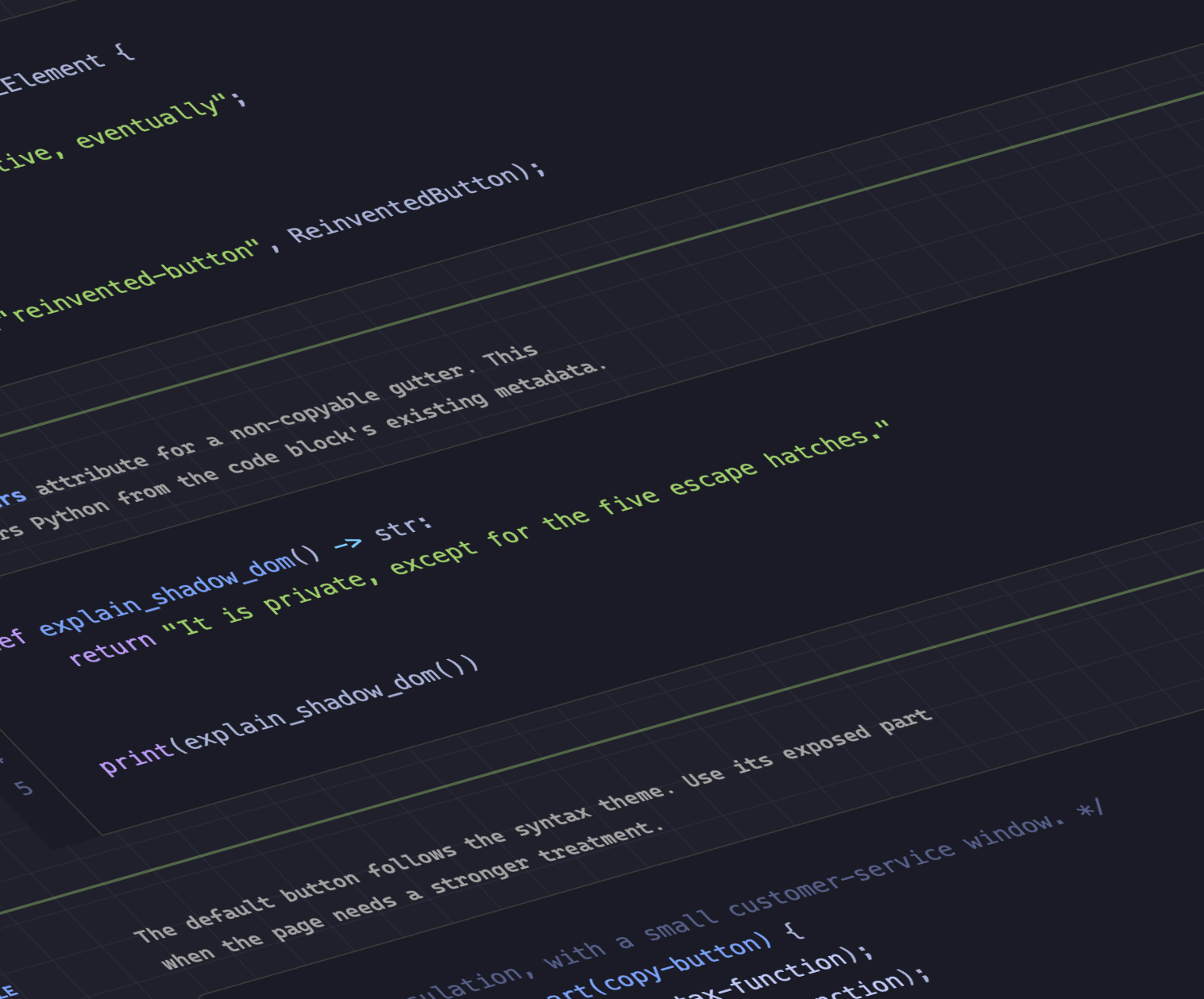
Simultaneously, the conversation turned to hardware integrations. Piccalilli published an exploration of the experimental <geolocation> HTML element. While promising to alleviate the historic friction points of managing GPS, Wi-Fi, and cellular triangulation permissions, the element’s strict styling limitations and restricted browser support necessitated pragmatic strategies for blending it with the legacy JavaScript Geolocation API.
Simultaneously, Dave Rupert unveiled MicroLighter, a minimalist syntax highlighter built directly on top of the Custom Highlight API, igniting a broader conversation about shifting away from heavy DOM tree modifications for text styling.
Late-Week: Selectors, Dark Mode, and Feature Queries
As the fortnightly cycle rounded its final corner, Bramus emerged as a prolific contributor to the specification debate, introducing multiple proposals within days:
- *The Class Prefix Selector (`.something-
):** A proposed syntax streamlining multiple class targeting without resorting to verbose attribute selectors ([class^="…"]`). - The
named-feature()Function: An expansion of the@supportsrule allowing developers to query hyper-specific engine behaviors—such as transform rendering within anchor positioning contexts—that were previously invisible to traditional feature detection.
Rounding out the week, perennial architectural debates were reignited. Lea Verou and Bramus locked horns over whether dark mode toggles should strictly adhere to a two-state or tri-state user experience model, while Ahmad Shadeed explored the mechanics of the newly minted flex-wrap: balance property in Chrome.
Supporting Data and Technical Breakdown
To fully grasp the implications of this cycle’s releases, examining the underlying code patterns and architectural trade-offs is essential.
1. Interest Invokers for Tooltips
With Chrome leading the charge on interest invokers, developers can begin writing cleaner markup for tooltips and popovers. By shifting delay logic to the layout engine via interest-delay-start and interest-delay-end, the burden on custom JavaScript timers is drastically reduced.
/* Conceptual implementation using interest-delay properties */
[popover]
  interest-delay-start: 300ms;
  interest-delay-end: 0ms;
Note: Because this is currently restricted to select Chromium channels, robust progressive enhancement strategies remain mandatory for cross-browser parity.
2. The Class Prefix Selector Performance Advantage
One of the most anticipated syntax proposals is the class prefix selector. Historically, matching groups of classes based on string prefixes required clumsy attribute selectors that imposed significant parsing overhead on the browser engine:
/* Legacy, performance-heavy approach */
[class^="something-"]
  /* High selector-matching cost */
The proposed prefix selector solves this by introducing dedicated syntax that browser engines can optimize natively:
/* Proposed, highly performant approach */
.something-*
  /* Clean, optimized parsing */
3. Bridging Grid Layouts to Custom Properties
Temani Afif’s exploration of piping CSS Grid metadata into custom properties relies on modern styling techniques, enabling reactive design systems where child elements are intrinsically aware of their precise spatial positioning within a parent grid container without manual class name injection.
Official Responses and Industry Perspectives
The reception to these updates highlights a healthy tension between bleeding-edge browser experimentation and production-grade stability.
- On Native Elements vs. APIs: Community feedback regarding the
<geolocation>element highlights ongoing anxiety surrounding vendor fragmentation. While browser-native UI components reduce boilerplate, design system architects remain wary of restrictive shadow DOM encapsulation that resists custom brand styling. - The Syntax Debate: Bramus’s introduction of the class prefix selector received widespread acclaim from component library authors, who have long sought cleaner alternatives to BEM-heavy naming conventions without sacrificing performance.
- The Dark Mode Divide: The debate between Lea Verou (advocating for a streamlined two-state system) and Bramus (advocating for explicit tri-state control: Light, Dark, System) underscores a persistent truth in UX design: there is no universal consensus on how users prefer to override system-level environmental preferences. Vale.Rocks’ intermediate "auto-until-overridden" model has gained considerable traction as a sensible middle ground.
Implications for the Future of Web Development
What do these collective updates mean for the day-to-day workflow of front-end engineers?
First and foremost, the boundary between JavaScript-driven UI logic and native browser capabilities continues to blur. Features that once required heavy third-party runtimes—such as syntax highlighting via the Custom Highlight API, layout balancing via flex-wrap: balance, and spatial awareness via grid-to-variable pipelines—are rapidly becoming native primitives.
For enterprise teams and solo developers alike, this demands a shift in mindset. Embracing progressive enhancement is no longer just a best practice for accessibility; it is the primary architectural vehicle for adopting tomorrow’s web standards today. As Chrome and other browser vendors continue to experiment with features like interest invokers and advanced @supports queries, developers who master these foundational primitives will build faster, more resilient, and more maintainable user interfaces.
As autumn arrives, the web platform stands better equipped, more expressive, and structurally sounder than ever before. Stay tuned for the next edition of What’s !important as these specifications evolve from experimental proposals into baseline web standards.