








Main Facts
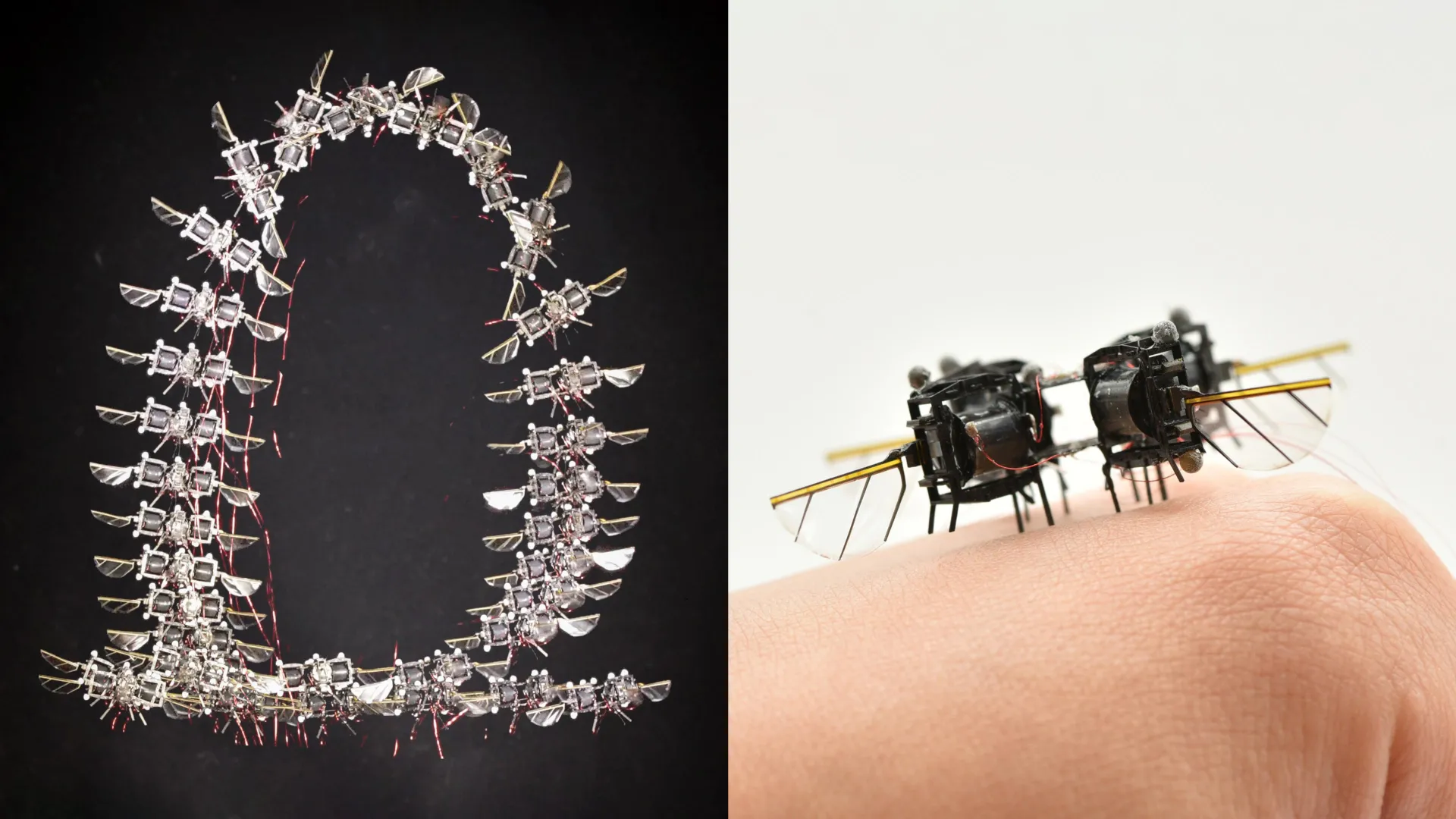
In a significant leap forward for robotics and artificial intelligence, researchers at the Massachusetts Institute of Technology (MIT) have developed a groundbreaking AI-driven control system that endows insect-scale flying robots with unprecedented speed, agility, and maneuverability. Roughly the size of a microcassette and weighing less than a standard paperclip, these micro-flyers are designed to tackle environments that remain entirely inaccessible to traditional quadcopters and larger drones.
The core innovation centers on a novel, two-part computational framework that successfully bridges the gap between hardware capabilities and software control. By combining a model-predictive controller with a deep-learning imitation policy, the MIT team increased the tiny robot’s maximum flight speed by approximately 450 percent and its acceleration by about 250 percent compared to previous iterations.
Most remarkably, the robot demonstrated the capability to execute 10 consecutive aerial somersaults in just 11 seconds—staying tightly within a 4-to-5-centimeter margin of its intended flight path—even while actively buffeted by artificial wind disturbances. This performance brings artificial microrobots closer than ever to matching the dynamic, high-speed mechanics found in natural biological insects such as bees, dragonflies, and flies.
The implications of this research extend far beyond academic curiosity. Engineers envision a future where swarms of these resilient, highly agile micro-robots could be deployed inside collapsed buildings following devastating earthquakes. Navigating narrow crevices, bypassing hanging debris, and dodging falling masonry, these devices could locate trapped survivors long before it is safe for human rescue teams or larger search dogs to enter.
The study, which was a collaborative effort between MIT’s Department of Electrical Engineering and Computer Science (EECS) and the Department of Aeronautics and Astronautics (AeroAstro), was officially published in the journal Science Advances.
Chronology of the Research
The realization of insect-scale, hyper-agile flight did not happen overnight; it represents the culmination of years of iterative engineering, materials science, and algorithm development.
Phase 1: Building the Hardware Foundation
For over five years, the research group led by Kevin Chen—an associate professor in EECS and head of the Soft and Micro Robotics Laboratory—focused heavily on perfecting the physical architecture of the microrobot. Early models, while innovative, were severely limited by fragile components and weak propulsion systems.
Recently, Chen’s team engineered a significantly more durable iteration of the micro-flyer. They equipped the device with larger flapping wings driven by advanced soft artificial muscles. These artificial muscles contract at rapid speeds, generating the immense frequency and power required for ultra-fast wingbeats. However, while the physical hardware was vastly improved, the software "brain" controlling the robot lagged behind, forcing researchers to rely on manual, human-tuned controllers that could not handle aggressive flight paths.
Phase 2: Unlocking the Software Bottleneck
To push the robot toward true insect-like performance, Chen’s lab partnered with the research group of Jonathan P. How, the Ford Professor of Engineering in AeroAstro. The goal was clear: design a controller smart enough to handle complex aerodynamics and spatial uncertainty, yet computationally lightweight enough to operate in real time on a tiny machine.
The teams devised a synergistic, two-step computational pipeline:
- The Expert Planner: A model-predictive controller that uses complex physics equations to map out optimal trajectories, handling high-torque movements like sharp turns and body flips.
- The Deep-Learning Policy: Because the model-predictive controller required too much computing power for instantaneous, onboard-style decisions, the researchers used a data-driven process called imitation learning. They trained a neural network to mimic the expert planner’s behavior, creating a rapid decision-making policy capable of running in real time.
Phase 3: Demonstration and Validation
With the AI controller integrated, the MIT team put the microrobot through rigorous testing. In high-speed motion-capture laboratories, the robot was subjected to destabilizing wind currents and commanded to perform demanding aerial stunts. The results shattered previous performance benchmarks, culminating in the successful execution of 10 consecutive somersaults and precise high-speed "saccade" maneuvers, validating the effectiveness of the two-part control framework.
Supporting Data and Technical Metrics
The quantitative advancements achieved by the MIT research team represent a massive statistical leap for the field of micro-robotics:
- Speed Increase: The robotic insect achieved a 447 percent increase in flight speed compared to the lab’s previous best recorded results.
- Acceleration Increase: Acceleration capabilities jumped by 255 percent, allowing the robot to change velocities almost instantaneously.
- Acrobatic Endurance: The machine successfully completed 10 consecutive aerial somersaults in 11 seconds.
- Path Precision: Despite performing aggressive rotational flips and dealing with active wind disturbances, the robot maintained a tight trajectory, staying within 4 to 5 centimeters of its pre-programmed path.
- Physical Profile: The robot remains roughly the size of a microcassette and weighs less than a single paperclip, utilizing soft artificial muscles to power its flapping wings.
Official Responses and Expert Perspectives
The breakthrough has generated immense excitement within the robotics community, highlighting the power of cross-disciplinary collaboration between hardware engineers and algorithm specialists.
Kevin Chen, co-senior author of the study and head of the Soft and Micro Robotics Laboratory, emphasized the biological inspiration driving the project:
"We want to be able to use these robots in scenarios that more traditional quadcopter robots would have trouble flying into, but that insects could navigate. Now, with our bioinspired control framework, the flight performance of our robot is comparable to insects in terms of speed, acceleration, and the pitching angle. This is quite an exciting step toward that future goal."
Reflecting on the symbiotic relationship between hardware development and software architecture, co-senior author Jonathan P. How noted:
"The hardware advances pushed the controller so there was more we could do on the software side, but at the same time, as the controller developed, there was more they could do with the hardware. As Kevin’s team demonstrates new capabilities, we demonstrate that we can utilize them."
Yi-Hsuan Hsiao, an MIT EECS graduate student and co-lead author, pointed out the significance of the algorithmic approach:
"This work demonstrates that soft and microrobots, traditionally limited in speed, can now leverage advanced control algorithms to achieve agility approaching that of natural insects and larger robots, opening up new opportunities for multimodal locomotion."
Describing the intricate training methodology required to turn the heavy mathematical models into a lightning-fast AI policy, How added:
"If small errors creep in, and you try to repeat that flip 10 times with those small errors, the robot will just crash. We need to have robust flight control… The robust training method is the secret sauce of this technique."
Looking toward the broader landscape of micro-robotics, Chen summarized the overarching ambition of the work:
"For the micro-robotics community, I hope this paper signals a paradigm shift by showing that we can develop a new control architecture that is high-performing and efficient at the same time."
Implications and Future Outlook
While performing somersaults in a controlled laboratory setting is a remarkable milestone, the real value of this research lies in its practical applications and the roadmap it establishes for future autonomous systems.
1. Disaster Response and Search-and-Rescue Operations
The primary long-term motivator for developing flying microrobot technology is disaster relief. Earthquakes, structural collapses, and industrial accidents often leave voids and pockets where survivors may be trapped. Standard search drones are too large to fit through gaps smaller than a few feet, and sending human rescuers into unstable ruins puts lives at extreme risk. Deploying a swarm of insect-scale robots equipped with micro-cameras and chemical sensors could revolutionize how first responders assess disaster zones, providing real-time video feeds from deep within rubble.
2. Bio-Mimetic Sensing and Saccade Maneuvers
In addition to sheer speed, the MIT team successfully programmed the robot to perform a biological maneuver known as a saccade. In natural insects, a saccade involves pitching the body sharply, moving rapidly to a new coordinate, and pitching in the opposite direction to halt. This rapid acceleration and deceleration clears visual motion blur and helps insects orient themselves. Implementing this behavior is a critical stepping stone for integrating miniature onboard cameras and environmental sensors, allowing the robots to interpret their surroundings dynamically without relying entirely on external motion-capture equipment.
3. Transitioning Toward True Autonomy
Currently, the microrobot relies on sophisticated external motion-capture systems to track its precise position during flight tests. A major milestone for future research will be miniaturizing sensors, processing units, and power sources so the robots can operate completely untethered in unstructured outdoor environments. Furthermore, researchers plan to study how multi-robot coordination and onboard sensing can allow swarms of these tiny machines to communicate, avoid colliding with one another, and collaboratively map unknown spaces.
Funding and Support
This advanced research was made possible through financial backing and fellowships from prominent scientific institutions, including the National Science Foundation (NSF), the Office of Naval Research, the Air Force Office of Scientific Research, MathWorks, and the Zakhartchenko Fellowship. As funding and development continue, society moves ever closer to a reality where insect-sized guardians come to the rescue when humanity needs them most.