







In a significant move for the field of autonomous systems, Google Research has open-sourced Harness² (Harness-squared), a groundbreaking framework designed to enable AI agents to improve their performance without the need for expensive, compute-heavy model retraining. By shifting the focus from modifying model weights to refining the "harness"—the ecosystem of prompts, tools, memory, and scripts surrounding an AI—Google has introduced a modular, recursive approach to agentic intelligence.
This development arrives at a critical juncture in the AI industry, where the "open world" problem—the tendency for agents to encounter novel, unforeseen tasks—often causes static, pre-trained models to falter. Harness² addresses this by treating the agent’s configuration as a living, evolving entity.
Main Facts: What is Harness²?
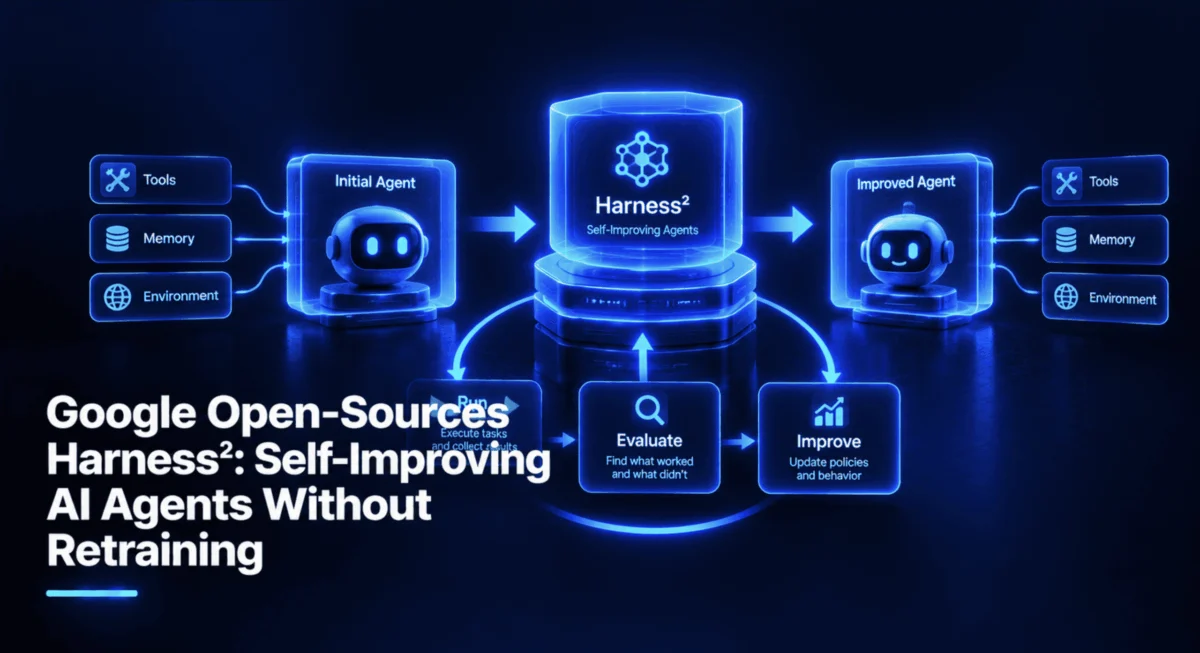
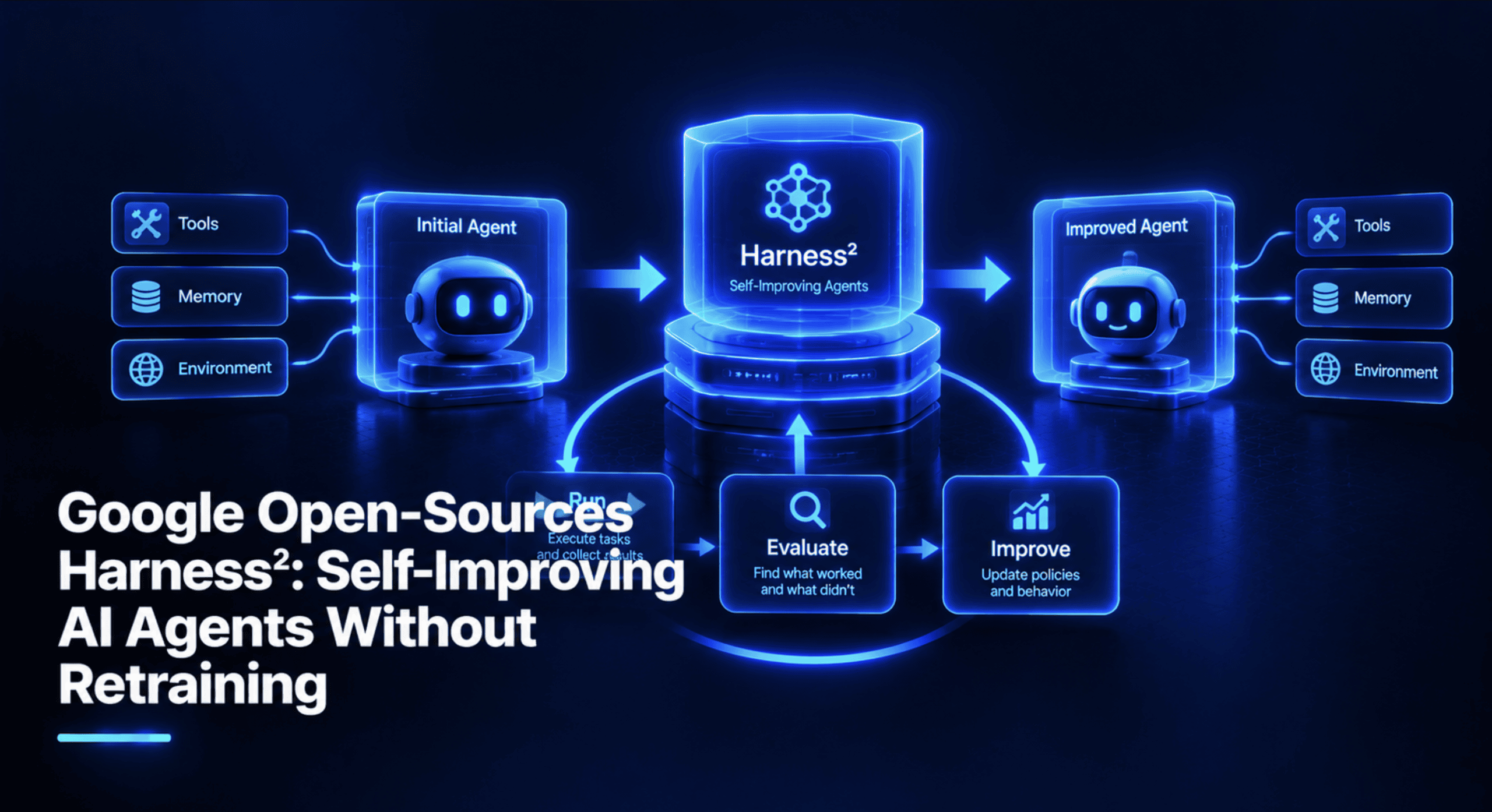
At its core, a "harness" constitutes the entire operational wrapper of an AI agent. It includes system prompts, guardrails, long-term memory, specialized skills, tool guidance, helper scripts, sub-agent delegation, and middleware plugins. Traditionally, optimizing these components requires manual intervention: engineers identify failure points, rewrite prompts, and inject new tools in a labor-intensive feedback loop.
Harness² automates this "harnessing" process. It allows the agent to iteratively refine its own operational parameters based on performance feedback, all while keeping the underlying model’s weights fixed. This approach provides three distinct advantages:
- Computational Efficiency: Avoiding fine-tuning eliminates the need for massive GPU clusters and specialized training datasets.
- Transparency: Because improvements are saved as plain-text files (scripts, prompts, or configurations), they are human-readable, auditable, and version-controllable.
- Portability: Lessons learned in one domain can theoretically be codified and transferred, creating an "experience library" that grows alongside the agent.
Chronology and Evolution of the Project
The concept behind Harness² is rooted in the necessity for agents to operate in dynamic, real-world environments where ground-truth labels are unavailable.
The Dual-Loop Architecture
The "squared" in Harness² refers to its two-tiered recursive mechanism:
- Loop 1 (Task-Level Recursion): This loop executes a "Propose–Probe–Compose" cycle. When an agent fails or underperforms, the system proposes changes to the harness components. It then "probes" the effectiveness of these changes by comparing behavioral contrasts between different execution runs.
- Loop 2 (Harnessing-Level Recursion): This layer acts as an "experience reflector." Once a task is completed, the system saves the successful harness and the lessons learned into a persistent library. This library informs future runs, meaning the framework essentially learns how to learn more effectively over time.
This development trajectory culminated in the recent release of the framework under the Apache 2.0 license, alongside a comprehensive research paper titled Harness²: Recursive Agent Harnessing for an Open World.
Supporting Data: Benchmarking Performance
Google’s research team put Harness² to the test using three distinct benchmarks, measuring how well the framework improved the performance of models like GLM-5 and Gemini 3.5 Flash. The results, while preliminary, demonstrate the potential of recursive self-improvement:
| Benchmark | Focus Area | Reported Performance Gain |
|---|---|---|
| WorkBuddy-Bench | Office, Web, and Code tasks | Up to +11.5 points |
| LAB (Legal) | Legal reasoning and analysis | Up to +11.8 percentage points |
| JobBench | Professional-grade tasks | Up to +4.5 points |
These metrics indicate that even with a minimal recursive budget (k=1), the agentic performance shows marked improvement. The research notes that larger recursion budgets (higher values of k) correlate with even more significant performance gains, though at the cost of increased computational time per task.
Implementation: A Practical Walkthrough
For developers looking to integrate Harness², Google provides a robust, zero-cost demo that does not require API credentials. The framework is built to be accessible via uv, a modern Python package installer.
The Workflow
- Environment Setup: By utilizing
uv, developers create an isolated Python 3.12 environment, ensuring all dependencies, including rendering libraries for spreadsheets and presentations, are correctly configured. - Execution: The framework uses a CLI-based approach where users can run
harness2-demo. During the demo, the system is challenged with accounting tasks that contain subtle bugs in helper scripts. - The "Ah-ha" Moment: In the demo, the agent identifies a flawed Python script that erroneously filters out negative numbers (credits) in a ledger. Without explicit instructions, the agent autonomously edits the script to include all transaction types. This is saved as a "Transferable Lesson" in the experience library, which then propagates to subsequent tasks.
Scaling to Real Benchmarks
For production-grade testing, such as running the LAB (Legal) benchmark on Vertex AI, the process involves:
- Configuration: Setting up a
.envfile with specific model IDs for the executor, improver, and judge roles. - Infrastructure: Using Google Cloud CLI to manage authenticated sessions.
- Evaluation: Using
harness2-judgeto compare the performance of the "refined" agent against the "base" (unimproved) agent.
Official Responses and Industry Implications
The release of Harness² has generated significant discourse within the AI research community, particularly on platforms like X (formerly Twitter). The primary excitement stems from the move away from the "black box" nature of model fine-tuning.
Implications for AI Development
- Democratization of Agent Optimization: Small teams and individual developers can now optimize agents using only CPU-based logic and API calls, rather than needing to host, train, or distill models.
- Safety and Guardrails: Because Harness² allows for the systematic editing of guardrails, it provides a structured way to implement safety updates. Organizations can "patch" agent behaviors in real-time by updating the guardrail component of the harness.
- The "Open World" Readiness: As agents move from controlled test environments into the chaotic reality of enterprise workflows, the ability to adapt to unanticipated tasks—without needing a retraining cycle—will become a critical competitive advantage.
Critical Considerations
Despite the optimism, the research team acknowledges that this is an early-stage framework. Open questions remain:
- Transferability: While the framework is designed to store lessons, determining how effectively a "legal reasoning" lesson translates to a "web browsing" task is a subject of ongoing study.
- Cost Dynamics: While avoiding fine-tuning saves on GPU costs, the "executor rollouts" and "improver sessions" required by the recursion loops consume significant API credits. Balancing the performance gains of high-budget recursion (large k) against the cost of inference is a primary operational challenge.
- Safety and Hallucinations: As agents begin to rewrite their own scripts and system prompts, ensuring that these automated changes do not introduce new security vulnerabilities or persistent biases is paramount.
Conclusion
Harness² represents a paradigm shift in how we approach agentic intelligence. By treating the AI agent not as a static model but as a dynamic system of components, Google Research has opened the door to a new era of "living" software—programs that learn, adapt, and refine their own operational logic in real-time.
For the developer community, the availability of this code means that the future of agent performance is no longer gated by access to massive training data or proprietary model weights. Instead, it is gated by our ability to craft, test, and iterate on the harnesses that guide our AI. As the community begins to explore the framework, we can expect a rapid evolution in how autonomous agents navigate the complexities of our increasingly digital world.
Quick Start Guide for Interested Developers:
- Repository: google-research/harness2
- Documentation: harness2.github.io
- Core Logic: The system relies on two loops (task-level and harness-level) to ensure continuous, non-destructive improvement.
- Compatibility: Designed for integration with major cloud platforms like Vertex AI, while remaining flexible enough for local development and testing.