







By Global Tech & Cybersecurity News Desk
Published: October 2026
Main Facts
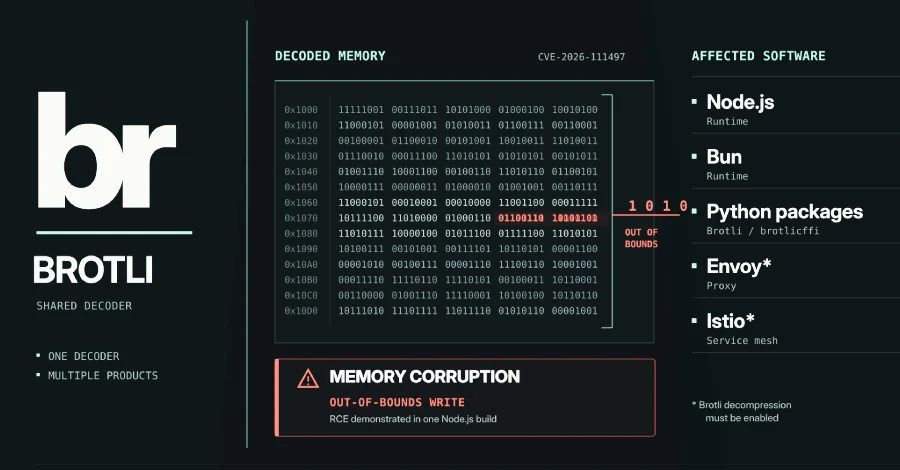
A high-severity memory-corruption vulnerability residing within Google’s core Brotli decompression library is currently threatening a vast swath of modern web infrastructure. Tracked officially as CVE-2026-111497, the flaw impacts virtually any software package, language runtime, or network proxy that bundles and relies on Google’s C-based implementation of the Brotli decoder to handle compressed data streams.
Because Brotli is ubiquitously deployed across the internet to compress web pages, API payloads, and network traffic, the vulnerability’s blast radius is unusually wide. Affected products include major development runtimes and proxy systems such as Node.js, Bun, Envoy, Istio, and standard Python extension modules including brotli and brotlicffi.
At its technical core, CVE-2026-111497 is a classic buffer-overflow and memory-corruption flaw. When a program processes a specially crafted, malicious Brotli-compressed data payload, the decoder writes past the allocated boundaries of a memory buffer. This malicious overflow corrupts adjacent memory spaces within the host process. Depending on the targeted architecture and the specific software environment, successful exploitation can lead to:

- Application crashes and localized Denial of Service (DoS) conditions.
- Memory leaks exposing sensitive internal runtime states.
- Arbitrary remote code execution (RCE) under the security context of the running application.
Security researchers from Imperva’s Red Team successfully demonstrated that the vulnerability can be leveraged to execute arbitrary shell commands on an unpatched build of Node.js 24.22.0 running on Linux for ARM64. Dubbed "Node2Shell," the proof-of-concept exploit showed that malicious payloads could be delivered dynamically either via an HTTP response fetched by the runtime or directly inside a parsed HTTP request body (such as through Express middleware).
While no active exploitation campaigns have been observed in the wild as of late October 2026, the potential for automated abuse has put security operations centers (SOCs) and software supply chain managers on high alert. CVSS v4.0 scoring assigns the flaw a 9.2 (Critical) severity rating in Google’s baseline assessment, though secondary scoring matrices from vendors like Red Hat peg the risk profile as "Important" due to the strict preconditions required for successful cross-platform exploitation.
Chronology of Discovery and Disclosure
The timeline of CVE-2026-111497 features an unusual development: the underlying code defect was technically identified and patched in Google’s source repository months before anyone realized it carried profound security implications.
- February 27, 2026: A code change intended to address stability issues within Google’s Brotli source code repository is quietly merged. At the time, neither the code contributors nor maintainers recognized that the bug could be manipulated to achieve arbitrary memory corruption or code execution. Because no official tagged release of the Brotli C library was issued following this commit, downstream projects continued using vulnerable, pre-existing code snapshots.
- Late Summer / Early Fall 2026: Researchers from OpenAI’s Codex Security team—specifically Khai Tran and Sylvie Mayer—discover the security implications of the lingering decoder bug. They determine that unauthenticated remote code execution is possible across a range of high-profile environments, affecting both clients processing malicious server responses and servers parsing untrusted client uploads.
- October 21, 2026: Coordinated global disclosure takes place. Node.js and Google simultaneously publish emergency security advisories and updated software builds containing patches for the Brotli decoding logic. Additional product vendors begin pushing emergency updates out to their respective package ecosystems.
- October 22–23, 2026: Security firms such as Imperva publicly outline the "Node2Shell" exploit mechanics against unpatched Node.js instances. CISA (Cybersecurity and Infrastructure Security Agency) issues an initial assessment indicating zero in-the-wild exploitation events. Linux distributions, including Debian and Amazon Linux, scramble to publish updated downstream package revisions.
- Late October 2026 Onward: Downstream maintainers, cloud-native tool creators, and Python library maintainers work to update package repositories and alert developers to verify their dependency trees manually, as automated dependency scanners (such as GitHub Dependabot) take time to index the newly assigned package advisories.
Supporting Data & Affected Software Ecosystem
Because the vulnerability lives in Google’s low-level C codebase rather than a single programming language’s native implementation, developers cannot rely on language-level memory safety guarantees to protect them. Every project that embeds its own copy of the Brotli decoder must independently apply patches and recompile its binaries.

Below is an overview of the impacted software products, affected versions, and remediation pathways:
| Product | Affected Versions | Fixed Version | Exposure Vector |
|---|---|---|---|
| Google Brotli (C Library) | 1.0.3 to 1.2.0 | 1.0.10, 1.1.1, 1.2.1 | Any standalone application decoding untrusted Brotli streams. |
| Node.js | 22.x, 24.x, 26.x (pre-fix); 20.x and older (EOL) | 22.23.4, 24.22.1, 26.12.1 | Built-in fetch() reading br responses; Express / body-parser processing br uploads. |
| Bun | 1.4.3 and earlier | 1.4.4 | Built-in fetch() of br responses or internal node:zlib usage. |
| Envoy Proxy | 1.39.2, 1.38.5, 1.37.7, 1.36.11 | 1.40.0, 1.39.3, 1.38.6, 1.37.8, 1.36.12 | Active only if the Brotli decompressor filter is explicitly configured. |
| Istio Service Mesh | 1.31.0–1.31.1, 1.30.0–1.30.5, 1.29.0–1.29.8 | 1.31.2, 1.30.6, 1.29.9 | Active only if Brotli decompression is enabled inside mesh configurations. |
Python Brotli Package |
1.2.0 and earlier | 1.2.1 | Package present; HTTP clients (requests, httpx, aiohttp) automatically decode responses. |
Python brotlicffi Package |
1.2.0.x and earlier | 1.2.1.0 | Package present; HTTP clients automatically handle Brotli decompression. |
| cdxgen | Standalone binaries & container images ≤ 13.4.0, ≤ 12.8.8 | 13.5.0, 12.8.9 | Scanning untrusted input files using vulnerable standalone distributions. |
Mechanics of Exposure
An application is only vulnerable to CVE-2026-111497 if it actively processes compressed data originating from an untrusted source:
- Client-Side Risks: When developers use modern built-in HTTP client utilities (such as Node.js or Bun’s global
fetch()API, or Python HTTP libraries likerequestsandhttpx), incoming HTTP responses containingContent-Encoding: brare automatically decompressed. A malicious server can exploit this auto-decompression behavior to compromise an unpatched client. - Server-Side Risks: Web servers or application layers that unpack incoming request bodies—such as Express 5 utilizing
body-parserto handle uploaded payloads—can be targeted by a malicious client sending specially formatted Brotli-compressed data. (Note: A baseline, unconfigured Node.js HTTP server does not automatically unpack request bodies out-of-the-box). - Proxy and Mesh Risks: Edge proxies like Envoy and Istio are vulnerable only if administrators have explicitly enabled Brotli compression/decompression filters in their routing configurations.
Official Responses and Industry Reactions
The discovery of CVE-2026-111497 has prompted swift, coordinated reactions from major cloud providers, security vendors, and open-source maintainers.
- OpenAI Codex Security: The research team that originally surfaced the issue emphasized the bidirectional nature of the threat. In their public disclosures, OpenAI noted that the vulnerability breaks traditional trust boundaries: an unpatched server can be compromised by a malicious client sending compressed input, and an unpatched client can be compromised by a malicious server during routine data retrieval operations (such as running command-line tools like
curl --compressed). - Node.js Maintainers: Crediting independent researchers alongside core contributors Matteo Collina and Antoine du Hamel, the Node.js security team rushed out emergency releases across their active maintenance streams. They urged developers to update their runtimes immediately, stressing that application-layer workarounds are insufficient to fully close the attack vector.
- Cloudflare and Vercel (Edge Security): Major edge computing platforms moved quickly to deploy Web Application Firewall (WAF) rules designed to filter out obviously malformed compression headers or known exploit signatures. However, Vercel issued a public advisory cautioning customers that edge firewalls cannot fully inspect or protect against backend data retrieved dynamically by serverless functions from external third-party servers. Consequently, infrastructure patches remain mandatory.
- Red Hat and CISA: While Google scored the vulnerability as a critical 9.2, enterprise Linux distributor Red Hat assessed the risk as an 8.1 ("Important"). Red Hat noted that while memory corruption is trivial to trigger theoretically, achieving reliable, weaponized remote code execution across varying memory layouts and security hardening configurations (such as ASLR and NX/DEP) requires specific environmental conditions.
Implications and Recommendations for Security Teams
CVE-2026-111497 serves as a stark reminder of the hidden systemic risks lurking deep within foundational software dependencies. Because foundational compression libraries like Brotli are baked into core language runtimes and binary distributions, vulnerabilities in C-based helper libraries often bypass standard application-level auditing.
Actionable Remediation Steps
- Immediate Package Updates: Upgrade all affected software runtimes, packages, and container images to their patched equivalents as outlined in the vulnerability table above.
- Full Service Restarts: Because running system processes maintain vulnerable library instances loaded into RAM, administrators must fully restart their application services and rebuild container images to ensure the updated decoder code is actively loaded into memory.
- Audit Python Environments: Python developers must explicitly verify their project environments. Because packages like
Brotliandbrotlicffiare frequently pulled in transitively by popular HTTP networking libraries (urllib3,requests), developers may be vulnerable even if their source code never explicitly imports the Brotli module. Manual version checks are strongly advised, as automated vulnerability scanners may lag behind PyPI advisory feeds. - Evaluate Edge Configurations: For organizations running Envoy, Istio, or custom proxy architectures, review ingress and egress filter configurations. If Brotli decompression is not strictly required for performance optimization, consider temporarily disabling it until all downstream nodes are fully patched.
- Monitor Threat Intelligence Feeds: Stay tuned to official channels from CISA, GitHub Security Advisories, and project maintainers for emerging proof-of-concept scripts and telemetry indicating active exploitation attempts in the wild.