SEATTLE — In a move set to redefine how enterprises manage the boundary between transactional databases and analytical data stores, Amazon Web Services (AWS) has announced a powerful new capability for Amazon Aurora PostgreSQL. By natively embedding the high-performance analytical engine DuckDB directly into the database service, AWS now enables engineers and data architects to run direct queries across live operational data and massive data lakes in Apache Iceberg and Apache Parquet formats.
The announcement, rolled out globally across commercial and AWS GovCloud regions, eliminates a long-standing architectural bottleneck: the need to build, maintain, and monitor complex Extract, Transform, and Load (ETL) pipelines to bridge transactional systems and cloud storage repositories.
Main Facts: Unifying Operational Data and Data Lakes
The core innovation centers on bringing the analytical horsepower of DuckDB straight into the Aurora PostgreSQL execution engine. This allows applications to query real-time transactional data—including uncommitted writes—simultaneously with historical archives stored in Amazon S3 or S3 Tables, all through standard PostgreSQL syntax.
Key elements of the new capability include:
- No ETL Required: By querying data lakes directly in place, organizations avoid data duplication, reduce infrastructure overhead, and eliminate the latency of synchronization jobs.
- DuckDB Integration: Powered by the recent integration of the DuckDB maintenance team into Amazon, the embedded engine handles heavy analytical scans locally within Aurora without additional network hops.
- Open Formats and Catalogs: The feature supports Apache Parquet and Apache Iceberg tables managed through the AWS Glue Data Catalog, as well as external Iceberg REST Catalog (IRC)-compatible catalogs via AWS Glue federation.
- Automatic Schema Inference: Using features like
IMPORT FOREIGN SCHEMA, Aurora can automatically infer schemas from file metadata, removing the need for tedious manual table definitions. - Advanced Query Optimizations: Aurora applies optimizations such as predicate pushdown and column pruning, ensuring that only relevant data is read from Amazon S3. Caching mechanisms further accelerate repeat queries, with monitoring exposed via
aurora_analytics_stat_statements().
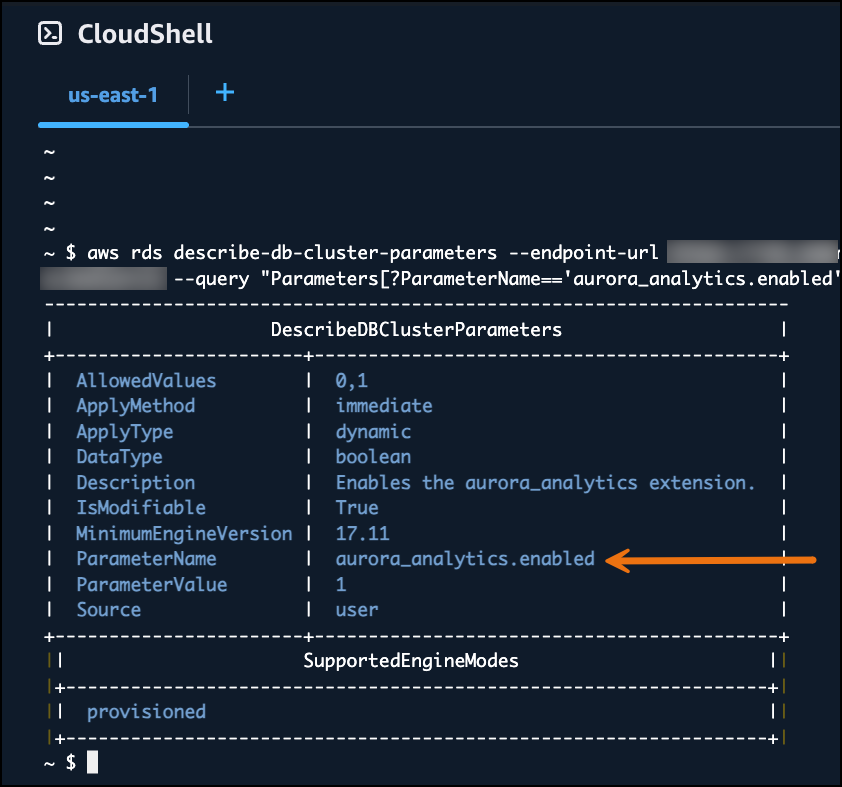
The capability is supported on Aurora PostgreSQL major versions 17 (starting with version 17.11) and 18 (starting with version 18.6). Crucially, AWS is offering this feature at no additional service charge; customers pay only for the incremental Aurora compute resources consumed by queries and standard Amazon S3 request and storage costs.
Chronology: The Evolution Toward Unified Data Architecture
The journey to this architectural milestone spans years of escalating complexity in enterprise data stacks, culminating in this deep integration of open-source analytical tools into managed cloud relational databases.
The Traditional Era of Data Fragmentation
For decades, enterprise data architectures maintained a strict division of church and state: operational data lived in transactional relational databases (OLTP) optimized for fast inserts, updates, and localized lookups, while historical, aggregated, or massive analytical datasets lived in data warehouses or data lakes (OLAP).
As data volumes exploded, organizations increasingly found themselves needing to combine real-time transactional metrics with long-term historical trends—for instance, checking a customer’s active shopping cart against five years of past purchase history. To achieve this, engineering teams constructed reverse-ETL pipelines, data warehouses, and synchronization jobs. These systems constantly duplicated data, inflated storage and infrastructure costs, and created fragile synchronization dependencies.
The Rise of Modern Data Lakes and AI
In recent years, open-source table formats like Apache Iceberg and Apache Parquet standardizing on Amazon S3 became the de facto standard for cloud-scale analytics. However, bridging these lakes back to operational applications remained an engineering tax.
This friction intensified dramatically with the advent of generative AI and autonomous AI agents. Modern AI applications frequently require runtime access to both live operational records and deep historical context. Because it is nearly impossible to predict and pre-replicate every dataset an AI agent might query on the fly, traditional pre-ETL approaches broke down entirely.
The DuckDB Integration and General Availability
The turning point arrived when DuckLabs—the core team behind the high-performance analytical database project DuckDB—joined Amazon. Rather than forcing a separate service integration, AWS architects embedded the DuckDB engine directly into the Aurora PostgreSQL infrastructure.
Following internal development and validation, AWS officially released the capability for production workloads, making it immediately available across all commercial AWS regions and AWS GovCloud (US) environments.
Supporting Data and Technical Implementation
To understand the mechanics of this new architecture, consider a standard financial scenario involving transactional records and historical archives.
In a typical setup, an enterprise maintains a recent_transactions table inside Aurora PostgreSQL containing the last seven days of customer activity. Meanwhile, five years of deep historical logs are stored as Parquet files in an Amazon S3 bucket.

Step-by-Step Configuration
- Enable the Extension: The administrator connects to the Aurora PostgreSQL cluster using standard tools like
psqland provisions the analytics module:CREATE EXTENSION aurora_analytics; - Attach IAM Roles: An AWS Identity and Access Management (IAM) role configured with the
AuroraAnalyticsfeature is attached to the cluster, granting Aurora secure read access to Amazon S3 and the AWS Glue Data Catalog. - Define Foreign Tables: Instead of building an ingestion pipeline, the engineer creates a lightweight foreign table pointing directly to the cloud storage path:
CREATE FOREIGN TABLE transaction_history ()
SERVER aurora_analytics_server
OPTIONS (
   location 's3://<my-bucket>/finance/transaction_history.parquet',
   format 'parquet'
);
Note: Because Aurora automatically interprets schema metadata from the Parquet or Iceberg files, manual column definitions are unnecessary.
Executing Unified Queries
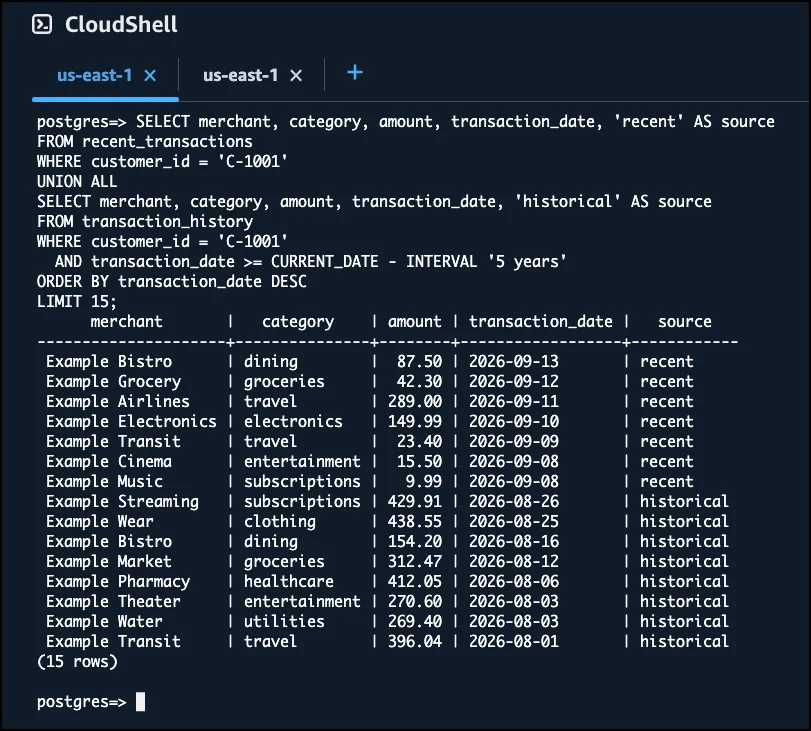
With both the operational table and the S3-backed foreign table registered, applications can execute unified queries joining live and archived data seamlessly:
SELECT merchant, category, amount, transaction_date, 'recent' AS source
FROM recent_transactions
WHERE customer_id = 'C-1001'
UNION ALL
SELECT merchant, category, amount, transaction_date, 'historical' AS source
FROM transaction_history
WHERE customer_id = 'C-1001'
  AND transaction_date >= CURRENT_DATE - INTERVAL '5 years'
ORDER BY transaction_date DESC
LIMIT 15;
Under the hood, DuckDB executes the analytical scan over the S3 Parquet files, while Aurora processes the operational records. The database engine merges the datasets into a single, cohesive result set without moving or copying bytes between storage tiers beforehand.
For workloads demanding single-digit-millisecond latency on hot data, developers can easily materialize data from the data lake into native Aurora tables using standard SQL commands like CREATE TABLE AS SELECT or MERGE INTO, offloading analytical heavy lifting to Aurora read replicas.
Official Responses and Strategic Vision
AWS leadership and product engineers emphasize that this release represents a fundamental shift in how developers interact with data infrastructure.
According to product communications from the AWS team, the primary objective is to strip away the accidental complexity of modern data engineering. "Whether you’re powering real-time dashboards, enriching transactions with historical context, or building AI agents that reason over both live and archived data, you can now do it all through a single, familiar interface," AWS noted in the launch documentation.
By anchoring this capability around the open-source DuckDB engine, AWS has positioned Aurora to benefit directly from future performance and functional enhancements contributed by the broader open-source community. Furthermore, the ability to federate external catalogs—such as Iceberg REST Catalog-compatible stores registered via AWS Glue—demonstrates a strong commitment to open standards and zero-ETL data architectures, allowing enterprises to preserve their existing investments in data cataloging systems.
Implications for Enterprise Architecture and AI Development
The arrival of direct data lake querying inside Amazon Aurora PostgreSQL carries profound implications across multiple domains of enterprise technology.
1. Simplification of Application Architecture
For software engineering teams, the elimination of reverse-ETL pipelines translates directly to reduced code maintenance, fewer points of failure, and lower infrastructure expenditures. Developers no longer need to write custom ingestion daemons, configure Kafka streams, or manage synchronization cron jobs simply to join transactional state with analytical archives. Applications can be built entirely around standard PostgreSQL interfaces, accelerating time-to-market for new features.
2. Unlocking the Potential of Autonomous AI Agents
As enterprises pivot toward generative AI and agentic workflows, data accessibility becomes the primary bottleneck. AI agents require fluid, ad-hoc access to sprawling enterprise data stores to reason effectively. Pre-replicating every possible data subset required by an agent is practically impossible. By allowing Aurora PostgreSQL to serve as an intelligent query router that taps live operational tables and vast S3 data lakes on demand, AI agents gain immediate, contextual visibility into the entirety of an organization’s digital footprint.
3. Cost Efficiency and Resource Optimization
Because AWS is offering the capability at no additional software license fee—charging only for the underlying compute and storage primitives—organizations can optimize their cloud spend. Intelligent features like predicate pushdown ensure that compute cycles are conserved, reading only the necessary partitions from Amazon S3. Additionally, the ability to execute analytical scans across Aurora read replicas ensures that heavy analytical queries do not degrade the performance of mission-critical operational workloads running on primary writer instances.
4. A Template for Future Hybrid Databases
This integration signals a broader industry trend: the convergence of transactional and analytical processing (HTAP) enabled by modular, embeddable database engines. By leveraging tools like DuckDB within traditional relational boundaries, cloud providers are dissolving the hard walls that historically separated databases from data lakes. For database administrators and cloud architects, this heralds a cleaner, more cohesive future where data storage format and query location are decoupled from application logic.