Amazon Web Services Unveils CloudWatch Omni: A Paradigm Shift Toward AI-Powered, Application-Centric Observability
SEATTLE — In a major development poised to reshape how enterprise engineering organizations manage complex software ecosystems, Amazon Web Services (AWS) has officially announced the launch of Amazon CloudWatch Omni. Built natively on OpenTelemetry and integrated deeply with generative artificial intelligence capabilities, CloudWatch Omni introduces an AI-powered observability experience designed to unify application performance monitoring, infrastructure metrics, and autonomous agent workflows into a single collaborative workspace.
By shifting the focal point of monitoring away from isolated infrastructure components and toward holistic, connected applications, AWS aims to eliminate the diagnostic friction, tool-switching fatigue, and communication silos that have long plagued modern software development and site reliability engineering (SRE) teams.
Main Facts
Amazon CloudWatch Omni represents a comprehensive reimagining of cloud monitoring architecture, engineered to solve the persistent challenges of scale, complexity, and cross-team collaboration in modern distributed systems.
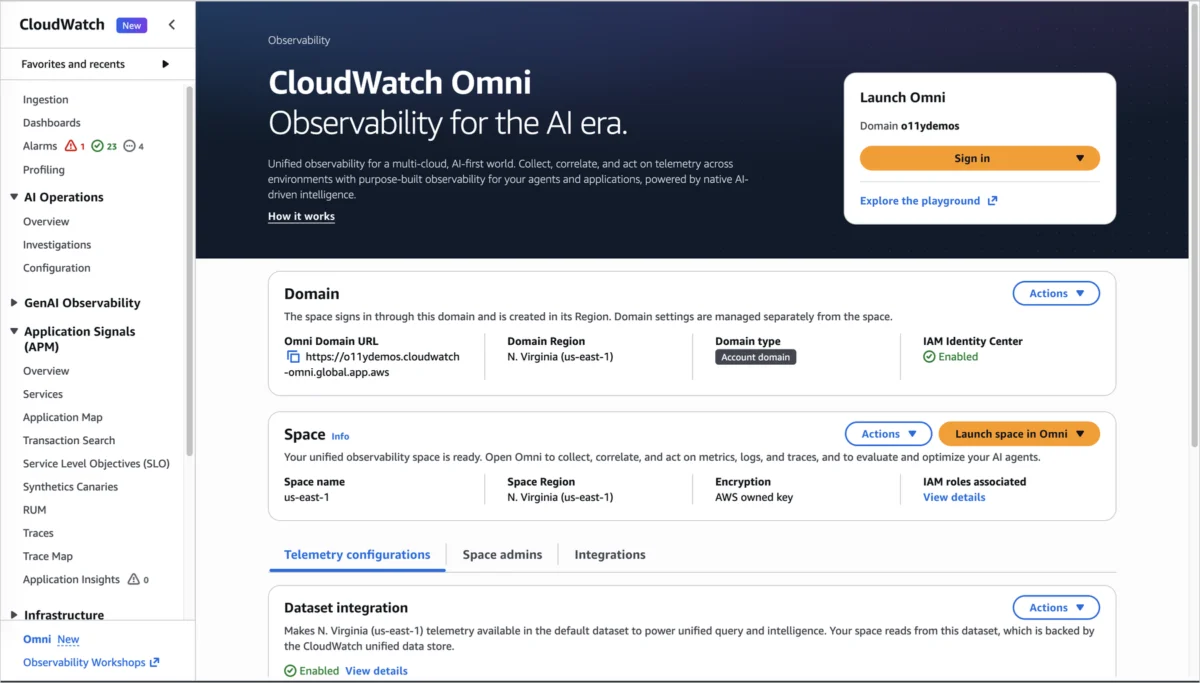
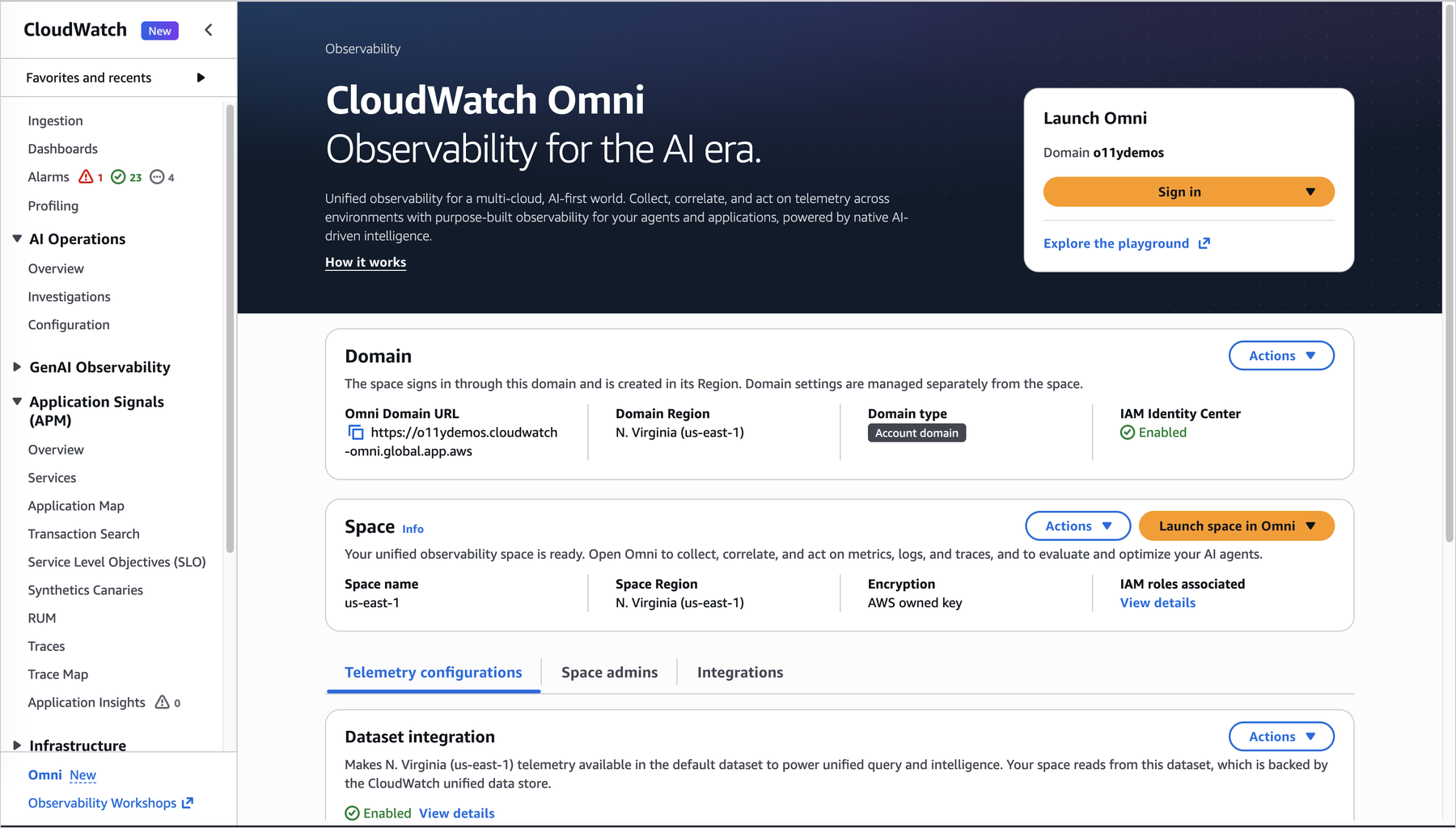
At its core, Omni provides a dedicated organizational URL and enterprise single sign-on (SSO) integration via AWS IAM Identity Center—supporting major identity providers such as Okta and Microsoft Entra ID (formerly Azure AD). This architectural choice means that cross-functional stakeholders—including software developers, database administrators, site reliability engineers, and engineering managers—can access critical operational data without requiring direct access to the AWS Management Console.
Key technical and operational pillars of CloudWatch Omni include:
OpenTelemetry-Native Foundation: Omni leverages OpenTelemetry as its primary telemetry ingestion standard. Telemetry data already streaming into CloudWatch appears natively with zero reconfiguration, while external workloads instrumented with OpenTelemetry can seamlessly transmit data via an OpenTelemetry Protocol (OTLP) endpoint.
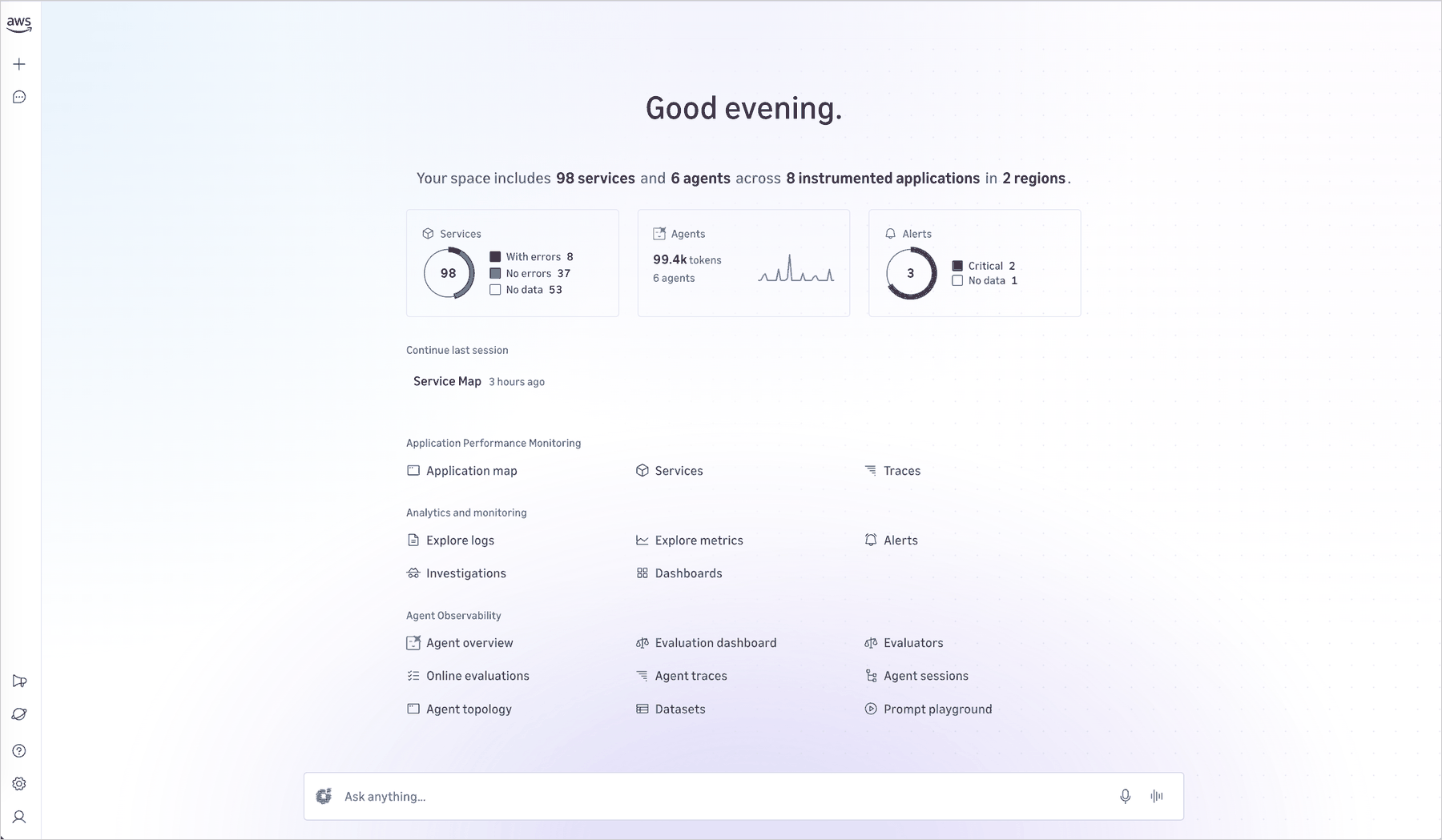
Unified Application and Agent Observability: Alongside traditional application metrics, logs, traces, and alarms, Omni introduces purpose-built monitoring for generative AI applications and autonomous agentic workloads, bridging the gap between deterministic code and probabilistic AI systems.
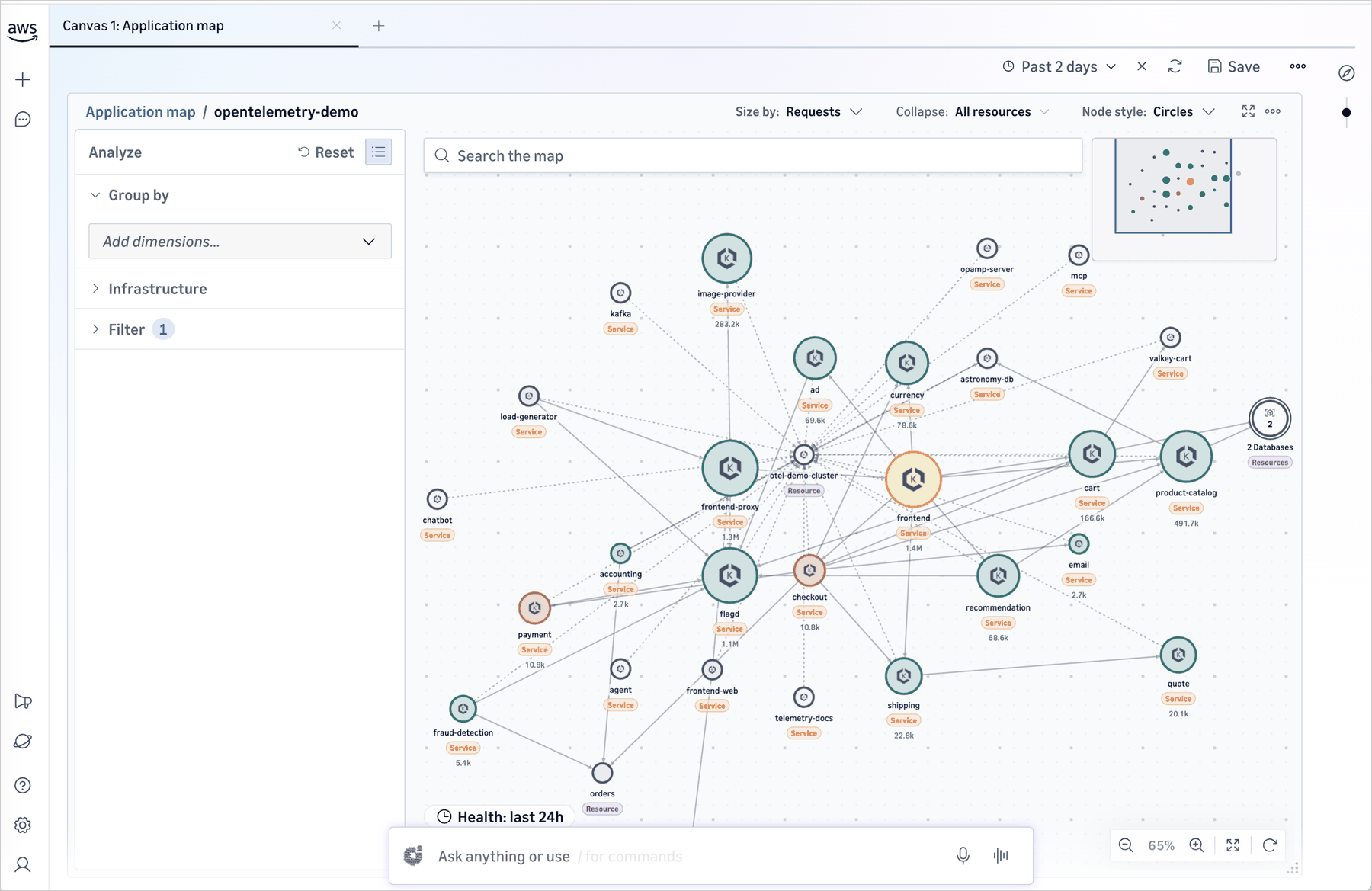
Application-Centric Organization: Rather than forcing teams to manually curate and maintain static dashboards, Omni automatically discovers services, maps underlying dependency topologies, and adjusts monitoring parameters dynamically based on defined service-level objectives (SLOs) and error budgets.
Autonomous Investigation via Amazon DevOps Agent: The platform integrates the Amazon DevOps Agent directly into live investigation sessions. Operating from the same real-time telemetry as human engineers, the agent correlates anomalies, surfaces root-cause paths through dependency graphs, suggests remediation pathways, and automatically documents the entire incident lifecycle.
Zero-Data-Movement Spaces: Teams are organized into dedicated "Spaces" that point directly to existing CloudWatch data pools. This architecture ensures that organizations do not incur additional data duplication or movement costs when transitioning to the Omni experience.
Chronology
The introduction of Amazon CloudWatch Omni follows a strategic trajectory by AWS to infuse generative AI and automated reasoning deeper into its core management and governance toolsets.
Laying the Telemetry Groundwork: Over preceding years, AWS heavily committed to upstream OpenTelemetry (OTel) standards, recognizing that modern enterprises run heterogeneous environments spanning multiple clouds, on-premises data centers, and diverse container orchestrators. This laid the groundwork for a unified telemetry ingestion layer.
The Rise of Generative AI Workloads: As enterprise adoption of Large Language Models (LLMs), retrieval-augmented generation (RAG) pipelines, and autonomous agentic workflows accelerated, traditional application performance monitoring (APM) tools struggled to provide visibility into non-deterministic agent loops, token latency, and prompt degradation.
The Dual-Release Strategy: AWS structured the rollout of Omni across two companion pillars. In its initial technical disclosures, AWS introduced the agent observability capabilities tailored specifically for generative AI and agentic workloads. Shortly thereafter, the company unveiled the broader application observability experience—the core subject of the current rollout.
General Availability (September 2026): AWS officially made CloudWatch Omni generally available to existing and new customers, providing instant access via the standard Amazon CloudWatch console through a dedicated "Try CloudWatch Omni" activation link, alongside robust enterprise setup workflows.
Supporting Data
The operational justification for CloudWatch Omni is grounded in empirical pain points reported by enterprise engineering leadership. Industry data consistently indicates that engineers spend up to 40% of their operational cycles on non-coding maintenance tasks—specifically curating monitoring dashboards, adjusting alert thresholds, and piecing together fragmented event timelines during incident post-mortems.
Architectural Performance Metrics
Zero Configuration Overhead: Existing CloudWatch customers experience instantaneous data availability; logs, metrics, traces, and pre-configured alarms populate new Spaces immediately upon activation without requiring schema migrations or data pipeline re-architecting.
Multi-Identity Enterprise Federation: Integration with IAM Identity Center supports SAML 2.0 compliant identity providers, allowing organizations to provision hundreds or thousands of collaborative user seats without expanding AWS IAM administrative credential footprints.
Unified Ingestion via OTLP: The platform accepts standard OTLP streams, making it frictionless to onboard microservices running on Kubernetes, AWS Lambda, Amazon Elastic Container Service (ECS), or external cloud providers into the exact same application topology map.
Official Responses
Speaking on the operational philosophy driving the new product, AWS engineering leadership emphasized that modern observability must evolve beyond passive data collection into active, collaborative problem-solving.
"Engineering teams spend a significant portion of their observability time maintaining dashboards, tuning thresholds, and switching between tools to piece together what happened during an incident," noted Daniel Abib, AWS product architect and spokesperson for the release. "When an issue crosses team boundaries, context gets lost in Slack threads and screenshots rather than flowing naturally to the next engineer. CloudWatch Omni changes this by organizing observability around your applications rather than individual signals, and bringing your whole team into the same workspace."
AWS further stressed that the integration of the Amazon DevOps Agent is not designed to replace human judgment, but rather to act as a tireless co-pilot during high-stress operational outages. By anchoring the AI agent’s reasoning strictly to the deterministic state of the application’s OpenTelemetry stream, AWS ensures that automated suggestions remain grounded, verifiable, and safe for enterprise production environments.
Implications
The rollout of Amazon CloudWatch Omni carries profound implications for the enterprise software observability market, internal developer platforms (IDPs), and the broader DevOps tooling ecosystem.
1. The Death of Static Dashboards
For decades, the standard operating procedure for monitoring has involved engineers manually building and maintaining sprawling Grafana or CloudWatch dashboards. CloudWatch Omni signals a definitive shift toward intent-based observability. By allowing engineering teams to declare high-level business and performance goals—such as availability targets, latency budgets, and error-rate thresholds—and letting the system dynamically adjust visualization topologies, organizations can drastically reduce engineering toil.
2. Bridging the Silo Between Dev, SRE, and Management
One of the most persistent bottlenecks in incident management is the "handoff gap." When a database failure cascades into an API Gateway timeout, context is frequently lost as the incident ticket moves from an on-call SRE to a database specialist. By providing a persistent, shareable investigation session where both human engineers and the Amazon DevOps Agent operate within the exact same chronological context, Omni dramatically compresses Mean Time to Resolution (MTTR). Furthermore, because the entire session history is recorded automatically, formal post-incident report generation becomes an automated byproduct of the resolution process rather than a tedious administrative burden.
3. Mainstreaming Agentic Workload Observability
As enterprises rapidly operationalize generative AI agents, monitoring these systems has emerged as a distinct engineering discipline. Traditional metrics like CPU utilization or memory leaks are inadequate for diagnosing why an autonomous agent entered an infinite evaluation loop or generated hallucinated outputs. By combining application observability with purpose-built AI agent tracing in a unified platform, AWS has positioned CloudWatch Omni as an essential operational control plane for the burgeoning agentic economy.
4. Competitive Landscape and Ecosystem Impact
By embracing an OpenTelemetry-native approach and offering zero-data-movement integration with existing CloudWatch repositories, AWS has lowered the barrier to entry for enterprises considering advanced AI observability solutions. Rather than forcing organizations to migrate petabytes of historical logs and traces to a third-party analytics vendor, Omni wraps intelligent collaboration and automated root-cause analysis directly around the customer’s existing data estate.
Getting Started and Availability
Amazon CloudWatch Omni is generally available now. Existing CloudWatch customers can evaluate the platform immediately by navigating to the Amazon CloudWatch console and selecting the "Try CloudWatch Omni" option.
For organization-wide deployments, cloud administrators can configure dedicated domains, link enterprise identity providers via AWS IAM Identity Center, and provision team-specific Spaces in minutes. Additional connectors are available to ingest telemetry from external environments, ensuring that organizations running multi-cloud or hybrid architectures can fully leverage Omni’s unified application mapping and AI-driven investigation workflows.