










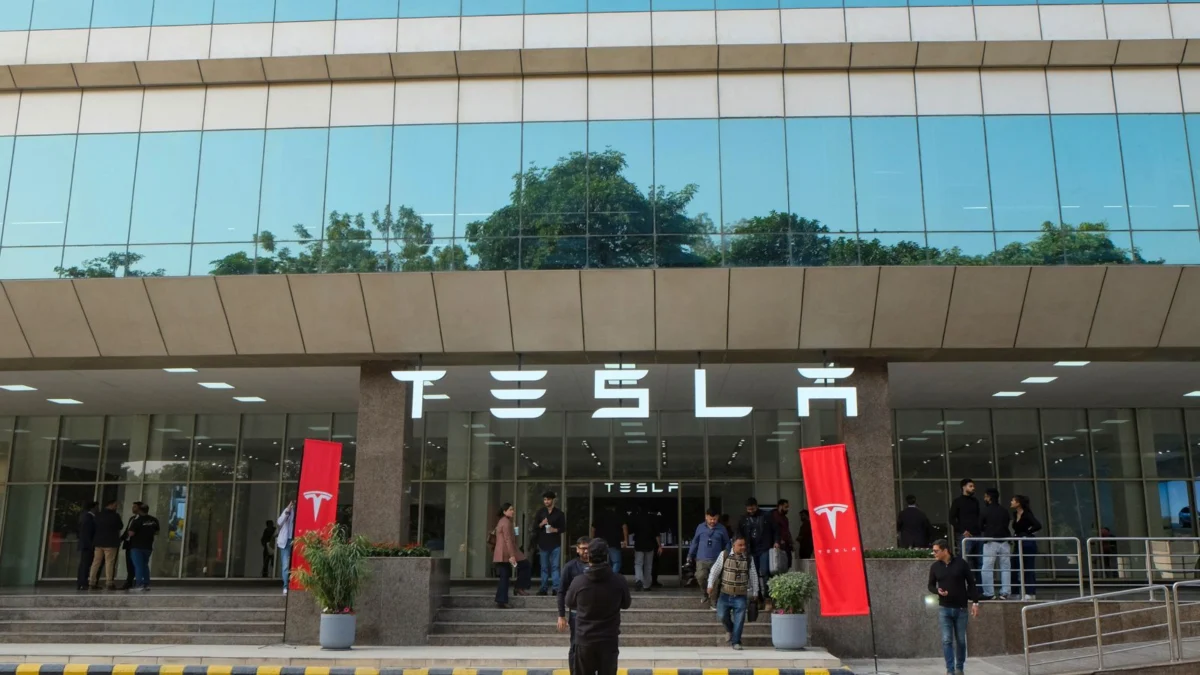
New Delhi: In a strategic concession to mounting regulatory pressure across the continent, electric vehicle pioneer Tesla has quietly renamed its controversial "Full Self-Driving" (FSD) software package on its European websites. The suite of advanced driver-assistance features is now officially designated as "Tesla Assisted Driving" across multiple European markets.
The move comes at a critical juncture for CEO Elon Musk, who has repeatedly staked the company’s long-term valuation and future growth trajectory on the successful commercialization and widespread regulatory approval of autonomous driving technology. By stripping away terms that European regulators deemed misleading, Tesla hopes to pave the way for a smoother, expedited path toward continent-wide software authorization.
While European platforms—including those in Germany, Spain, the Netherlands, and Slovakia—have pivoted to the new nomenclature, the United States market continues to use the designation "Full Self-Driving (Supervised)." This regional discrepancy underscores the intense regulatory scrutiny Tesla faces globally as authorities push back against what they characterize as overzealous marketing.
Main Facts: The European Rebrand and Regulatory Showdown
The core development centers on Tesla’s realization that semantic compliance is the price of admission for autonomous technology markets in Europe. For years, the phrase "Full Self-Driving" has been a lightning rod for criticism from consumer protection agencies, transportation ministries, and safety watchdogs.
Regulators across the European Union have consistently argued that the original terminology is inherently deceptive. They maintain that the moniker implies a level of vehicle autonomy that simply does not exist in current commercial models. Under current technological classifications, Tesla’s software requires constant, unwavering human supervision, leaving the driver fully and legally responsible for the vehicle’s operation at all times.
- The Name Change: European web portals for Tesla have replaced "Full Self-Driving" with "Tesla Assisted Driving."
- The Geographic Scope: The rebrand has rolled out in key European territories, including Germany (which initially reported the shift), Spain, the Netherlands, and Slovakia. Meanwhile, American web assets retain the "(Supervised)" suffix.
- The Regulatory Catalyst: The shift directly addresses persistent objections from national transport agencies regarding consumer confusion and safety misinterpretations.
- The Stakes: Elon Musk views autonomous software as the defining pillar of Tesla’s corporate evolution, transitioning the company from a traditional automotive manufacturer into an AI and robotics powerhouse.
Chronology: How the Pressure Mounted on Tesla
The journey toward this rebrand has been marked by a protracted diplomatic and bureaucratic chess match between Tesla’s lobbying apparatus and European transportation ministries.
Late 2024 to Early 2025: Heightened Scrutiny
As Tesla intensified its efforts to introduce advanced driver-assistance capabilities to European roads, national transport agencies began raising formal flags regarding the marketing language used to promote the software. Freedom-of-information requests later revealed internal government memos cautioning that consumers could easily misinterpret the capabilities of the vehicle.
Summer 2025: Grassroots Lobbying Campaigns
Recognizing bureaucratic bottlenecks, Tesla launched an aggressive, coordinated campaign to secure FSD approval in Europe. According to investigative reports published by Reuters, this campaign mobilized not only corporate lobbyists but also enthusiastic Tesla owners and online supporters. The community was encouraged to lobby national regulators directly to demand faster approval timelines for the software updates.
September 2025: Public Inquiries and Accountability
Grassroots engagement yielded pointed interactions. In September, a Norwegian Tesla owner used freedom-of-information channels to formally query the Norwegian Public Roads Administration. The owner pressed regulators for clarity, demanding to know what specific milestones Tesla or the Norwegian government needed to achieve to break the regulatory deadlock, rather than relying on generic statements about waiting for overarching EU consensus.
October 2025 to January 2026: Regional Concessions
Recognizing that blanket EU approval would face delays, Tesla adopted a country-by-country appeasement strategy. Authorities in Sweden and Italy pressed their respective transport agencies to evaluate whether FSD marketing violated consumer protection laws. By early 2026, German officials confirmed that Tesla had proactively offered to rebrand the software to alleviate regulatory anxiety.
October 2026: The Official Rollout
By mid-October 2026, the rebranding went live across European domains. Slovakia’s FSD landing pages began redirecting automatically to "Tesla Assisted Driving," cementing a localized shift in corporate strategy. Concurrently, an anticipated EU-wide regulatory vote was pushed back from October to at least December 2026, as member states like France insisted on conducting rigorous, independent testing of the software.
Supporting Data: The Global Regulatory Landscape
To understand the weight of Tesla’s decision in Europe, one must examine the fragmented and cautious regulatory environment governing autonomous and semi-autonomous driving systems globally.
- Market Acceptance: Despite regulatory friction, eight EU member states have already permitted the deployment of Tesla’s system under strict local guidelines. Slovakia is poised to become the ninth nation to greenlight the technology.
- The Automation Continuum: According to the Society of Automotive Engineers (SAE), driving automation spans from Level 0 (no automation) to Level 5 (full automation). Tesla’s current public-facing software operates firmly at Level 2 (partial automation), which mandates continuous driver engagement.
- Regulatory Fears: Internal government correspondence in Italy—uncovered via public records requests—explicitly warned that pairing the "Full Self-Driving" name with high-gloss promotional materials led users to incorrectly believe the cars possessed Level 3 (conditional automation) or higher capabilities, where drivers can legally look away from the road under specific conditions.
- The EU-Wide Voting Delay: While localized approvals have trickled in, a centralized European Union vote on standardizing and authorizing the software has been repeatedly deferred. Originally slated for October, the vote has now been pushed to December 2026 at the earliest, largely driven by France’s insistence on prolonged national safety evaluations.
Official Responses and Stakeholder Perspectives
The tug-of-war over autonomous vehicle terminology has drawn sharp commentary from government regulators, consumer advocacy groups, and Tesla’s own leadership ecosystem.
Regulatory Authorities
European transport ministries have maintained a unified stance regarding consumer safety. Officials from countries such as Sweden, Italy, and Norway have consistently argued that automotive marketing must align strictly with the technical reality of the product.
In statements obtained through transparency laws, Italian transport officials emphasized that semantic precision is non-negotiable when dealing with public safety on high-speed roadways. Regulators argue that any ambiguity in software labeling compromises driver vigilance, potentially increasing the risk of catastrophic traffic incidents.
Consumer Advocacy Groups
Consumer protection organizations across the continent have largely celebrated the rebrand, viewing it as a long-overdue victory for truth in advertising. For years, watchdogs argued that calling a system "Full Self-Driving" while simultaneously burying disclaimers about driver supervision in fine print created an unacceptable safety hazard. These groups contend that the shift to "Tesla Assisted Driving" establishes a more honest baseline for consumers, making it immediately clear that the human being remains the primary operator of the vehicle.
Tesla and Elon Musk
Tesla’s corporate leadership has approached the European market with pragmatism. While CEO Elon Musk has frequently expressed frustration at what he views as overly conservative and slow-moving European bureaucracy, the company ultimately recognized that stubbornness regarding nomenclature would only delay market penetration. By compromising on the name, Tesla hopes to appease skeptical transport ministries, secure the remaining regional approvals, and build political goodwill ahead of the crucial EU-wide legislative votes scheduled for late 2026.
Implications: What the Rebrand Means for Tesla’s Future
The decision to drop the "Full Self-Driving" label in Europe carries profound implications for Tesla’s business model, its technological roadmap, and the broader future of autonomous mobility.
1. A Blueprint for Global Compliance
Tesla’s pivot in Europe may serve as a template for how the company navigates regulatory pushback in other international markets. As governments from Asia to the Americas ramp up oversight on artificial intelligence and machine learning in consumer products, automotive manufacturers can no longer rely on hyperbole in their marketing. If the "Assisted Driving" branding proves successful in unlocking European approvals, Tesla may consider adopting similar semantic adjustments in other jurisdictions where regulatory resistance remains stiff.
2. Managing Consumer Expectations and Liability
By explicitly labeling the software as "Assisted Driving," Tesla effectively insulates itself against certain types of liability claims stemming from driver misuse. When a system is marketed as "Full Self-Driving," consumer psychology often encourages complacency, leading drivers to engage in distracted behaviors such as texting, reading, or sleeping. The new terminology acts as an ongoing psychological cue, reminding motorists that they are merely receiving assistance, not relinquishing control.
3. Financial and Valuation Pressures
Wall Street and tech investors have long evaluated Tesla not merely as a car manufacturer, but as a disruptive software company whose valuation relies heavily on the monetization of autonomous software (via subscriptions or upfront purchases). Any regulatory roadblock in major markets like the European Union directly threatens projected software revenues. By cooperating with European regulators and securing localized rollouts, Tesla protects its financial pipeline and keeps its autonomous vehicle narrative intact.
4. The Path to True Autonomy
Ultimately, changing the name of the software does not change the underlying code or its technical capabilities. The true test for Tesla in Europe will not be what the feature is called on a website, but whether the underlying artificial intelligence can demonstrate a level of safety and reliability that satisfies independent regulators. As France and other EU nations conduct rigorous testing ahead of the December vote, Tesla must prove that its "Assisted Driving" technology is robust enough to eventually earn the right to drop the assistance training wheels entirely—paving the way for genuine, unsupervised autonomy in the years to come.



