







SEATTLE — Managing containerized applications at scale on cloud infrastructure has long presented platform and DevOps teams with a persistent balancing act. While orchestration engines like Amazon Elastic Container Service (ECS) streamline the deployment and scaling of microservices, configuring ingress networking for dozens or hundreds of individual services has historically created severe operational bottlenecks.
Today, Amazon Web Services (AWS) is fundamentally shifting how organizations handle container connectivity with the official launch of Amazon ECS Gateway. This powerful new account-level resource is engineered to automate and simplify ingress networking for containerized workloads. By dynamically provisioning, configuring, and managing the underlying infrastructure—such as Application Load Balancers (ALBs), security groups, and SSL/TLS certificates—ECS Gateway eliminates the tedious, per-service provisioning overhead that has long slowed down deployment velocity and introduced the risk of configuration drift.
Available immediately across all commercial AWS regions where ECS operates, the new feature is provided at no additional control-plane charge. Organizations pay only for the underlying cloud resources they consume.
Main Facts: What is Amazon ECS Gateway?
At its core, Amazon ECS Gateway acts as an intelligent, managed routing layer that bridges external traffic to internal containerized services on Amazon ECS. Traditionally, every time a platform or application team deployed a new service requiring external or internal access, they had to manually provision an Application Load Balancer, request and validate AWS Certificate Manager (ACM) certificates, configure AWS WAF web ACLs, set up explicit target groups, and write custom automation scripts to keep those resources in sync as services scaled up, scaled down, or underwent continuous updates.

Amazon ECS Gateway re-architects this workflow by introducing a centralized, account-level resource that automates the complete lifecycle of ingress infrastructure.
Key Capabilities and Architectural Highlights:
- Host-Based Routing Optimization: ECS Gateway utilizes Application Load Balancers with advanced host-based routing. Crucially, it allows up to 25 distinct container services to safely share a single ALB, driving massive infrastructure cost efficiencies compared to traditional one-ALB-per-service patterns.
- Automated Lifecycle Management: The service oversees the entire infrastructure lifecycle. When the first service connects, ECS automatically provisions the initial ALB. As capacity fills up, it seamlessly adds more ALBs (up to a configured maximum quota), and automatically decommissions them when workloads wind down.
- Instant DNS and Endpoints: Upon successful provisioning, each connected service receives a unique, ready-to-use DNS hostname, allowing application teams to immediately receive production traffic without wrestling with DNS records or routing tables.
- Many-to-Many Architecture: A single gateway can be associated with up to 10,000 discrete ECS clusters, while an individual cluster can bind to up to five separate gateways. This flexibility allows platform teams to segment traffic streams easily—such as establishing separate public-facing and VPC-internal gateways—across diverse environments.
Chronology: The Evolution Toward Automated Ingress
The path to Amazon ECS Gateway is the result of years of feedback from enterprise platform engineering teams struggling with operational scale.
- The Early Days of ECS (2015–2018): When Amazon ECS was first introduced, container networking relied heavily on host port mappings and basic Classic Load Balancers. As microservices architectures exploded in popularity, the industry transitioned to Application Load Balancers and AWS Fargate, requiring teams to manually map task ports to target groups for every single service deployment.
- The Rise of Custom Automation (2019–2022): To cope with the friction of manual configuration, sophisticated engineering organizations began building complex internal developer platforms (IDPs). These systems utilized tools like AWS CloudFormation, Terraform, and Kubernetes-style custom controllers to automate ALB rule creation. However, maintaining these custom glue-scripts proved brittle and resource-intensive.
- The Introduction of Service Connect (2023): AWS launched ECS Service Connect to simplify service-to-service communication within a mesh. While Service Connect solved internal east-west traffic, north-south ingress networking—getting traffic safely from the outside world into specific container tasks—remained a complex, manual challenge.
- Today: With the launch of ECS Gateway, AWS has brought native, managed automation to north-south ingress, closing the loop on end-to-end container networking simplicity.
Supporting Data: Infrastructure Limits and Configuration
Amazon ECS Gateway is designed to scale effortlessly to meet the demands of enterprise-grade cloud architectures. Understanding its structural limits and configuration parameters is critical for platform architects planning their rollouts.
| Configuration Parameter | Specification / Limit |
|---|---|
| Cluster Associations per Gateway | Up to 10,000 clusters |
| Gateway Associations per Cluster | Up to 5 gateways |
| Service Density per ALB | Up to 25 services sharing a single ALB |
| Load Balancing Schemes | Internet-facing (Public) or VPC-internal |
| Supported Protocols | HTTP, HTTPS, TCP-based listener configurations |
| Additional Protections | AWS WAF web ACL integration |
Incremental Adoption Path
Recognizing that enterprises cannot afford downtime to re-architect existing production systems, AWS designed ECS Gateway to support incremental adoption. If an organization currently operates an ECS service with its own dedicated load balancer, engineers do not need to perform a disruptive cutover.

By calling the UpdateService API and attaching a gateway connector, teams can run both ingress paths simultaneously. This dual-path approach allows platform engineers to thoroughly validate the new gateway routing configuration and test endpoint stability before safely deprecating and removing the legacy load balancer infrastructure.
Official Responses and Expert Insights
Industry reactions from early evaluators and cloud architects highlight the profound impact ECS Gateway is expected to have on developer productivity.
"For years, our platform engineering organization spent an exorbitant amount of engineering hours building and maintaining wrapper scripts just to automate ALB target group registrations and ACM certificate attachments for new microservices," said a Principal Cloud Architect at a major fintech enterprise. "Amazon ECS Gateway shifts that undifferentiated heavy lifting directly into the platform, returning precious weeks of development time back to our feature teams."
Channy Yun, Principal Developer Advocate at AWS, emphasized the structural separation of duties that the new feature enables:
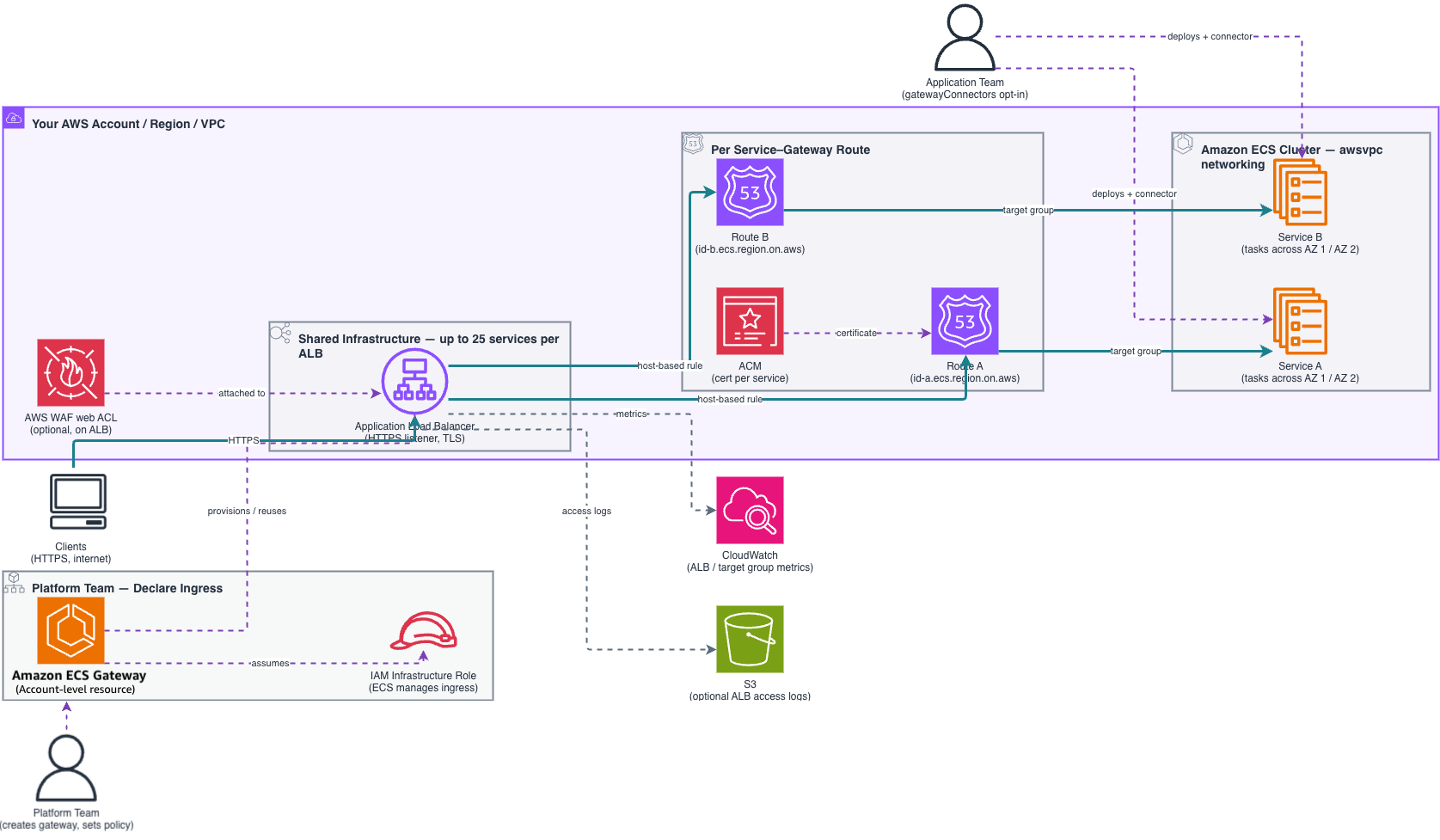
"ECS Gateway introduces a crystal-clear boundary of responsibilities. Platform teams define the secure, compliant boundaries—subnets, security roles, and WAF rules—while application teams simply plug their services into the gateway. It streamlines operations without sacrificing security or governance."
AWS executives have also highlighted the integration of modern tooling, noting that platform engineers can create and manage ECS Gateways programmatically using the AWS Command Line Interface (AWSCLI), infrastructure-as-code frameworks, or the newly introduced AWS MCP Server plugins alongside AI-assisted coding tools.
Implications: What This Means for Platform and Development Teams
The introduction of Amazon ECS Gateway carries sweeping implications for how organizations approach cloud architecture, security posture, and developer velocity.
1. Radical Acceleration of Developer Velocity
In traditional enterprise setups, spinning up a new microservice could take days or weeks as security and platform teams reviewed networking change tickets, verified security group rules, and provisioned load balancer listeners. With ECS Gateway, once a platform team establishes a baseline gateway with predefined security parameters, application teams can spin up compliant, publicly or privately accessible services in a matter of minutes.
2. Strict Separation of Concerns (Platform vs. Application Teams)
Cloud governance models often struggle with the tension between security control and developer agility. ECS Gateway resolves this tension elegantly:
- Platform Teams retain absolute authority over the infrastructure baseline. They define the IAM infrastructure roles, select authorized VPC subnets, configure AWS WAF web ACLs, and set maximum load balancer quotas.
- Application Teams operate within those guardrails. By adding a simple gateway connector definition to their task or service configuration (
CreateServiceorUpdateService), they inherit enterprise-grade security and routing automatically, without needing deep expertise in ALB listener rules or certificate management.
3. Optimized Infrastructure Economics
Cloud sprawl often occurs when teams provision dedicated load balancing infrastructure for smaller, low-traffic microservices just to avoid configuration complexity. By allowing up to 25 services to share a single Application Load Balancer through intelligent host-based routing, ECS Gateway drastically reduces idle infrastructure costs, helping organizations optimize their monthly cloud spend.
4. Simplified Compliance and Configuration Drift Mitigation
Configuration drift—where manual tweaks made during emergency fixes diverge from infrastructure-as-code templates—is a silent killer of system reliability. Because Amazon ECS Gateway manages the lifecycle of the underlying AWS resources directly within the account under automated system control, the risk of orphaned target groups, expired certificates, or misconfigured security groups is heavily mitigated.
Getting Started
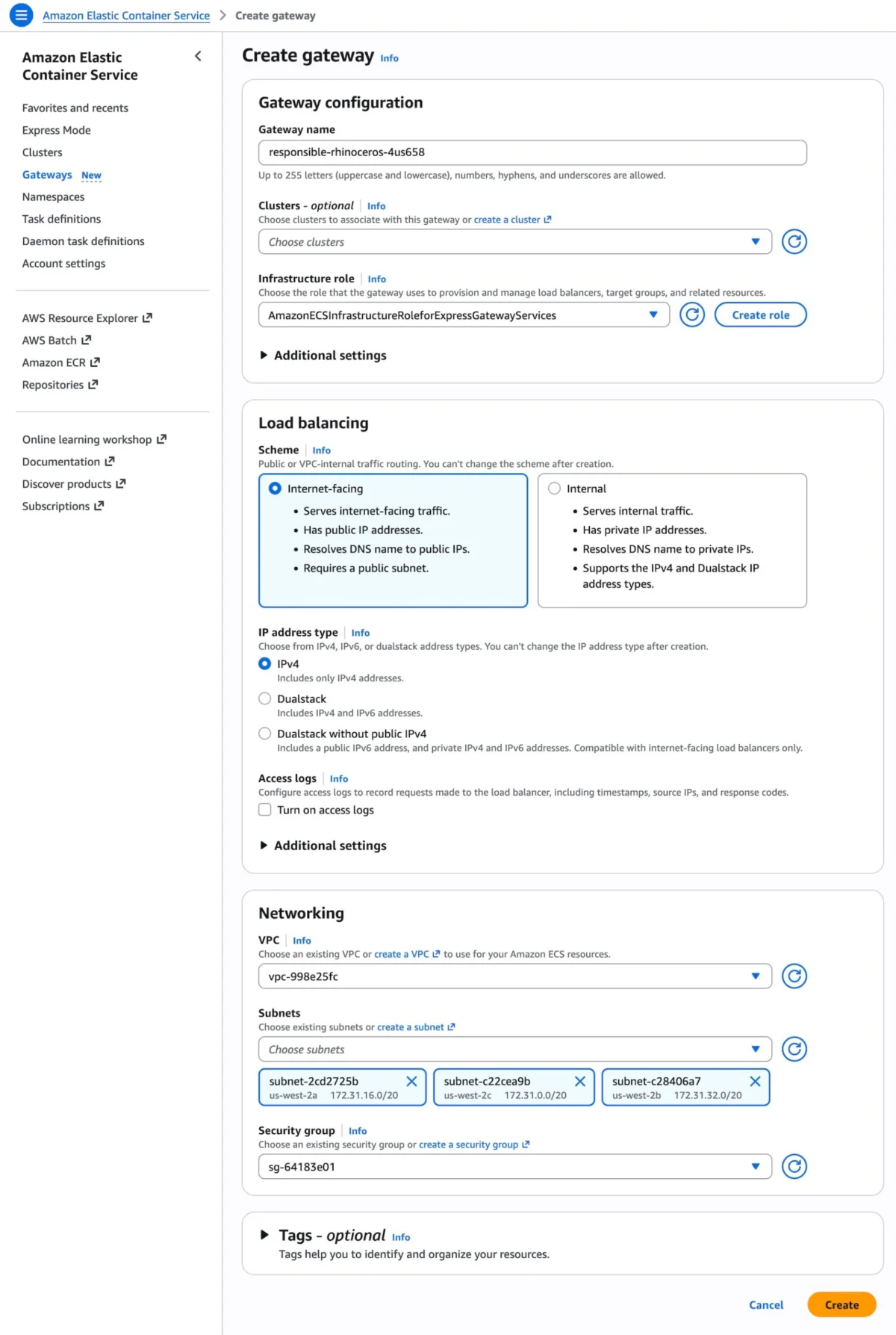
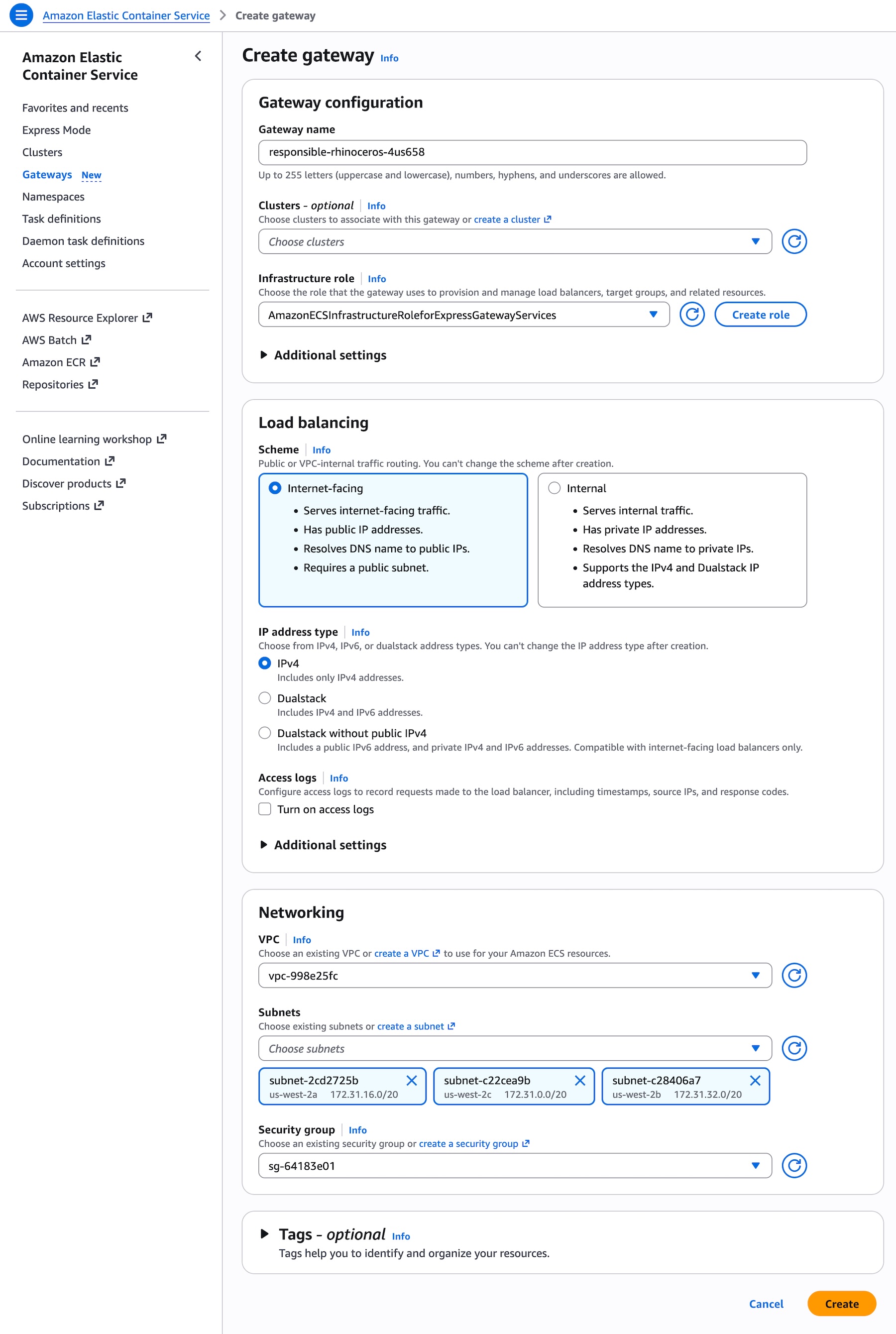
Platform teams looking to implement Amazon ECS Gateway can begin immediately through the Amazon ECS Management Console or via the AWS CLI.
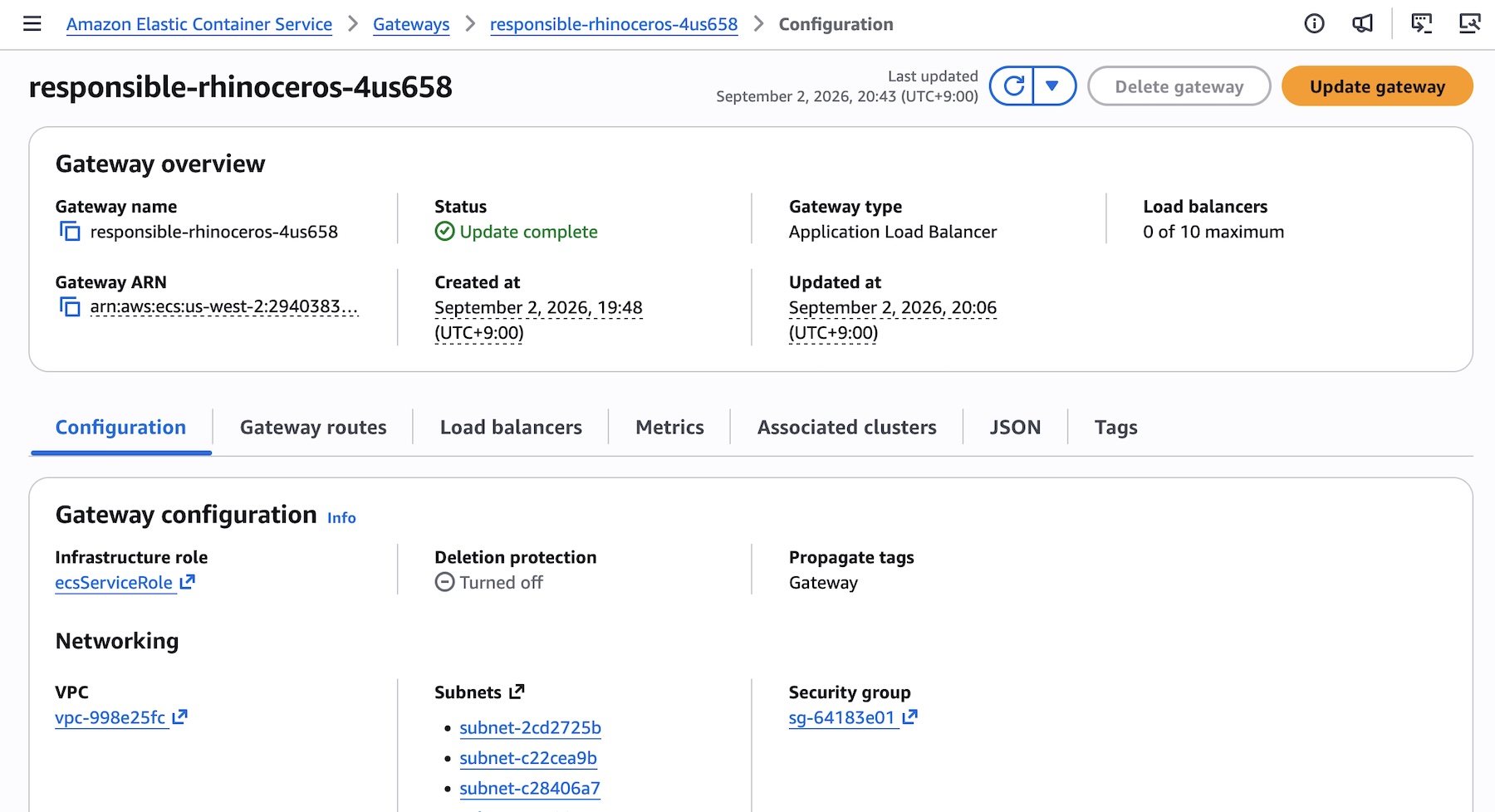
To create a gateway using the CLI, administrators call CreateGateway, supplying a unique name, an authorized IAM infrastructure role, and a configuration object defining the target VPC subnets and traffic scheme:
aws ecs create-gateway
  --name my-team-gateway
  --infrastructure-role-arn arn:aws:iam::123456789012:role/ECSGatewayRole
  --configuration '
    "HostSharedAlb":
      "networkConfiguration":
        "subnets": [
          "subnet-080779f9bd887757a",
          "subnet-03d5b2fead6bc6258",
          "subnet-0861210a397d31252",
          "subnet-06539e194023cb77a"
        ],
        "ipAddressType": "ipv4"
      ,
      "scheme": "internet-facing"

  '
Once established, the gateway can be associated with clusters using AssociateGatewayWithCluster, instantly opening a secure, highly scalable, and fully managed ingress pathway for all containerized applications across the organization.