In the corridors of economic policy, the assessment of India’s industrial trajectory over the past twelve years has become a battleground of metrics and narratives. A recent high-profile critique characterized the ‘Make in India’ initiative as having a “low and patchy impact,” citing a dozen specific indicators to support its verdict. However, this evaluation suffers from a fundamental analytical flaw: it treats two vastly different global eras as if they were identical, failing to account for the profound geopolitical and macroeconomic shifts that have defined the period from 2014 to 2026.
To judge India’s industrial performance without acknowledging the external environment is akin to timing a runner without considering whether they were sprinting downhill on a clear track or battling into a gale-force headwind.
Two Distinct Eras: A Tale of Two Global Economies
The economic landscape of 2002–2013 was a golden era for global trade. During this period, world merchandise exports surged from $6.2 trillion to $18.8 trillion. It was a time of market liberalization, stable regulatory frameworks, and a "rising tide" that lifted the prospects of every export-oriented economy.
In stark contrast, the decade from 2014 to 2025 has been defined by fragmentation. World export growth slowed significantly, rising to $26.3 trillion—a growth rate of less than two-fifths compared to the preceding decade. This period was marred by the COVID-19 pandemic, escalating tariff wars, international sanctions, and armed conflicts that disrupted supply chains. When observers note that India’s non-petroleum exports grew by 400% in the first period compared to 53% in the second, they are observing the reality of a global slowdown, not necessarily a failure of domestic policy.
The China Factor and Global Headwinds
The narrative of a “flat export share” for India often ignores the reality of the global supply chain, dominated by the sheer scale of China. Between 2014 and 2025, China’s trade surplus more than tripled to $1.19 trillion. With manufacturing value-added (MVA) at $4.8 trillion—roughly 27% of the world’s total and nine times that of India—China remains an industrial behemoth.
Faced with cooling domestic demand, Chinese firms have pivoted to aggressive export strategies, often at predatory prices. Economic analysis suggests that in 2022 alone, there was an estimated $365 billion of “excess” Chinese exports in low-skill sectors. This phenomenon has squeezed industrial output across the globe; Germany, the gold standard of European manufacturing, saw industrial output in 2025 run approximately 14% below its 2018 levels. In this context, maintaining a 1.7% share of world exports is not evidence of stagnation, but rather a display of resilience.
Comparative Performance: How India Stands Out
A fair assessment of industrial policy must compare India against its peers—economies that faced the same external shocks—rather than against a historical baseline. When measured against Brazil, Mexico, Indonesia, and South Africa, India’s performance is superior.
Between 2014 and 2025, India’s share of world manufacturing value-added climbed from 2.4% to 3%. In dollar terms, India’s MVA grew by 73%, significantly outpacing China’s 51% and the global average of 36%. This growth was achieved despite a challenging currency environment, with the rupee depreciating from 61 to the dollar to over 85.
Critics often point to Vietnam as the benchmark for success. However, Vietnam’s export growth is largely driven by foreign-invested firms assembling imported components. India has chosen a more arduous path: building deep, indigenous industrial capabilities. While this approach takes longer to manifest in trade statistics, it creates a more sustainable and durable economic foundation.
Data Points: Deconstructing the "Patchy" Claim
The skepticism surrounding ‘Make in India’ often overlooks critical data within the national accounts:
- Growth Momentum: Manufacturing has consistently outpaced the broader economy over the last three years.
- FDI Shift: Manufacturing’s share of Foreign Direct Investment (FDI) inflows has climbed from 48% to 55%.
- Value Added: At constant prices, manufacturing’s share of Gross Value Added (GVA) rose from 14.7% in 2022-23 to 16.1% in 2025-26. While the share at current prices appears to have remained stagnant, this is primarily due to factory-gate prices being suppressed by the influx of cheap Chinese goods.
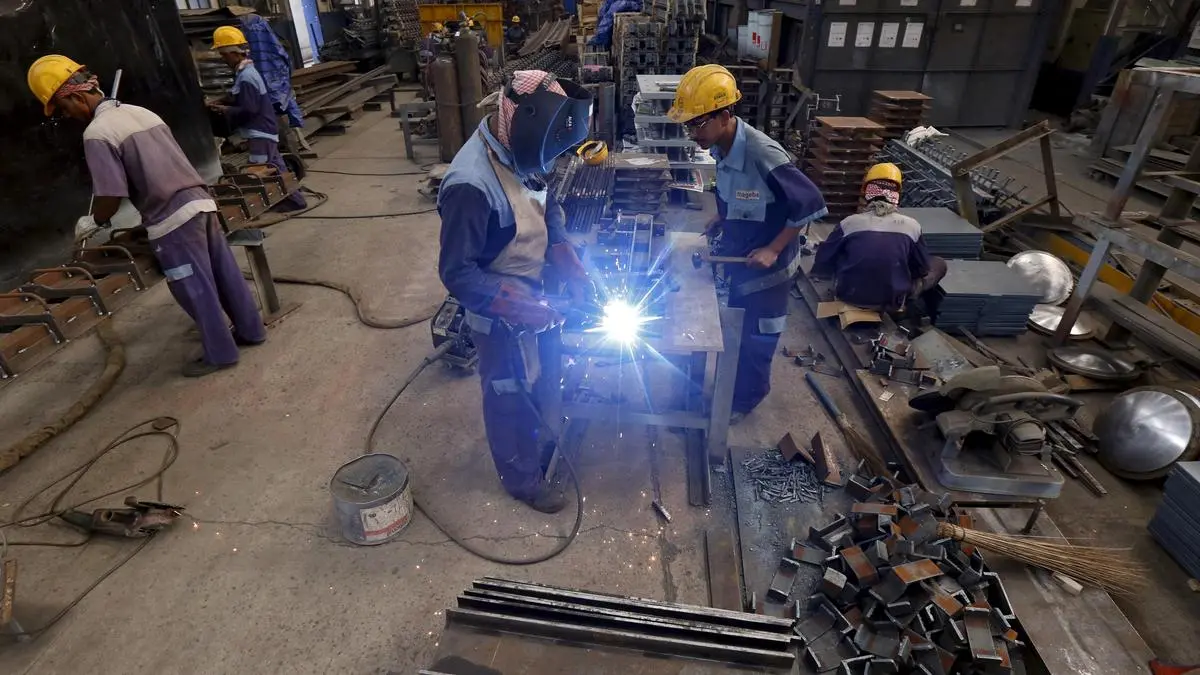
- Employment Dynamics: The Annual Survey of Industries indicates that registered factories employed 2.10 crore people in 2024-25—an increase of 14 lakh over the previous year. This suggests a vital structural transition: labor is migrating from informal, unorganized sheds into formal, protected, and higher-paying factory jobs.
Structural Reforms and the Strategic Pivot
When the government launched its industrial mission in 2014, the core philosophy was that industrialization requires a conducive environment rather than mere handouts. Significant structural reforms were subsequently enacted, including the Goods and Services Tax (GST), the Insolvency and Bankruptcy Code (IBC), a reduction in corporate taxes in 2019, and the decriminalization of 183 provisions under the Jan Vishwas Act. Furthermore, logistics costs—a historic bottleneck for Indian manufacturing—have been reduced from 13-14% of GDP to approximately 8%.
The pivot toward Production Linked Incentive (PLI) schemes was a direct response to the post-2020 global shift, where nations like the US began subsidizing domestic production (e.g., $52.7 billion for the semiconductor industry). India’s PLI schemes have attracted ₹2.4 lakh crore in investment. While critics call this “concentration,” it is, in fact, targeted design. By focusing on solar modules, electronics, pharmaceuticals, automobiles, and specialty steel, India is tackling the sectors where scale is the only path to survival.
The results are tangible: solar module capacity has skyrocketed from 2.3 GW in 2014 to 192 GW; electronics exports reached $47.96 billion in 2025-26; and India has regained the capacity to manufacture essential pharmaceuticals like Penicillin G, ending a long-standing reliance on imports.
Work in Progress: The Road Ahead
None of the current successes imply that the mission is complete. The challenge remains in increasing domestic value addition, particularly in electronics, where it currently sits at 18-23%. To address this, the government has approved 106 projects under the components scheme worth ₹70,000 crore.
In the semiconductor sector, five units are currently in production, with a second phase of investment totaling ₹1.275 lakh crore approved in July. The government is also pushing to close the gap between solar cell and module capacity, with new mandates requiring the use of domestic cells in government-backed projects.
Perhaps the most difficult hurdle is labor-intensive manufacturing. While the textile sector has faced slower-than-expected investment, the development of seven PM MITRA textile parks and a new footwear and leather scheme announced in the 2025 Budget represent long-term strategic bets. The implementation of four labor codes, in force since November 2025, is designed to provide the regulatory flexibility required for firms to scale up operations.
Conclusion: The Long View of Industrialization
Industrialization is not an event; it is the work of decades. The historical examples of nations that achieved sustained growth of 7% or more over 25 years demonstrate that the path to prosperity is found through deep engagement with global markets and a relentless focus on building domestic capability.
India is currently following this path, securing its interests through trade agreements with the UAE, Australia, the EFTA nations, the UK, Oman, New Zealand, and the EU. The next phase of development requires continued simplification of land and permit rules, alongside the rationalization of tariffs on intermediates and capital goods.
In a decade defined by global turbulence and a hostile environment for late-industrializers, India has not failed. It has built, reformed, and positioned itself for the next stage of global integration. The test is no longer about the progress of the last twelve years, but about the speed at which India can scale these capabilities in the years to come.
This analysis was prepared by Nageswaran, Chief Economic Advisor to the Government of India, and Kokila and Sahar, Indian Economic Service Officers in the Department of Economic Affairs, Ministry of Finance. Views expressed are personal.