










For decades, the gold standard of digital visibility was simple: rank in the top three of a search engine results page (SERP) and capture the click. But as AI models like ChatGPT, Gemini, Perplexity, and Google’s AI Overviews become the primary interface for consumer discovery, that paradigm is fracturing.
Traditional SEO tools often offer a binary metric—does the AI mention your brand, or does it not? However, as industry research from experts like Lily Ray has highlighted, mere citation is a vanity metric. A brand might appear in a list within a model’s training data but be consistently bypassed when the AI actually makes a recommendation to a user. In the age of Generative Engine Optimization (GEO), "share of citation" is a slide-deck illusion; the real battleground is the "recommendation share."
Social Beat, a digital marketing leader, is addressing this shift with GEO Pulse, a proprietary visibility tool designed to navigate the "harder half" of AI search: the qualitative and predictive analysis of brand influence across the world’s most popular AI interfaces.
The Anatomy of AI Visibility: What GEO Pulse Tracks
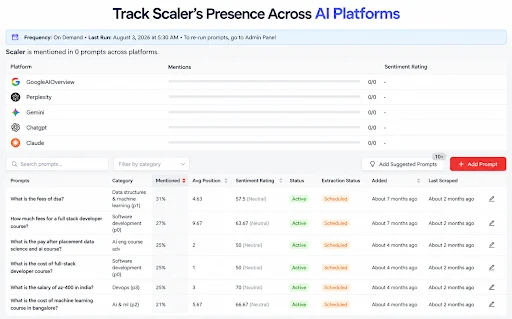
Understanding AI visibility requires moving beyond static keyword tracking. GEO Pulse operates by running hundreds of buyer-intent prompts across major LLMs weekly. By analyzing the output, the platform provides four critical pillars of data:
1. Longitudinal Trend Analysis
Instead of a one-time snapshot, brands receive trend lines tracking their share of voice and mention share against direct competitors. By segmenting data at the category level—such as differentiating between "SIP" and "tax-saving" prompts for a mutual fund—brands can avoid the trap of averaging data into meaningless, high-level figures.
2. Source Attribution and Mapping
The tool maps every cited URL, sorted by competitor and depth of page. If an AI consistently cites specific community forums or trade publications when discussing your sector, the path for PR and content budgets becomes clear. This allows companies to stop guessing where to invest their outreach efforts and instead focus on the platforms that the AI models actually trust.
3. The Accuracy and Compliance Audit
Perhaps the most urgent feature is the accuracy check. AI models are prone to "hallucinations"—pulling outdated pricing, incorrect coverage details, or false eligibility claims. In regulated sectors like finance, insurance, and healthcare, these aren’t just technical glitches; they are regulatory liabilities. With the DPDP Act and evolving consumer protection laws, the "the AI said it" defense is increasingly insufficient. GEO Pulse flags these inaccuracies, allowing brands to remediate their digital footprint before they face legal or reputational blowback.
4. Direct Business Correlation
Data is only valuable if it drives growth. GEO Pulse integrates directly with Search Console and internal analytics to overlay mention share with branded search and direct traffic. By anchoring these insights in first-party data rather than third-party estimates, brands gain proof of ROI that is verifiable and actionable.
The Methodology: Why "One-Off" Runs Are Misleading
One of the most persistent myths in the AI space is that a single prompt run provides a reliable benchmark. However, collaborative research between SparkToro and Gumshoe.ai, involving 2,961 prompts and 600 volunteers, revealed a startling truth: there is less than a 1-in-100 chance that two identical prompts will return the same brand list.
To combat this volatility, GEO Pulse rejects the "one-shot" methodology. Instead, it aggregates results across seven to ten days of repeated runs. This is not mere caution; it is statistical necessity. By averaging results, the tool identifies patterns of citation frequency—the only metric that truly repeats in a chaotic, probabilistic environment.
Furthermore, the prompt list is not built on generic keyword volume, which is often a "guess dressed up as data." Instead, it is curated using the client’s actual voice data: call center queries, support chats, and real-time discussions on platforms like Reddit, Quora, and LinkedIn.
Case Studies: Two Paths to AI Optimization
The strategy required to win in AI search depends entirely on where the "visibility gap" lies. Two recent examples illustrate this divergence:
The Restricted Category: Mental Health
For a mental health provider, paid media was prohibited due to ad-restrictions on AI surfaces. The brand had to rely entirely on organic citations. By placing brand mentions in the community forums and trade publications the AI already trusted, and restructuring site content to be more "extractable" for LLMs, the brand saw a 61% increase in conversions and an 86% rise in AI-surface impressions between January and May 2026. Interestingly, the click-through rate (CTR) fell, suggesting that while fewer users clicked, those who did were higher-intent, better-qualified leads.
The Technical Pivot: Global Technology Consultancy
Conversely, a global consultancy faced a structural problem. Their site architecture prevented AI models from effectively "reading" their expertise. By performing deep technical SEO, cleaning up duplicate pages, and implementing a hub-and-spoke content architecture, the brand saw a 55% increase in AI Overview visibility and a 54% jump in organic traffic within six months.
The lesson is clear: one problem was a "citation placement" issue solved off-site; the other was an "architecture" issue solved on-site. GEO Pulse identifies which of these paths a brand must take.
The Future of the Industry: Why Dashboards Are Not Enough
The landscape of AI visibility is shifting rapidly. On August 31, 2026, Google introduced native AI performance reports within Search Console, providing brands with free, first-party data on their performance in AI Overviews.
This development poses an existential threat to many "AI SEO" tools that simply count citations. When the primary source of truth (Google) provides the data for free and begins to block third-party scrapers, any product whose value proposition is merely "counting mentions" faces a short shelf life.
Moreover, AI visibility is inherently "rented." When a model updates its default version—as seen on August 8, 2026, when ChatGPT’s update caused a massive drop in Reddit and arXiv citations—brands that over-indexed on a single source of truth saw their visibility evaporate overnight.
Implications for Brands: A Strategic Shift
As India solidifies its position as a top-three global market for AI Mode, the need for regional language support is no longer optional. If a brand’s visibility strategy ignores Hindi, Tamil, or Marathi, it is effectively ignoring the majority of its potential audience.
The future of GEO is not in passive monitoring; it is in the "action layer." Modern agencies must provide more than a dashboard. They must offer:
- Model Shift Sensitivity: Real-time reporting on how changes in LLM defaults impact visibility.
- Accuracy Policing: Ensuring the brand narrative remains factual across all AI touchpoints.
- Regional Retrieval: Mastering the nuances of non-English language queries.
- The Action Layer: The actual content, PR, and technical engineering required to force the AI to recommend your brand.
For brands looking to secure their future in an AI-first world, the question is no longer "are we ranking?" It is "when the AI makes a choice, why does it choose us?"
If you want to understand the current state of your category, the process is straightforward: identify ten questions your customers are actually asking, run them through an analytical framework, and observe which sources the models are citing. The answers to those ten questions will dictate your PR, content, and digital strategy for the next quarter. In the era of Generative Engine Optimization, the brand that provides the most reliable, accurate, and accessible data to the model wins the recommendation—and the customer.



