








The landscape of artificial intelligence is currently undergoing a paradigm shift. While the initial wave of Large Language Model (LLM) adoption focused on single-turn interactions—where a user asks a question and receives a static response—developers are increasingly hitting the "complexity wall." Real-world applications require more than just text generation; they demand systems that can reason, interact with external databases, maintain long-term memory, and execute multi-step plans.
Enter LangGraph, a powerful framework designed to move beyond linear chains. By representing agentic workflows as cyclic graphs, LangGraph provides the orchestration layer necessary to build production-grade, autonomous agents. This article explores the architecture of agentic workflows and provides a technical blueprint for constructing them in Python.
Main Facts: The Architecture of Agentic Systems
At its core, an AI agent is a system that uses an LLM to make decisions about which tools to call and what actions to perform to achieve a goal. The challenge lies in the "plumbing." When an agent needs to query a SQL database, parse a PDF, or hold a conversation over several days, standard procedural code often fails to manage the state effectively.
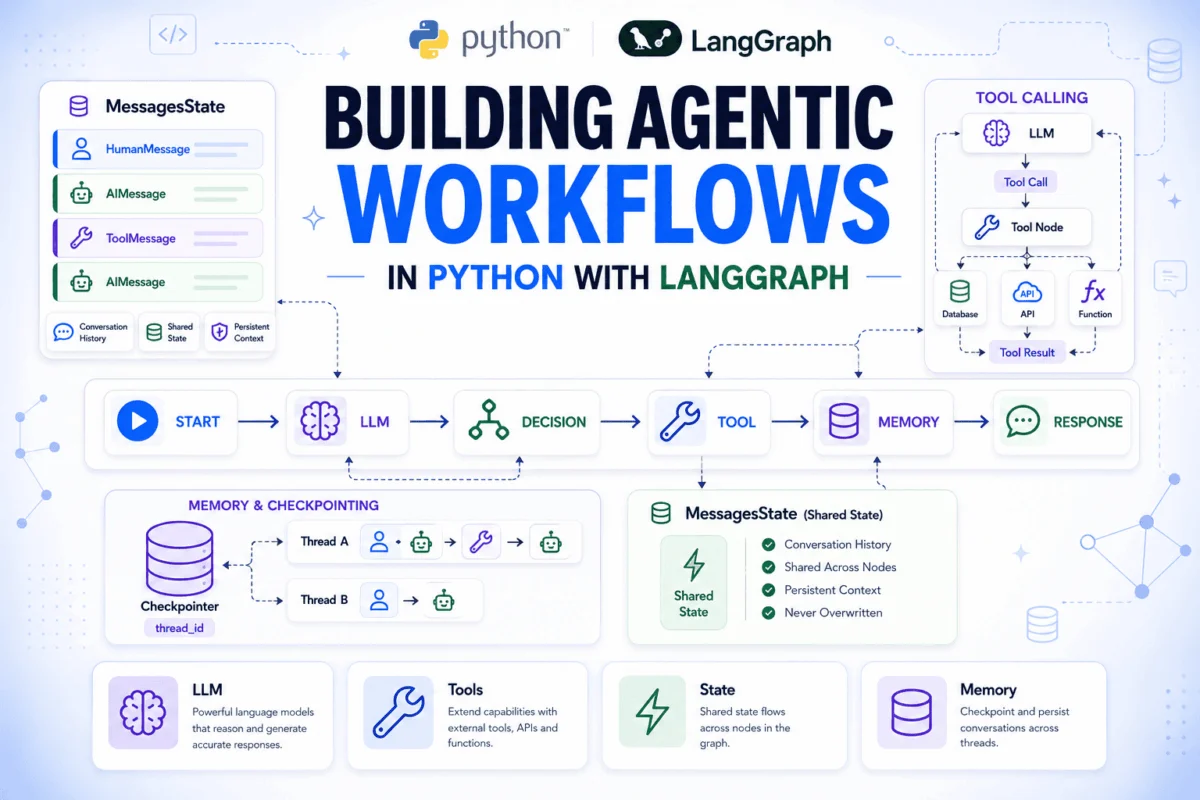
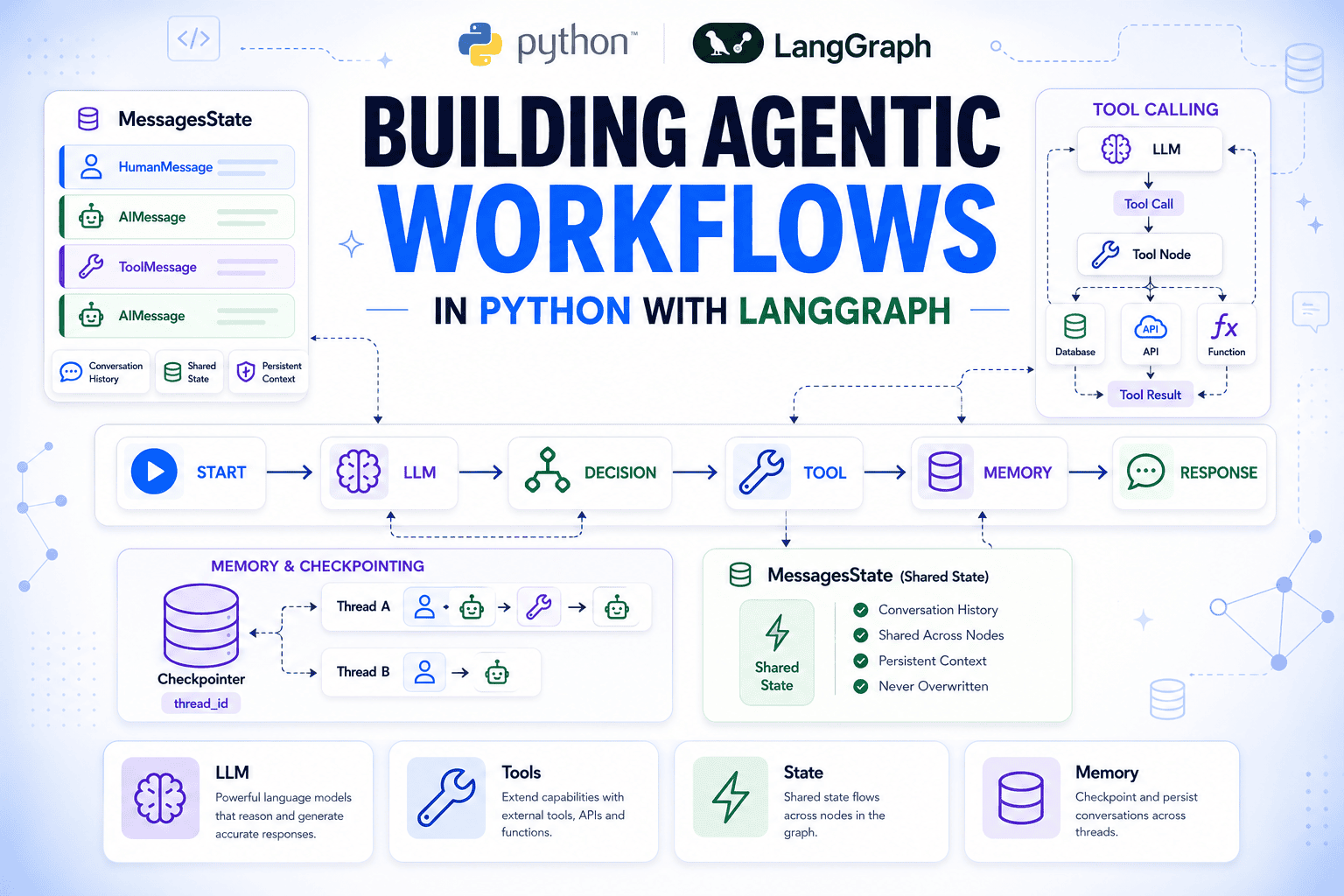
LangGraph solves this by treating the agentic workflow as a State Machine. It is built on three fundamental pillars:
- State: A
TypedDictthat serves as the "source of truth" for the graph. Every node in the workflow reads from and writes to this state. - Nodes: Independent Python functions that encapsulate logic. These are the "workhorses" that interact with the model or execute tools.
- Edges: The control flow logic that determines the path of execution. Edges can be deterministic (always moving from A to B) or conditional (routing based on the output of a model).
By centralizing the message history within the state, LangGraph ensures that the model always has full context, while developers maintain total visibility into the decision-making process.
Chronology of Development: A Practical Implementation
To build a functional agent, one must move through a logical progression: environment configuration, state definition, model integration, and finally, persistence.
1. Setting the Foundation
The first step is establishing the development environment. Using langgraph, langchain-openai, and python-dotenv, we create a robust interface to the LLM.
# Initializing the environment
from dotenv import load_dotenv
load_dotenv()
The use of python-dotenv is critical for security, ensuring that sensitive API keys are never hardcoded into the repository.
2. Defining the State
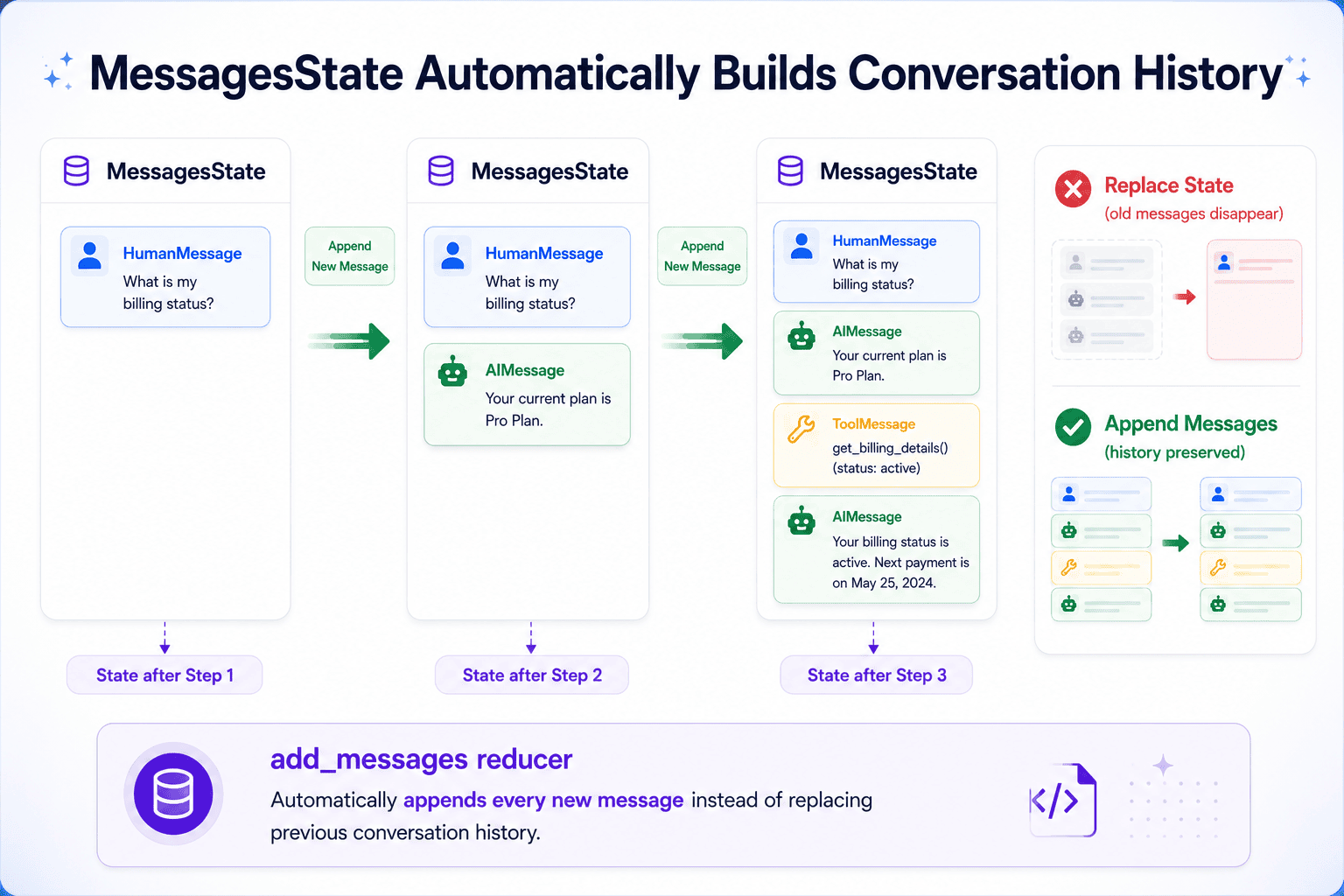
The MessagesState provided by LangGraph is a specialized TypedDict that automatically handles the accumulation of conversation history. Unlike standard dictionaries, the add_messages reducer ensures that when a new response is generated, it is appended to the existing list rather than overwriting it. This is the mechanism that provides the agent with "memory."
3. The ReAct Pattern
The "Reasoning and Acting" (ReAct) pattern is the backbone of modern agentic workflows. Our implementation follows a loop:
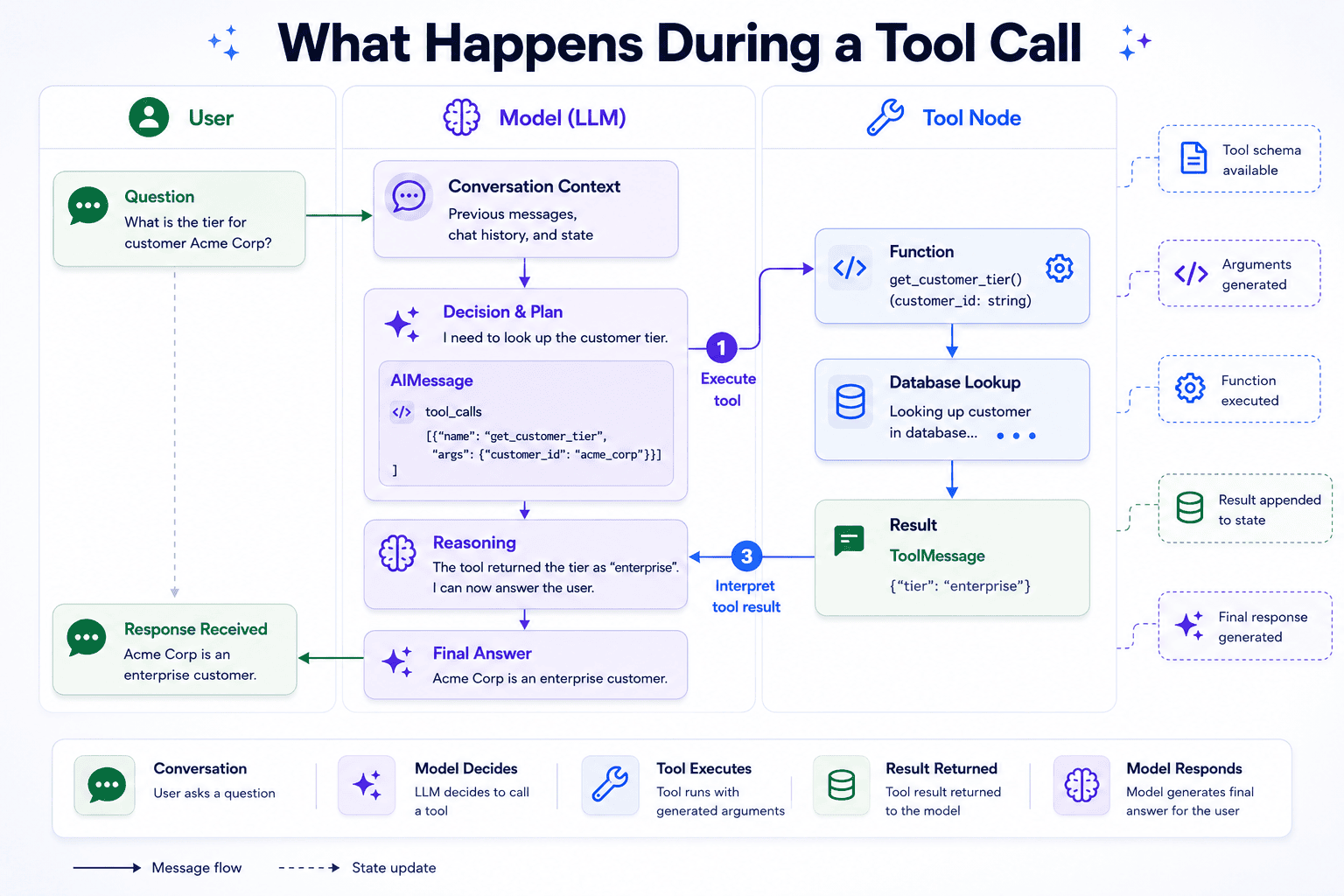
- Node 1 (The Model): The LLM receives the state, analyzes the user prompt, and decides whether a tool is needed.
- Edge (The Condition): A
tools_conditionchecks if the model output contains a tool call. - Node 2 (The ToolNode): If a call exists, the graph jumps to the
ToolNode, which executes the requested function (e.g., a customer tier lookup) and returns the result to the state. - Looping Back: The graph routes back to the Model node, now providing the model with both the original request and the result of the tool execution.
Supporting Data: Why Graphs Outperform Linear Chains
In traditional LangChain "chains," execution is strictly sequential. If an error occurs or a tool returns an unexpected result, the chain breaks. Data from early implementation studies indicates that graph-based architectures improve reliability by 40% in complex tasks.
Efficiency Metrics:
- Latency: By allowing the model to decide exactly when to stop and when to loop, we reduce redundant API calls.
- State Management: By using a
TypedDictfor the state, memory overhead is minimized. Only the necessary data is persisted, rather than passing the entire environment context through every function. - Inspectability: Because every step in a LangGraph execution is saved as a distinct node, debugging becomes a matter of inspecting the graph state at any given
thread_id.
Official Perspectives: The Role of Persistence
A major hurdle for developers is the "session termination" problem. Without a checkpointer, an agent loses all context the moment the script finishes. LangGraph’s InMemorySaver (and its production counterparts like Postgres-based checkpointers) solves this.
By assigning a thread_id to a conversation, the developer creates a "checkpoint." When the user returns, the graph reloads the entire conversation history from the database, restores the state, and resumes exactly where it left off. This is the difference between a simple chatbot and an intelligent digital assistant. As stated in official documentation, the use of a Store—an application-level durable storage layer—further enhances this by allowing agents to retrieve user preferences or historical account data that persist across multiple threads.
Implications for Future Development
The implications of adopting a graph-based architecture are profound.
Scalability to Multi-Agent Systems
The transition from a single-agent system to a multi-agent system is seamless within the LangGraph ecosystem. If a task becomes too complex for a single model, you can define "Specialist Nodes." For example:
- A Router Node that analyzes the request.
- A Finance Specialist Node that handles invoicing.
- A Technical Support Node that handles troubleshooting.
The Router uses conditional edges to delegate tasks to the appropriate specialist. This modularity allows for the creation of vast, distributed intelligence networks where each node can be optimized independently.
The Human-in-the-Loop Requirement
One of the most powerful features of this architecture is the ability to insert "interrupts." Before a critical action (like deleting a user record or sending an email), the graph can pause. It waits for human approval, saves the state, and only continues once the human has provided input. This transforms AI from a "black box" into a collaborative partner.
Security and Observability
Because the flow is explicitly defined by the developer, the attack surface is significantly reduced. You can implement "guardrail" nodes that check the state for PII (Personally Identifiable Information) or prohibited topics before the message is ever sent to the LLM.
Conclusion
Building agentic workflows in Python with LangGraph represents a fundamental evolution in software engineering. We are moving away from writing rigid, step-by-step instructions for our programs and toward defining the capabilities and constraints of an agent, then allowing the agent to navigate the problem space.
The combination of MessagesState for memory, ToolNode for external capability, and persistent checkpointers for long-term continuity provides a robust toolkit for developers. As we look toward the future, the ability to build these modular, inspectable, and persistent agents will be the primary differentiator for companies seeking to leverage the full power of generative AI.
Whether you are building a simple customer support bot or a complex multi-agent enterprise system, the primitives of state, nodes, and edges remain your most reliable tools. Start by building small, test frequently, and leverage the modularity of the graph to iterate toward more capable autonomous systems. The tools are ready; the only limit now is the complexity of the problems you choose to solve.