










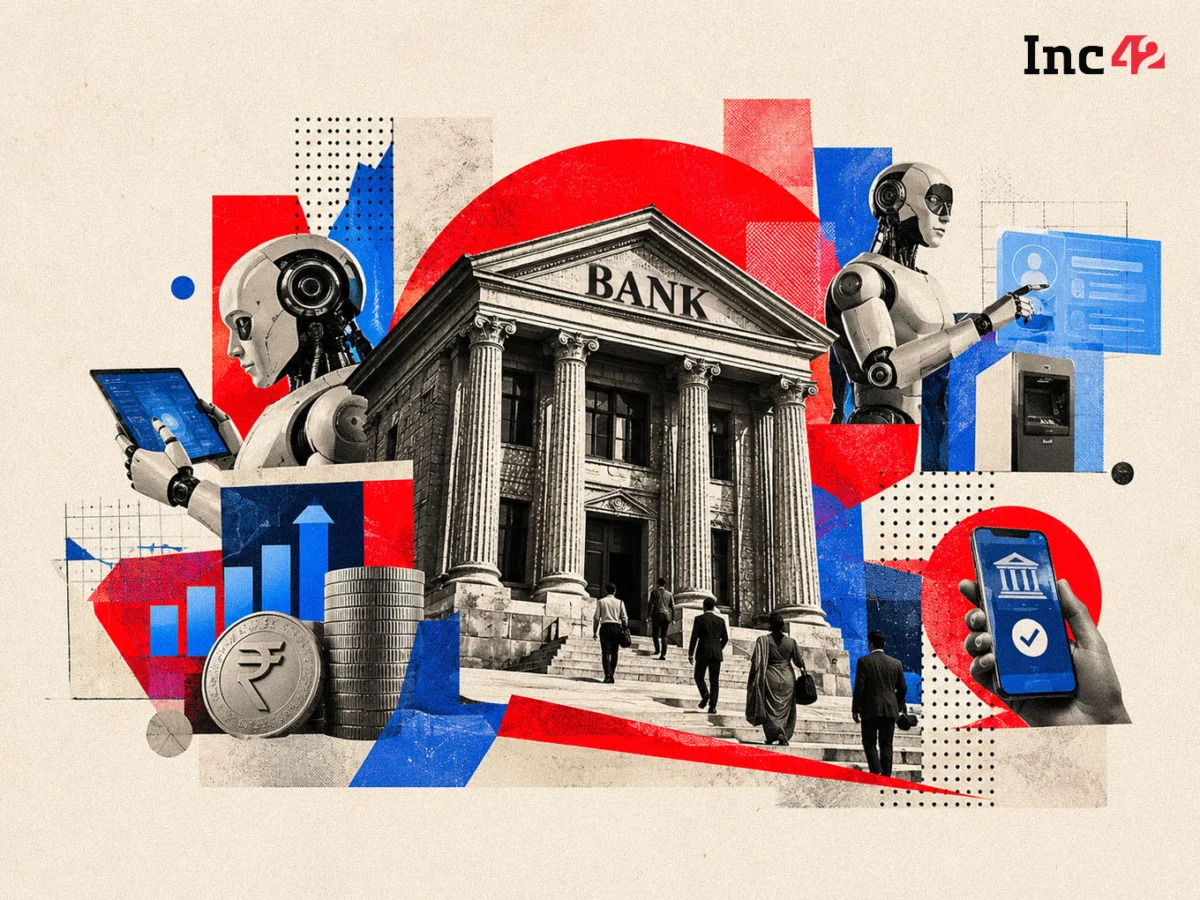
NEW DELHI / GLOBAL FINANCE — The traditional boundaries separating financial institutions from their technology providers are rapidly dissolving. For decades, the relationship between global banking giants and software startups was defined by a straightforward, arm’s-length dynamic: a bank purchased a software license, integrated the tool into its operations, and maintained a strictly vendor-client boundary.
Today, that paradigm is undergoing a structural collapse. Driven by the high-stakes, highly regulated demands of artificial intelligence, the world’s most prominent banking institutions are no longer merely buying software—they are buying equity.
From Wall Street to Tokyo and across India’s burgeoning financial corridors, a new wave of capital deployment is sweeping through the fintech ecosystem. Banks and their corporate venture arms are taking significant equity stakes, co-building foundational models, and embedding themselves directly into the cap tables of early- and growth-stage AI startups.
Main Facts: The Shift from Licensing to Co-Creation
The magnitude of this shift became acutely apparent when US-based financial-services AI startup Rogo closed a $30 Mn funding round. While venture capital backing is standard for high-growth tech firms, Rogo’s cap table welcomed an unprecedented roster: some of the world’s largest banks—including Barclays, BNP Paribas, Citi, MUFG, and Société Générale—joined as equity investors. Today, nine global financial institutions holding nearly $20 Tn in combined assets are stakeholders in Rogo.
This is not an isolated anomaly. According to an Evident AI analysis of the world’s 50 biggest global banks, investments by large banks and their venture arms into AI companies have grown at a compound annual rate (CAGR) of 21% since 2023. In the United States, institutions like Wells Fargo, Citigroup, and Goldman Sachs have emerged as the most active banking investors in the space.
Internationally, this trend is reshaping cross-border investments. Citigroup and Spain’s Banco Santander have taken strategic stakes in Tokyo-based Sakana AI, a firm specializing in foundational models and custom financial-services AI.
In India, this movement is manifesting through aggressive domestic partnerships and equity plays:
- HDFC Bank and Canara Bank (via Canbank Venture Capital Fund) have invested in conversational AI firm CoRover, the creator of BharatGPT.
- IDFC FIRST Bank has forged a landmark R&D partnership with Sarvam AI to build a self-improving banking ecosystem.
- Mahindra Finance, Tata Capital, and SBI Life have integrated Sarvam’s voice AI into core customer-facing operations.
- Bajaj Finance acquired a 5% stake in Delhi NCR-based generative-video startup TrueFan AI under its newly launched ₹1,500–2,000 Cr Finserv Intelligence programme.
Chronology of an Evolution: How the Bank-AI Relationship Changed
To understand how banking institutions moved from cautious technology adopters to aggressive equity stakeholders, one must examine the progression of tech integration in the BFSI (Banking, Financial Services, and Insurance) sector over the past decade:
- Phase 1: Procurement and Digitization (2010s): Banks treated software as a utility. Core banking solutions, mobile apps, and payment gateways were purchased via standard vendor contracts or built by outsourced IT services firms.
- Phase 2: The Fintech Disruption (Late 2010s – Early 2020s): As neobanks and digital-first startups challenged traditional institutions, banks realized internal legacy systems could not innovate fast enough. Corporate venture capital (CVC) arms began making minority investments in fintechs primarily to secure distribution channels and monitor emerging threats.
- Phase 3: The Generative AI Boom (2023 – Present): With the arrival of large language models (LLMs) and advanced machine learning, the technology became too complex and critical for simple licensing. Because AI models require continuous training on proprietary, highly sensitive financial data, standard commercial agreements fell short. Banks realized that to control data security, compliance, and product roadmaps, they needed a seat at the board table.
Supporting Data: The Scale of BFSI AI Adoption
The financial services sector has firmly established itself as the leading enterprise consumer of artificial intelligence. Driven by relentless demands for automated fraud detection, risk management, multilingual customer support, and hyper-personalized financial products, the market dynamics speak for themselves:

- Market Growth: India’s BFSI AI market surpassed $1 Bn in 2025 and is projected by IMARC Group to expand to $9.4 Bn by 2034, registering a staggering CAGR of 26.5%.
- Global Activity: Evident AI data reveals that bank-backed AI venture funding has expanded at a 21% CAGR globally since 2023.
- Headcount Corrections: The operational efficiencies generated by these AI integrations are already visible in institutional balance sheets. Major Indian lenders—including Axis Bank, HDFC Bank, Kotak Mahindra Bank, and ICICI Bank—have reported measurable declines in net headcounts, directly or indirectly tied to automated workflows and productivity enhancements. For instance, Axis Bank reported a reduction of over 3,100 employees in FY26.
Official Responses and Expert Perspectives
Industry leaders and banking executives have been vocal about why equity investments and deep R&D collaborations are replacing traditional vendor-client relationships.
Mukesh Pandey, Founder of Rupyaa Paisa:
"Licensing provides a means to access technology, while investment or co-development may result in a more profound collaboration between a bank and a startup. Co-creation gives the bank an ability to affect product architecture and workflows instead of simply fitting the bank’s processes into a ready-made solution."
Ankush Sabhrawal, Founder and CEO of CoRover:
"The feedback provided by banks becomes useful for determining specific areas where AI needs more accuracy, context, security, and compliance. It is crucial for BharatGPT, as the majority of banking transactions involve multilingual clients and difficult financial terms. The company views the controlled customization as a use of the client’s approved knowledge reference points, algorithms, and mechanisms instead of utilizing proprietary information in a standard solution."
Prasad Lad, Head of Business Intelligence Unit, Axis Bank:
Emphasizing the necessity of external startup partnerships over purely in-house development, Lad noted that Axis Bank actively collaborates with startups across voice AI, document processing, and rapid UI/UX prototyping.
"Startups such as Sarvam bring capabilities, particularly across Indian languages, that would be difficult for a bank to develop internally."
Vijay Narayanan, Head of Innovation and AI, Kotak Mahindra Bank:
Echoing a similar sentiment, Narayanan noted that while core AI workloads are managed internally, the bank routinely leans on specialized startup partners to address niche technological requirements.
Salee S Nair, MD and CEO, Tamil Nadu Small Mercantile Bank:
Addressing concerns over workforce shifts, Nair emphasized that automation is driving internal role transformations rather than mass layoffs:

"We expect 50-60% of our employees to be repurposed into sales and relationship roles over the next two years, with no layoffs as part of this transition, but we continue to hire, especially for specialised technology talent."
Implications: What This Means for the Future of Banking and Startups
The blurring lines between investor, client, and co-developer carry profound implications for both the financial ecosystem and the broader startup economy.
1. For Early-Stage AI Startups: The "Triple Threat" Dilemma
While securing a major bank as an investor, client, and co-developer provides an unmatched runway, proprietary data access, and instant market credibility, it creates an intimidating bottleneck for early-stage founders.
- The Access Gap: Startups that fail to secure bank partnerships or strategic investments may struggle to acquire the high-trust, production-grade data required to train competitive financial models.
- The Power Imbalance: When a startup’s largest client is also its equity holder, pricing negotiations, product roadmaps, and intellectual property rights become deeply complex. Founders may find their strategic independence compromised.
2. For Institutional Governance: The Human-in-the-Loop Imperative
As banks deploy AI deeper into underwriting, credit decisioning, risk assessment, and customer onboarding, operational headcounts are shrinking. Axis Bank CEO Amitabh Chaudhry noted in an interview with Bloomberg that technology investments will allow the bank to expand its business operations without a proportional rise in staff, signaling a prolonged period of slower hiring.
However, historical precedent shows that every major technological leap in banking—from internet and mobile banking to automated clearing houses—has brought teething pains, software bugs, and structural vulnerabilities. Because future banking systems will operate with significantly fewer human intermediaries, human responsibility at the leadership level will magnify exponentially.
When automated systems make critical financial decisions at scale, the buck ultimately stops with the human executives guiding the institution.
Conclusion
The era of treating AI as an off-the-shelf software purchase is officially over. By embedding themselves into startup cap tables and co-creating custom foundational models, banks are ensuring they dictate the architecture of next-generation finance. Yet, as the financial sector marches toward a hyper-automated, AI-first future, the defining challenge for banking leadership will not merely be managing capital and code—it will be defining the precise, irreplaceable role of humans in a system designed to run without them.



