










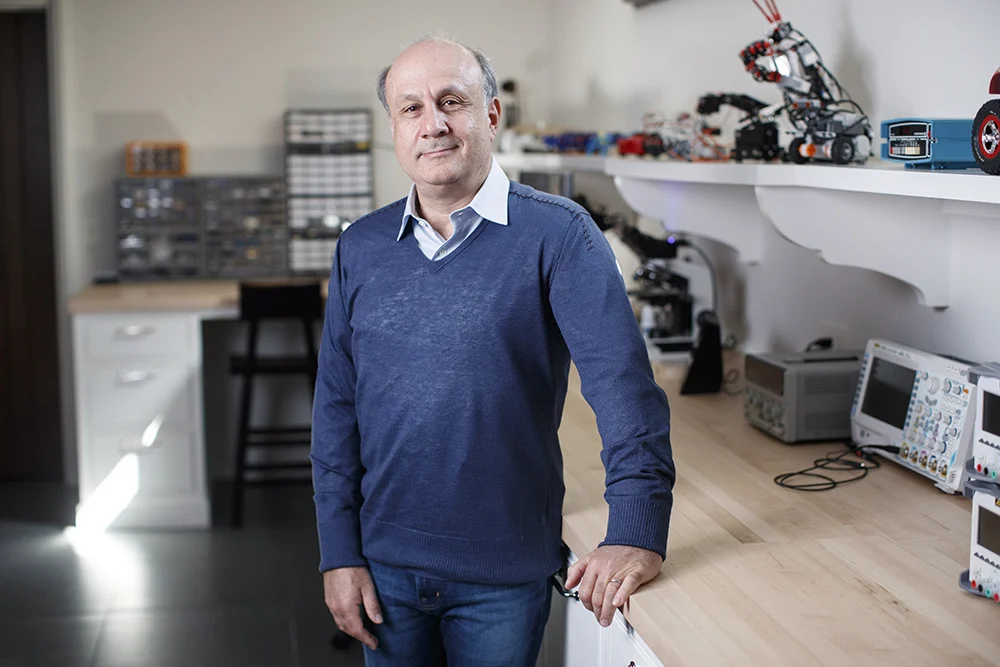
In a move that signals a deepening commitment to the intersection of artificial intelligence and the natural sciences, the Massachusetts Institute of Technology (MIT) has announced that David Siegel—a distinguished computer scientist, pioneering entrepreneur, and philanthropist—will serve as the MIT Innovation Fellow for the 2026-27 academic year.
The fellowship, which brings high-level industry and government leaders into the heart of the Institute, will see Siegel embedded within the MIT Schwarzman College of Computing. His primary mandate: to catalyze the application of artificial intelligence in accelerating the pace of scientific discovery, a goal that represents one of the most complex and promising "engineering challenges" of the modern era.
The Intersection of Intelligence and Discovery
The appointment is more than a formal title; it is a strategic alignment of resources. Siegel, who has long been a pillar of the MIT ecosystem, will work alongside faculty, students, and researchers to identify how the next generation of AI can be deployed to solve intractable scientific problems.
"Using AI to accelerate scientific discovery is the ultimate engineering challenge," Siegel remarked upon the announcement. "There is simply no better launchpad in the world for that work than MIT."
For the MIT Schwarzman College of Computing, the collaboration offers a unique opportunity to bridge the gap between abstract AI theory and practical, high-impact scientific inquiry. The College, which serves as the hub for computer science and AI research at the Institute, is looking to leverage Siegel’s decades of experience in both the private sector and the philanthropic space to ensure that the rapid advancements in large language models and autonomous systems are channeled toward the public good.
A Legacy of Innovation: The Chronology of a Career
David Siegel’s history with MIT is both profound and foundational. His journey began in the mid-1980s, an era when the field of computer science was transforming from a niche academic pursuit into the backbone of global industry.
Academic Foundations (1983–1991)
After completing his undergraduate studies at Princeton University in 1983, Siegel arrived at MIT. He earned his master’s degree in 1986 and his PhD in 1991. During this period, he was deeply involved in the MIT Artificial Intelligence Lab (now the Computer Science and Artificial Intelligence Laboratory, or CSAIL). Working under the mentorship of Professor Tomás Lozano-Pérez, Siegel contributed to groundbreaking research on human-machine interaction, specifically focused on the development of a pioneering humanlike robotic hand. This early work laid the technical groundwork for his later career, fostering an early appreciation for the complexities of "agentic" systems.
The Two Sigma Era (2001–2024)
Following his doctoral studies, Siegel navigated the early internet boom before co-founding Two Sigma in 2001. As a global investment firm, Two Sigma was a pioneer in applying a rigorous data science and engineering lens to finance. By embedding the scientific method into the heart of the firm’s culture, Siegel helped scale an organization that relied heavily on machine learning and quantitative modeling. His retirement from the day-to-day management of the firm in 2024 marked not an exit from the field, but a transition toward his current focus on systemic societal change.
Philanthropy and Public Service (2011–Present)
Parallel to his corporate success, Siegel has built a robust philanthropic footprint. In 2011, he established the Siegel Family Endowment to explore how technological shifts affect society. His commitment to public service deepened further in 2025 with his appointment to the U.S. Department of Energy’s Office of Science Advisory Committee, where he provides counsel on federal research programs.
Supporting Data and Strategic Initiatives
Siegel’s influence on the current AI landscape is supported by several key initiatives that align with his upcoming fellowship goals:
- The MIT Siegel Family Quest for Intelligence: Originally an Institute-wide initiative exploring intelligence in both biological and artificial systems, this project was renamed to honor Siegel’s early and sustained advocacy. It remains a central pillar of his collaborative work with the Institute.
- Open Athena: Recognizing a critical "resource gap" for academic researchers—who often lack the massive computational power available to private tech giants—Siegel founded Open Athena in 2024. The nonprofit provides research labs with elite AI talent and hardware. Its flagship project, "Marin," is a 535-billion-parameter foundation model built entirely in public, designed to ensure that the progress of frontier AI remains a shared global asset.
- Literacy and Education: Through his involvement with the Scratch Foundation, which he co-founded with Professor Mitch Resnick, and his support for organizations like Khan Academy, Siegel has consistently prioritized the democratization of technical education.
Perspectives from Leadership
The appointment has been met with enthusiasm from the highest levels of the MIT administration, who view Siegel as a rare bridge between academic rigor and practical, scalable implementation.
MIT President Sally Kornbluth noted, "From the MIT Schwarzman College of Computing to the MIT Siegel Family Quest for Intelligence, David has been a superb thought partner for me and other Institute leaders. We look forward to working with him now as he helps us identify new opportunities at the intersection of AI and scientific discovery."
Provost Anantha Chandrakasan echoed these sentiments, highlighting the "fit" of the fellowship: "His long-standing commitment to MIT, together with his vision for the future of AI and science, makes him an especially fitting Innovation Fellow."
Dean Dan Huttenlocher of the Schwarzman College of Computing, a longtime peer of Siegel, added, "He understands both the college’s aspirations and the challenges ahead. His perspective will help us identify concrete paths for research, education, and broader engagement."
Implications for the Future: "When Machines Act"
The timing of Siegel’s residency coincides with the publication of his book, When Machines Act: The Promise and Peril of Navigating Our Agentic AI Future, forthcoming from MIT Press in March 2026.
The book is expected to serve as a cornerstone of his fellowship, providing a roadmap for the governance and deployment of autonomous AI systems. Based on years of off-the-record discussions with over 300 CEOs and tech leaders, the text addresses the tension between the immense potential of AI and the risks inherent in its rapid integration into society. By bringing this research into the classroom and the laboratory, Siegel aims to foster a more nuanced understanding of "agentic" AI—systems that not only process information but act upon it.
The Role of the Innovation Fellow
The MIT Innovation Fellow program is designed to be highly interactive. Unlike traditional academic fellowships that focus on solitary research, the Innovation Fellow role is an exercise in institutional agility. Fellows serve as conduits between the Institute and the broader world, utilizing their professional networks to enrich the student experience and provide strategic counsel to the administration.
Past fellows have included a diverse array of leaders:
- Brian Deese: Former director of the White House National Economic Council.
- Virginia M. “Ginny” Rometty: Former CEO of IBM.
- Eric Schmidt: Former executive chair of Alphabet.
- Ash Carter: Former U.S. Secretary of Defense.
These appointments underscore MIT’s desire to keep its research agenda grounded in real-world application. For Siegel, the 2026-27 academic year will represent a homecoming. By returning to the halls where he once built robotic hands, he will now return to help build the frameworks that will define the next generation of scientific research.
As the Institute looks toward the future of the digital age, David Siegel’s residency stands as a testament to the idea that the most profound technological leaps are made when the brightest minds—from the lab, the boardroom, and the public square—are brought together in a singular, collaborative space.



