










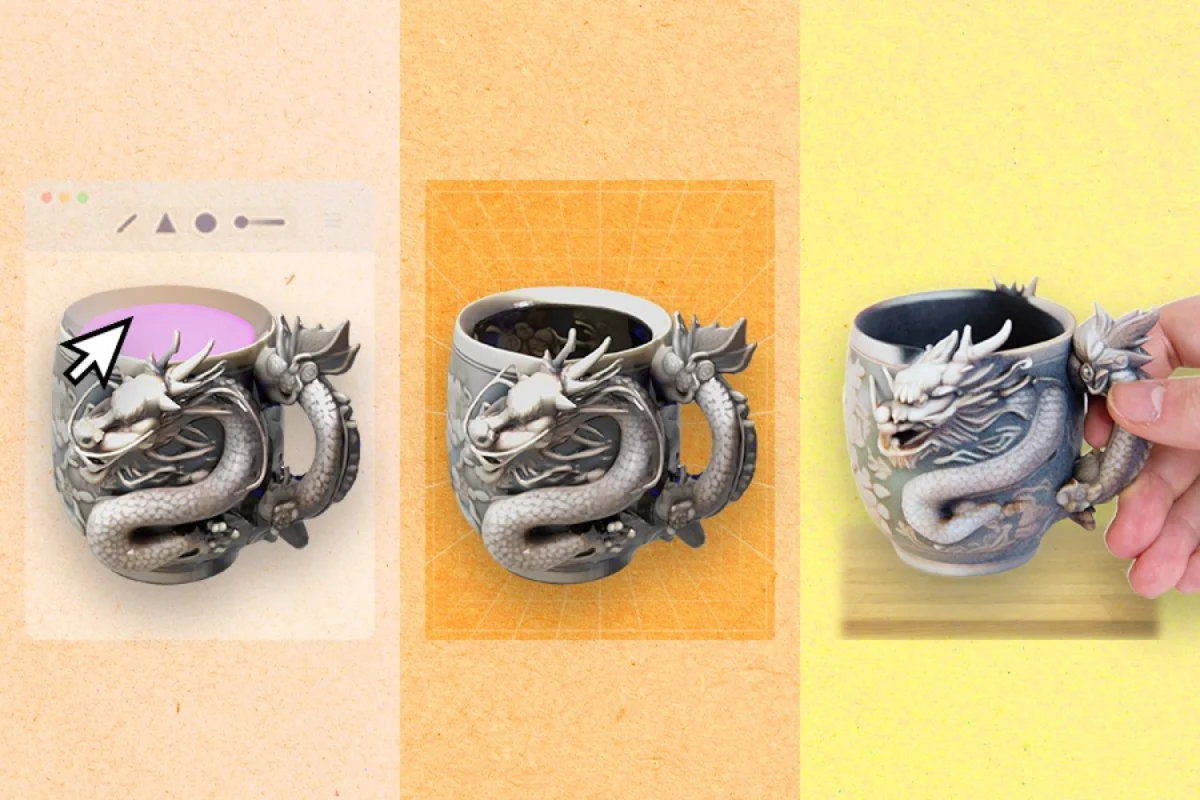
For decades, the "What You See Is What You Get" (WYSIWYG) paradigm has served as the bedrock of digital creation. From word processors to graphic design suites, the promise is simple: the digital representation on your screen should mirror the final output. However, in the burgeoning world of generative artificial intelligence for 3D printing, that promise has largely gone unfulfilled.
If you have ever attempted to use a generative AI model to design a household object—say, a coffee mug—you have likely encountered a frustrating reality: the AI produces a visually stunning, artistically rendered object that is, for all practical purposes, useless. It might lack a bottom, possess a handle that cannot be gripped, or be porous in a way that renders it incapable of holding liquid. The issue is a fundamental cognitive disconnect in AI models: they understand how an object should look, but they lack any comprehension of how an object works.
Enter InstructMesh, a groundbreaking new interface developed through a collaborative effort between MIT’s Computer Science and Artificial Intelligence Laboratory (CSAIL), Google, and Northeastern University. By marrying the structural generative capabilities of 3D modeling with the linguistic reasoning of Large Language Models (LLMs), InstructMesh is effectively solving the "useless object" problem, democratizing 3D design for novices and experts alike.
The Genesis of a Design Revolution: How InstructMesh Works
The core innovation of InstructMesh lies in its hybrid architecture. It creates a synergy between Microsoft’s TRELLIS system—which excels at generating 3D models from text and image prompts—and OpenAI’s GPT-4.
"We wanted to bring together the talents of 3D generators and the reasoning skills of LLMs in an interactive space to make objects that people actually want," explains Faraz Faruqi, the project’s lead author and a researcher whose work spans MIT’s Department of Electrical Engineering and Computer Science and his current tenure at Google.
The workflow is designed to be intuitive. A user provides a prompt, and the system generates a 3D blueprint. If the model contains structural flaws—such as an uneven base or a non-functional joint—the user can simply highlight the specific area and use natural language to instruct the AI to refine it. The system then interprets these textual instructions, adjusts the underlying geometry in the latent space, and presents a revised design for approval.
A Chronology of Development
The path to InstructMesh began with a realization that generative 3D models were "black boxes." Users could not easily edit the output without sophisticated CAD (Computer-Aided Design) skills.
- Initial Research Phase: The team analyzed existing 3D models from platforms like Thingiverse, discovering that nearly 80% of AI-generated designs contained structural flaws.
- Integration Phase: The researchers paired the visual-spatial prowess of TRELLIS with the reasoning engine of GPT-4.
- User Validation Phase: Novice users were introduced to the platform. Remarkably, these participants were able to identify and fix structural flaws in roughly 90% of cases—a success rate validated by expert review.
- Refinement Phase: The addition of manual sliders provided users with a tactile, precise way to tweak dimensions, ensuring that the final output met the "What You See Is What You Get" standard.
From Whimsical Mugs to Functional Robotics
The versatility of InstructMesh is perhaps best demonstrated by the diverse array of objects it has already produced. By moving beyond the constraints of standard geometry, the software allows for a level of creative personalization previously reserved for expert engineers.
Creative Applications
- Artistic Homewares: The team demonstrated a mug enveloped by a dragon, where the creature’s tail serves as a functional, ergonomic handle. Similarly, they created a shell-shaped whistle and butterfly-winged glasses, proving that aesthetic whimsy need not sacrifice functionality.
- Utility and Healthcare: In a practical demonstration of personalized medicine, scientists fabricated a knee brace finished in a denim texture to match a patient’s jeans—a small but significant step toward making medical devices feel like natural accessories.
- Robotics: Perhaps most impressive is the creation of a "bristle bot." The software generated a colorful, shrimp-shaped enclosure that housed a motor and wireless components, allowing the device to skitter across surfaces. This suggests a future where users can design bespoke robotic chassis as easily as they might design a phone case.
Supporting Data: Validating the Novice Experience
The effectiveness of InstructMesh was not left to chance; it was rigorously tested against the limitations of current design software. The researchers focused on the "structural failure" rate of AI-generated models.
By tasking non-experts with the role of "design auditors," the team gathered compelling data. When given the tools to describe problems in plain language—such as "make the base flatter" or "widen the handle for a better grip"—novices bridged the expertise gap.
"The users got what they prompted for and easily tweaked designs where needed," Faruqi notes. "What they saw is what they got, and the items worked as advertised, so to speak." This success demonstrates that the barrier to high-quality 3D printing is not a lack of user creativity, but rather a lack of intuitive, intelligent interfaces.
Official Responses and Expert Perspectives
The project is being led by a team of high-caliber researchers, including senior author Stefanie Mueller, an associate professor at MIT’s EECS and a CSAIL member. The paper represents a diverse cross-section of expertise, featuring contributions from Google researchers Ahmed Katary, Fabian Manhardt, Vrushank Phadnis, Ruofei Du, and Federico Tombari, as well as Northeastern University’s Assistant Professor Megan Hofmann.
The team’s research will be presented in November at the ACM Symposium on User Interface Software and Technology (UIST), a premier venue for human-computer interaction research.
The inclusion of Google researchers in the project hints at the potential commercial trajectory of the technology. As the industry moves toward deeper integration of generative AI in physical hardware, tools like InstructMesh provide the "glue" that connects high-level intent to low-level manufacturing specifications.
Implications: The Future of On-Demand Manufacturing
The implications of InstructMesh extend far beyond printing personalized mugs or novelty robots. We are witnessing the early stages of a shift toward "context-aware manufacturing."
1. The AR Integration
Faruqi’s vision for the future involves integrating InstructMesh into Augmented Reality (AR) platforms. Imagine walking into a room, identifying a need—perhaps a custom-fitted mount for a specific piece of equipment—and having the AI design, test, and prepare the file for printing in real-time. By using the context of the user’s surroundings, the software could create objects that are physically tailored to the environment.
2. Physics-Informed Design
The next frontier for the InstructMesh team is the incorporation of physics simulations. Future iterations of the software could automatically simulate the structural integrity of a design. If a user tries to print a bowl, the system might warn them: "This material is too thin for the weight of the liquid; it will likely fracture." By baking the laws of physics into the generative process, the software moves from being a mere creative assistant to a sophisticated engineering consultant.
3. Democratization of Hardware
For the DIY community, the barriers to entry for 3D printing have always been steep. Mastery of software like Fusion 360 or Blender often requires months, if not years, of study. InstructMesh, by scaffolding the modeling process, effectively lowers these barriers to the level of simple conversation. If you can describe it, you can make it.
Conclusion: A New Era of Physical Creation
As we look toward the potential integration of tools like TRELLIS.2 to refine even finer, more complex features, it is clear that the gap between digital ideation and physical reality is closing. InstructMesh does more than just fix broken 3D models; it changes the nature of our relationship with physical objects.
In a world where we can prompt an AI to design a custom-fit tool or a personalized accessory that is both beautiful and functional, the definition of "home manufacturing" is set for a radical expansion. By aligning the "What You See" with the "What You Get," the MIT CSAIL team has paved the way for a future where our physical environment is as fluid, customizable, and accessible as the digital content we consume every day.



