PARIS — In the wake of a sophisticated cyber-incident that targeted the heartland of France’s retail and supermarket food supply chains, operators across the country have scrambled to secure their infrastructure. Rather than undertaking complex software patching cycles, facility managers have enacted an emergency operational pivot: dragging vulnerable refrigeration control systems offline entirely.
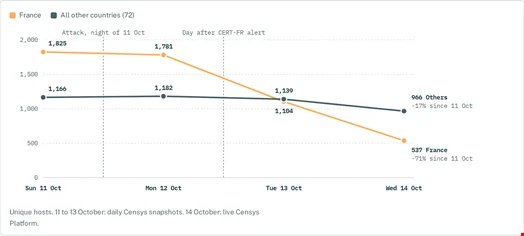
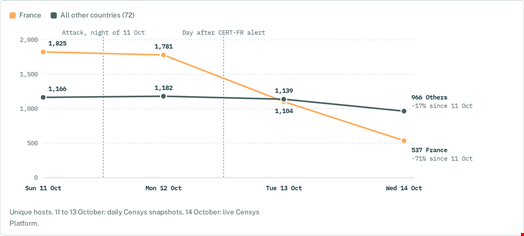
Data released by attack-surface management and internet-scanning firm Censys reveals a staggering 71% drop in internet-exposed Danfoss StoreView refrigeration controllers in France over a mere three-day window following the October 11 cyber-assault. The rapid mass-disconnection highlights both the precarious state of Operational Technology (OT) security in the retail sector and the frantic efforts of system operators to mitigate ongoing threats.
Main Facts: The Anatomy of the Exposure and Attack
The crisis centers on Danfoss StoreView—a widely deployed control panel interface used to monitor and manage industrial refrigeration controllers manufactured by Danfoss, a premier Danish temperature regulation systems provider. These controllers are the invisible backbone of modern grocery retail, regulating the massive industrial fridges and freezers required to maintain the "cold chain" for perishable food supplies.
According to technical advisories and incident reports, the October 11 cyber-attack heavily impacted hundreds of French supermarkets. While the initial access vector has not been formally confirmed by Danfoss or law enforcement, cybersecurity experts have pointed to a glaring vulnerability landscape: many of the targeted units were either legacy hardware models no longer supported with security updates (such as the AK-SM800 and AK-SC355 series) or newer hardware running outdated firmware (such as the AK-SM800A).
The threat landscape surrounding these devices was brought into sharp focus earlier by industrial security researchers, notably from Claroty. Demonstrations showed how critical vulnerabilities—specifically CVE-2025-41450 and CVE-2025-41451, patched by Danfoss in early and mid-2025—could be chained together. Successful exploitation of these flaws grants malicious actors remote code execution (RCE) capabilities. In a worst-case scenario, an attacker could remotely manipulate cooling systems, disable refrigeration units entirely, and deliberately falsify temperature logs. Such capabilities allow malicious actors to silently compromise food safety while masking equipment failures from human operators, spelling disaster for commercial inventory and public health.
Censys’ internet telemetry exposed the immense scale of this exposure. On October 11, the search engine indexed 2,991 internet-exposed hosts globally running Danfoss StoreView control panels. A staggering 61% of these (1,825 instances) were physically located in France, laying bare a massive geographic concentration of vulnerable industrial exposure.
Chronology of Events: From Vulnerability Disclosure to Emergency Shutdowns
To understand how a regional cyber-incident triggered a continental shift in industrial network management, it is vital to trace the timeline of software updates, security research, and the kinetic digital response in October.

- March to August 2025: Danfoss releases a series of critical security patches addressing vulnerabilities within its AK-SM 800A controller series, cataloged under CVE-2025-41450, CVE-2025-41451, and CVE-2025-41452.
- Late 2025 (Post-Patch Window): Security researchers from industrial threat intelligence firms, including Claroty, publicly demonstrate proof-of-concept exploits chaining the unpatched vulnerabilities to achieve unauthorized remote code execution and temperature spoofing. Despite the warnings, mass updates across the global retail sector lag significantly.
- October 11, 2025: A coordinated cyber-incident strikes hundreds of supermarket food supply systems across France. Danfoss StoreView controllers are among the primary equipment categories targeted during the offensive. Censys scanning logs document 2,991 globally exposed hosts, with 1,825 residing in France.
- October 12, 2025 (Day 1 Post-Attack): Realizing the active exploitation of internet-facing systems, French supermarket operators begin scrambling to secure their networks. Censys data shows the number of visible French StoreView control panels drops immediately to 1,781.
- October 14, 2025 (Day 3 Post-Attack): Censys publishes its formal threat intelligence report, titled "Frostbitten in France," documenting an unprecedented 71% decline in exposed French instances in just 72 hours, with the total dropping down to a mere 537 active, internet-reachable control panels.
Supporting Data: Disconnection Over Patching
One of the most revealing analytical takeaways from the Censys telemetry is how operators chose to mitigate the threat. In typical enterprise IT environments, a critical vulnerability triggers an immediate emergency patching cycle. However, the data gathered from the Danfoss StoreView incident tells a starkly different story about Operational Technology (OT) hygiene.
Censys researchers closely monitored the firmware versions of the StoreView instances before and after the October 11 attack. If operators had applied official Danfoss software updates to fix the trio of CVEs, the data would have shown a measurable shift toward newer, secure firmware releases (version 4.3.1 or later).
Instead, telemetry data showed that all categories of StoreView instances—ranging from unpatched legacy systems (older than version 4.2) to intermediate firmware releases (version 4.2.4)—shrank at the exact same proportional rate of roughly 70%.
Censys Telemetry: France Danfoss StoreView Exposure Timeline
--------------------------------------------------------------
October 11:  1,825 exposed hosts (Baseline pre-attack)
October 12:  1,781 exposed hosts (Initial reaction)
October 14:  __537 exposed hosts (71% total drop)
--------------------------------------------------------------
* Note: Proportional drops across all firmware versions indicate
  network isolation rather than systematic software patching.
"Patching would have left a mark in the data: the share of versions 4.3.1 or later would have grown," the Censys researchers noted in their report. "Instead, all categories shrank by roughly the same amount."
Security experts have largely applauded this drastic measure. Censys explicitly emphasized that disconnecting these industrial nodes from the public web is fundamentally the correct operational choice. Industrial control systems (ICS) and building management systems (BMS) possess no functional requirement to maintain direct, unshielded connectivity to the public internet. By yanking the network cables or modifying firewall rules to block external access, operators successfully neutralized the vector for remote exploitation, even if the underlying software vulnerabilities remain unaddressed.
Despite the rapid lockdown in France, global data indicates that risky configurations remain widespread. While France had 74% of its internet-exposed StoreView instances running below the secure version threshold on October 11, other nations exhibited even higher proportions of unpatched exposure:
- Poland: 81% unpatched exposure
- Romania: 80% unpatched exposure
- Belgium: 76% unpatched exposure
- The Netherlands: 62 exposed unpatched hosts
- United States: 58 exposed unpatched hosts
Official Responses and Industry Stakeholder Reactions
Danfoss has responded to the crisis by acknowledging that its temperature regulation hardware was directly targeted in the French retail sector cyber-attacks. In statements to industry media, the company verified that the vast majority of compromised or targeted units consisted of older legacy infrastructure—such as the AK-SM800 and AK-SC355 controllers—which have reached end-of-life status and no longer receive routine security patches. Furthermore, newer models operating on outdated iterations of the AK-SM800A firmware were found to be similarly vulnerable due to deferred maintenance cycles.
The vendor has reiterated its security guidance, urging all commercial clients and system integrators to ensure their industrial assets are isolated behind secure corporate virtual private networks (VPNs), firewalls, and zero-trust architectures rather than being left exposed to wide-area network discovery engines like Censys, Shodan, or Greysan.
Cybersecurity agencies and industrial control system watchdogs have echoed these sentiments, pointing out that the incident serves as a textbook example of the "shadow IT" problem within facilities management. Supermarket refrigeration systems are frequently installed by third-party HVAC and refrigeration contractors who may connect them directly to cellular gateways or broadband routers for remote maintenance convenience, inadvertently exposing mission-critical operational hardware to global threat actors without the knowledge of corporate IT security teams.
Implications: The Intersection of Food Security and Cyber Defense
The coordinated attack on French supermarket refrigeration controllers marks a chilling escalation in the convergence of cyber threats and physical infrastructure. For decades, cybersecurity discussions surrounding critical infrastructure have focused heavily on power grids, water treatment facilities, and oil pipelines. The "cold chain" governing the distribution, storage, and retail sale of perishable food products has historically received secondary attention.
This incident demonstrates that grocery supply chains represent a high-consequence, soft-target vector for malicious actors seeking to cause economic disruption, inventory loss, or public panic. The ability to covertly manipulate refrigeration temperatures introduces severe implications:
- Food Safety and Public Health: Spoiled or temperature-compromised meat, dairy, and produce inadvertently sold to consumers can lead to widespread foodborne illness outbreaks.
- Economic Sabotage: The sudden loss of entire inventory stocks across hundreds of supermarket locations translates to tens of millions of dollars in direct financial losses, supply chain bottlenecks, and brand reputation damage.
- Operational Blindness: When attackers can simultaneously spoof temperature readings while shutting down cooling compressors, facility managers are blinded by false telemetry, stripping them of the situational awareness required to mitigate physical damage before inventory is unsalvageable.
Moving Forward: Securing the Cold Chain
As the retail sector processes the lessons of the October 11 incident, industry analysts argue that emergency disconnections are merely a stopgap measure. While pulling vulnerable devices off the internet successfully prevents remote exploitation, it also cuts off legitimate remote monitoring capabilities required by facilities management teams, potentially delaying physical maintenance responses.
Long-term resilience will require a fundamental shift in how grocery operators and equipment manufacturers approach Operational Technology security:
- Mandatory Network Segmentation: Industrial controllers must never be assigned public IP addresses or connected directly to the internet without robust encryption, multi-factor authentication, and enterprise-grade VPN tunnels.
- Lifecycle Management for OT: Retailers must establish rigorous asset inventories to track legacy OT hardware, ensuring that end-of-life systems are systematically retired or replaced before they become undefendable liabilities.
- Automated Patch Hygiene: Manufacturers must streamline the firmware update process for industrial controllers, making it easier for non-technical facility operators to apply security patches without disrupting vital cooling cycles.
The "Frostbitten in France" incident stands as a stark warning to commercial enterprises worldwide. As attackers increasingly pivot toward vulnerable, internet-exposed OT devices in retail, logistics, and building automation, organizations can no longer afford to treat physical refrigeration units as mere appliances. They are critical digital nodes that demand the same rigorous cybersecurity posture as any corporate database or financial server.