










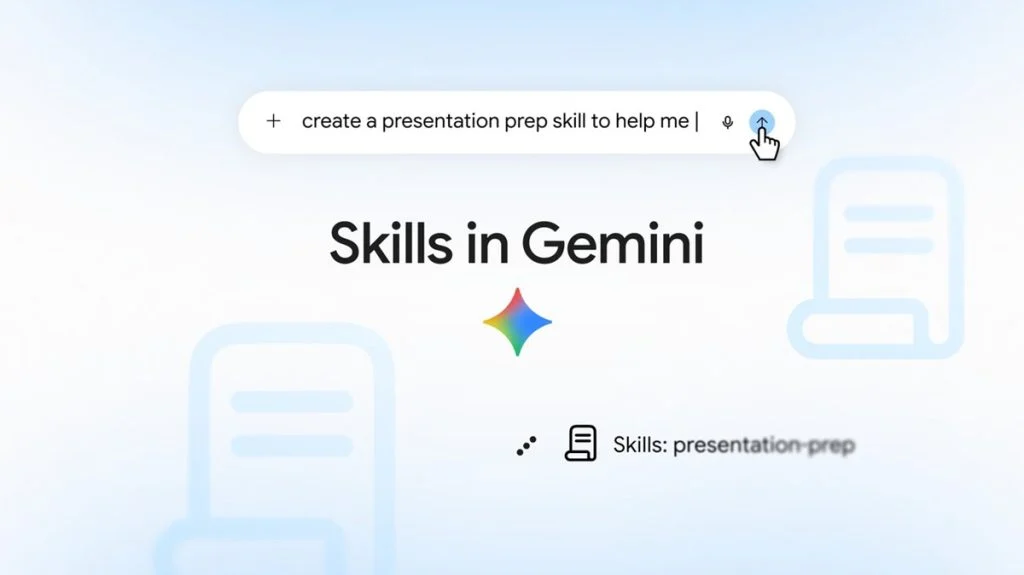
In a significant pivot to streamline generative AI productivity, Google has officially announced the rollout of "Skills" in Gemini. This new feature is designed to replace the existing "Gems" functionality, offering a more robust, integrated, and modular approach to automating repetitive tasks. By allowing users to codify frequently used instructions into reusable workflows, Google is moving Gemini closer to becoming an autonomous personal assistant rather than just a conversational chatbot.
This transition marks a strategic shift for the Mountain View giant as it attempts to solidify its dominance in the workspace productivity sector. As users increasingly rely on AI to handle complex, multi-step processes, the ability to store, stack, and trigger custom workflows has become a critical requirement.
The Core Mechanics: How Gemini Skills Work
At its heart, Gemini Skills is an evolution of prompt engineering. While Gems allowed users to provide a static set of instructions to the AI, Skills introduces a functional interface that feels more akin to coding or macro-creation.
The Forward-Slash Trigger
The most immediate change for power users is the introduction of the "trigger" command. By typing a forward slash (/) followed by the specific skill name directly into the prompt bar, users can instantly invoke a pre-configured set of instructions. This minimizes the need to copy-paste prompts or repeatedly explain tone, style, and formatting requirements to the AI.
Contextual Intelligence and Creation
Gemini is also becoming more proactive. The system can now analyze a user’s existing chat history to identify patterns and suggest custom skills based on recurring prompts. Furthermore, when a user enters a prompt that aligns with an established skill, Gemini can suggest running the task through that pre-configured workflow, ensuring consistency across disparate projects.
Modular Stacking
Perhaps the most powerful feature of Skills is the ability to "stack" multiple workflows. For instance, a user can create a "Corporate Brand Voice" skill and stack it with a "Technical Documentation Structure" skill. When applied simultaneously, Gemini processes the content through both filters, ensuring that the final output adheres to both stylistic preferences and structural requirements. This level of granular control was previously difficult to achieve without complex, multi-stage prompting.
Chronology: The Evolution of Gemini Personalization
The path to "Skills" reflects Google’s rapid experimentation cycle with its AI models.
- Mid-2024: Google introduces "Gems" as a way for users to create custom versions of Gemini with specific instructions, personalities, and goals.
- Late 2025: User feedback indicates that while Gems were helpful for persona-based tasks, they lacked the procedural flexibility needed for enterprise-grade workflow automation.
- October 2026: Google officially announces the deprecation of Gems and the launch of Skills.
- November 2026: The scheduled sunsetting of "Opal," the Google Labs experiment for mini-apps, signaling a consolidation of AI toolsets.
- Late 2026 – Early 2027: The phased migration period where Google automatically transitions existing Gems into the new Skills architecture.
Supporting Data: Why the Shift Matters
The move to Skills is backed by internal data suggesting that power users spend upwards of 30% of their AI-interaction time repeating the same "context-setting" prompts. By automating this, Google aims to reduce latency in productivity.
Integration with Reference Files
Skills are not limited to text-based instructions. Users can now attach reference files—ranging from PDFs and plain-text documents to high-resolution images—to a skill. This allows the AI to "anchor" its outputs to specific data sources, such as a company’s internal style guide, a project’s technical specifications, or a set of historical sales data.
This functionality is set to expand further in the coming weeks, with Google promising integration with Google Drive and Gemini Notebooks. This will allow users to draw live data from their cloud storage, effectively turning Gemini into a dynamic engine that updates its "skills" based on real-time changes in a document or spreadsheet.
Official Responses and Strategic Implications
Google’s communication regarding the transition has been framed as an "upgrade" to the user experience. The company’s blog post emphasizes that the move is intended to reduce "prompt fatigue" and improve the reliability of AI outputs in professional environments.
The Death of Opal
Alongside the transition to Skills, Google has confirmed the termination of Opal, an experimental Google Labs project focused on building standalone AI mini-apps. While some users utilized Opal for specialized niche tasks, Google has determined that the functionality of these mini-apps is better served by the more integrated, ecosystem-wide Skills architecture. It is important to note that unlike Gems, Opal creations will not be migrated into the new system. Users are advised to manually document any logic used in Opal mini-apps before the service is shuttered in November 2026.
Implications for the Enterprise
For enterprise clients, this shift is highly significant. By allowing users to share skills, teams can standardize their AI output. A marketing department, for example, can create a "Social Media Copy" skill that is shared across the entire team, ensuring that every AI-generated post aligns with the company’s brand voice. This creates a "single source of truth" for AI prompting, mitigating the risk of inconsistent AI performance across a workforce.
Analysis: The Future of AI Workflow Automation
The transition to Skills highlights a broader trend in the generative AI landscape: the shift from "chatting with AI" to "orchestrating AI."
The Productivity Paradigm
In the early days of LLMs, the "chat" interface was a novelty. However, as the novelty has worn off, users are demanding tools that function more like software. The ability to save a process, call it up with a shortcut, and feed it live data from Google Drive transforms Gemini from a toy into a legitimate utility.
Competitive Positioning
Google is currently in a fierce race with OpenAI and Microsoft. OpenAI’s "GPTs" and "Actions" serve a similar purpose to Google’s new Skills. By integrating these features directly into the Workspace ecosystem (Docs, Sheets, Drive), Google is leveraging its greatest advantage: the fact that most of the world’s professional data already lives within their cloud infrastructure.
While competitors might offer more powerful model capabilities in isolated sandboxes, Google is betting that the path to victory is through seamless workflow integration. If a user can trigger a complex document-summarization skill that pulls from their private Drive files without leaving the Gemini interface, the stickiness of the Google ecosystem increases exponentially.
Navigating the Transition: A Guide for Users
As the sunsetting of Gems approaches, users should take a proactive approach to managing their AI assets.
- Inventory Your Gems: Review the custom instructions you have currently stored in Gems. Are they still relevant? Does the logic hold up, or could it be improved?
- Monitor Migration: Google has stated that migration will be automatic. However, users should verify the integrity of their instructions once they appear in the new Skills interface.
- Audit Your Labs Experiments: If you are an active user of the Opal experiment, you must export your data immediately. Because Opal projects will not be migrated, failing to do so will result in the permanent loss of your custom mini-app configurations.
- Explore the Help Center: Google has published comprehensive documentation in its help center to guide users through the nuances of the Skills architecture, including how to set up complex stacked workflows and how to manage file permissions for shared skills.
Conclusion
The introduction of Gemini Skills is a clear signal that Google is moving beyond the "experimental" phase of generative AI. By prioritizing repeatability, modularity, and integration, Google is catering to the professional user who requires reliability and efficiency over conversational flair.
While the discontinuation of Gems and Opal may cause temporary friction for power users, the long-term benefits of a unified, high-performance workflow engine are likely to outweigh the short-term inconvenience of migration. As we look toward the end of 2026, it is evident that the future of AI is not just about what the model can say, but what it can do—and how quickly it can do it on behalf of the user.



