










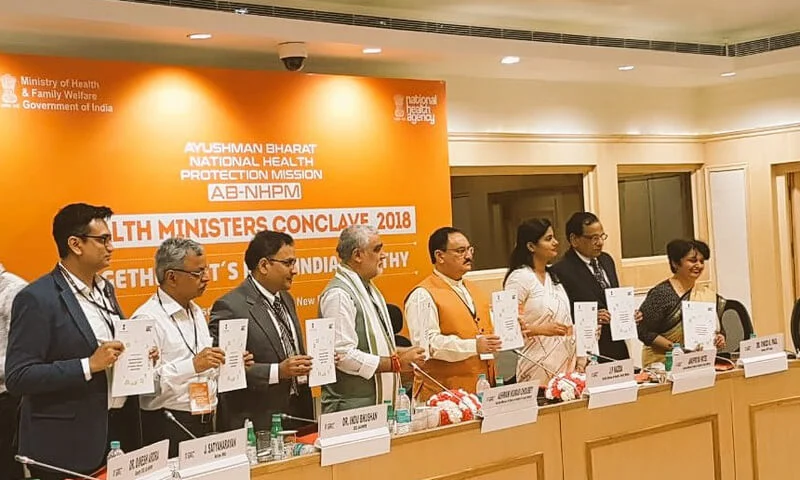
In a swift and significant policy reversal, the Indian government has clarified that the Aadhaar card is "preferable but not a must" for citizens seeking to avail themselves of the benefits under the National Health Protection Scheme (NHPS), now widely known as Ayushman Bharat. This announcement comes merely 24 hours after an official government notification suggested that the biometric identity document would be a mandatory prerequisite for accessing the world’s largest government-funded medical insurance program.
The sudden shift in stance has sparked a nationwide conversation regarding the intersection of digital identity, state-funded welfare, and the constitutional right to healthcare. While the government’s initial directive aimed to streamline the delivery of the Rs. 5 lakh annual health cover for vulnerable families, the subsequent withdrawal of that directive underscores the complexities of implementing a massive, technology-driven social security net in a country with diverse demographic and regional challenges.
Chronology of the Policy Shift
The volatility surrounding the implementation of the NHPS reflects the ongoing tension between administrative convenience and the accessibility of welfare services.
The Initial Mandate
On July 11, 2018, the central government issued a detailed notification asserting that because the funds for the NHPS are drawn from the Consolidated Fund of India, the scheme falls under the statutory purview of the Aadhaar Act, 2016. The notification was prescriptive, stating clearly: “A beneficiary eligible for receiving the benefits under the scheme shall be required to furnish proof of possession of Aadhaar number or undergo Aadhaar authentication.”
The directive further mandated that any individual seeking to benefit from the scheme who was not yet enrolled for Aadhaar must apply for it by March 31, 2019. It established a framework wherein beneficiaries would need to present either an Aadhaar number, an enrolment ID slip, or proof of a request for enrolment to receive medical services.

The Rapid Reversal
By the following day, the government had retracted the rigid stance. Union Health Minister J.P. Nadda stepped in to clarify the administration’s position, stating, “We will provide services to all eligible beneficiaries with or without Aadhaar cards.” This effectively neutralized the mandatory nature of the biometric requirement, signaling that the government would not allow administrative hurdles to impede access to critical life-saving surgeries or medical consultations.
The Role of Alternative Identification
With the relaxation of the mandate, the Ministry of Health and Family Welfare confirmed that alternative government-issued identification cards will be sufficient for verification. Eligible beneficiaries can now produce documents such as a Ration Card, Voter ID, or MGNREGA job card to prove their identity.
This pivot acknowledges the reality that while Aadhaar penetration in India is high, there remains a segment of the population—particularly the marginalized, elderly, or those living in remote, underdeveloped regions—who may face genuine difficulties in securing, updating, or authenticating their Aadhaar credentials. By allowing alternative IDs, the government has ostensibly prioritized the "service-first" approach over the "technology-first" approach.
Analyzing the Government’s Stance and Strategy
The government’s decision to mandate Aadhaar initially was rooted in a desire to curb leakage, prevent fraudulent claims, and ensure that the Rs. 5 lakh insurance cover reaches the intended recipients. By leveraging the Aadhaar database, the government sought to create a unified digital footprint for every beneficiary.
However, the rapid retraction highlights a critical oversight in the initial policy draft. The Ayushman Bharat scheme is intended for the most socially vulnerable sections of society. For these individuals, the requirement to undergo biometric authentication at the point of care, or to secure a physical Aadhaar card by a specific deadline, could potentially lead to the exclusion of the very people the scheme was designed to support.

The "One-Time Access" Provision
Prior to the full reversal, internal documents and tender details had suggested a more nuanced, albeit restrictive, approach. Reports indicated that beneficiaries arriving at hospitals without Aadhaar would be required to sign a declaration of non-possession. They would be permitted to access treatment only once, while simultaneously being provided with a list of the nearest Aadhaar enrolment centers. This "treatment-first, documentation-later" model suggests that the government had always anticipated the friction that the Aadhaar mandate would cause, even if it had not fully communicated this to the public.
Implications for Public Health and Digital Governance
The U-turn on the Aadhaar mandate carries profound implications for how the state manages large-scale social welfare programs.
1. The Balance Between Efficiency and Exclusion
Digital identity systems are designed to enhance transparency and efficiency. However, in the context of healthcare, efficiency cannot come at the cost of inclusion. If a patient in critical condition is denied admission due to a lack of biometric authentication, the administrative efficiency of the scheme becomes a moral failure. The government’s reversal suggests an acknowledgment that the "Right to Health" must take precedence over the "Right to Identify."
2. Administrative Burden on States
The initial notification placed a significant burden on state governments, instructing them to establish Aadhaar enrolment centers and facilitate wide publicity regarding the mandatory nature of the scheme. By walking back the mandate, the government has essentially shifted the focus of the states from "enrolment enforcement" to "service delivery." States are now tasked with ensuring that beneficiaries are aware that, while Aadhaar is preferred, it is not a hurdle to receiving medical care.
3. Trust and Public Perception
The confusion caused by the conflicting notifications highlights the challenges of implementing "Aadhaar-linked" governance. For the average citizen, inconsistent messaging creates anxiety and mistrust. Ensuring that the most vulnerable populations understand that their access to medical care is guaranteed, regardless of their status in the UIDAI database, is vital for the long-term success and adoption of Ayushman Bharat.

Future Outlook: The Path Forward for Ayushman Bharat
As the Ayushman Bharat scheme continues to scale, the government will likely continue to encourage Aadhaar enrollment as a means to simplify the verification process. The convenience of a digital identity in a hospital setting—where time is of the essence—is undeniable. An Aadhaar-linked system can facilitate seamless portability of insurance benefits across different states, allowing a migrant worker from Bihar to access treatment in a hospital in Maharashtra without the need for manual paperwork.
However, the government’s reversal serves as a crucial reminder that technology should act as an enabler rather than a gatekeeper. For future iterations of the scheme, policymakers must ensure that:
- Redundancy is built-in: The system must continue to accept multiple forms of identification to account for lost, damaged, or unlinked documents.
- Support systems are localized: If the government insists on Aadhaar, it must ensure that enrollment centers are co-located with healthcare facilities, as the initial notification suggested, to ensure that the patient’s journey is not interrupted.
- Communication is consistent: Clear, transparent, and non-contradictory communication is essential to prevent panic among beneficiaries.
Conclusion
The government’s decision to retreat from making Aadhaar mandatory for the Ayushman Bharat scheme is a pragmatic move that balances technological ambition with the ground-level realities of public health. While the Aadhaar card remains a powerful tool for streamlining the administration of social welfare, it must not become a barrier to life-saving medical intervention.
By opening the door to alternative identification methods, the government has reaffirmed its commitment to the universal nature of the health scheme. As the nation moves toward a more digitized future, the lesson from this episode is clear: the success of India’s social welfare programs depends not just on the strength of its digital infrastructure, but on the flexibility of its policies to protect the most vulnerable citizens. The focus must now remain on the ultimate goal of the scheme: to provide affordable, accessible, and high-quality healthcare to those who need it most, with or without a digital tag.



