










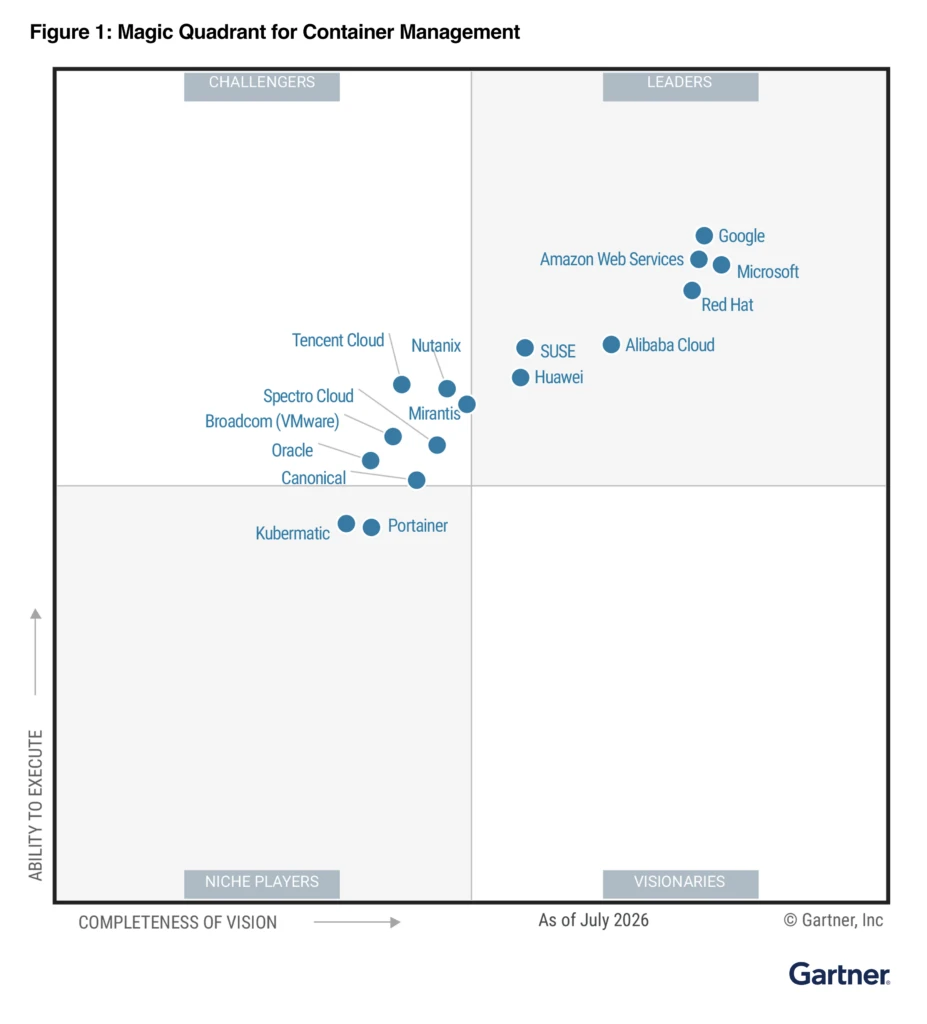
In a significant milestone for enterprise cloud computing, Microsoft has been recognized as a Leader in the 2026 Gartner® Magic Quadrant™ for Container Management. Positioned furthest to the right on the "Completeness of Vision" axis, this acknowledgment underscores Microsoft’s strategic evolution from a cloud-provider to a comprehensive platform-orchestration powerhouse.
As artificial intelligence (AI) workloads transform the technological landscape, the requirements for container orchestration have moved well beyond simple service deployment. Today, enterprises are tasked with managing distributed systems that must span public clouds, private datacenters, and edge environments—all while maintaining strict regulatory sovereignty. Microsoft’s recognition highlights its ability to meet these complex demands, offering a unified operational model that allows businesses to modernize applications without the burden of rebuilding them for every new environment.
The Evolution of Container Orchestration: A Historical Perspective
To understand the weight of this achievement, one must look back at the origins of the Kubernetes ecosystem. A decade ago, the challenge was fundamentally different: the goal was to democratize distributed systems, making reliable service architecture accessible. Microsoft’s early involvement in Kubernetes was rooted in a philosophy of abstraction—describing workloads by their functional requirements rather than their physical location.
This design choice proved prescient. By ensuring the scheduler remained agnostic to the specific nature of the workload, the system gained the flexibility required for the massive influx of AI-driven applications seen today. Kubernetes, originally built to manage simple web services, has now become the backbone of the modern AI revolution. However, the requirements have shifted from simple scheduling to data-local inference and stringent compliance enforcement.
The Dual-Model Paradigm for AI Infrastructure
As organizations integrate AI into their operational stacks, Microsoft has observed a bifurcation in how platforms are utilized. Effective enterprise strategy now relies on balancing two distinct architectural models:
1. The Persistent Serving Layer
In this model, platform teams maintain total control over the infrastructure. This includes GPU scheduling, model lifecycle management, and the compliance boundaries that satisfy legal and regulatory requirements. For large-scale, predictable enterprise operations, this "platform-as-a-service" approach ensures that application teams can consume infrastructure safely while platform engineers retain governance. Tools such as the AI toolchain operator on Azure Kubernetes Service (AKS) allow for automated model deployment, and the CNCF AI Conformance certification provides the necessary assurance that the ecosystem remains stable and interoperable.
2. The Elastic Agentic Model
Conversely, many modern applications require on-demand, transient capacity. In this scenario, an agent invokes inference, executes generated code, and immediately releases resources upon completion. This model prioritizes extreme elasticity and isolation. Azure Container Apps was specifically architected to handle this "bursty" workload, offering serverless GPU capabilities and hardware-isolated sandboxes that ensure security without requiring developers to manage the underlying Kubernetes complexity.
The "holy grail" for modern enterprise engineering is creating a seamless bridge between these two models. Microsoft’s vision is to provide a consistent identity, network control, and policy framework that functions identically whether a team is operating a long-running production model or a transient, serverless agent.
Bridging the Gap: The Role of Azure’s Portfolio
Microsoft’s container portfolio—centered on AKS, Azure Container Apps, Azure Arc, and Azure Kubernetes Fleet Manager—is designed to eliminate the friction that typically arises as a digital estate expands.
Maintaining Sovereignty at the Edge
As AI inference moves closer to the user to reduce latency and satisfy data residency laws, the infrastructure is no longer centralized. This decentralization often leads to "coordination failures," where configuration drift, uneven upgrades, and policy inconsistencies emerge across geographically dispersed clusters.
To combat this, Microsoft has introduced "AKS Everywhere," a strategy designed to extend the Azure-built and secured Kubernetes platform from the heart of the cloud to the remote edge. By leveraging Azure Arc, organizations can apply a common policy, identity, and observability model across heterogeneous environments—including clusters running on competing clouds.
Managing Scale with Fleet Manager
As cluster counts grow, the operational burden often outpaces the size of the IT team. Azure Kubernetes Fleet Manager serves as the central nervous system for these growing estates, providing a single pane of glass for managing upgrades, workload placement, and policy enforcement across a fleet of clusters, rather than treating each as an isolated silo.

Crucially, Microsoft’s strategy remains firmly grounded in open-source collaboration. By serving as the largest contributor among cloud providers to CNCF projects over the past three years, Microsoft ensures that the Kubernetes API remains stable and non-proprietary. This commitment to the upstream community ensures that the "Azure experience" remains compatible with the wider ecosystem, preventing vendor lock-in.
The Future of Operations: Agentic Management
The next frontier in container management is the transition from manual, alert-based operations to "agentic operations." As the complexity of modern estates increases, human intervention cannot scale linearly with the number of clusters.
Microsoft is pioneering this transition through the Azure SRE Agent and the AKS MCP Server. These tools are designed to move beyond passive monitoring, enabling automated diagnosis and remediation of operational issues. The objective is not to replace human operators, but to liberate them from routine, time-consuming diagnostic work, allowing them to focus on high-value architecture and innovation.
Industry Momentum and Customer Impact
The effectiveness of this platform-first approach is reflected in the diverse range of industries currently deploying Azure’s container services. Whether it is a training cluster housing thousands of GPUs for deep learning, or a regulated SaaS platform requiring rigorous multi-tenancy, the unifying factor is the need for an architecture that can evolve.
Brian Sutliffe, Vice President of Engineering at CallRevu, emphasizes the operational necessity of this flexibility: "Azure Kubernetes Service gives us the control and cost efficiency we need. We can scale GPU resources based on call volume and test new models without touching production."
Implications for the Enterprise
The recognition by Gartner serves as more than a badge of honor; it signals a shift in what enterprises should expect from their cloud partners. In an era where AI is the primary driver of technological change, the platform is no longer a passive utility—it is a competitive differentiator.
For the CIO and the platform engineer, the implications are clear:
- Consistency is Key: Enterprises must demand an operating model that persists across cloud, on-premises, and edge environments.
- Open Standards Prevent Stagnation: Relying on proprietary forks of Kubernetes limits future flexibility. Microsoft’s emphasis on open-source conformance is a hedge against future technical debt.
- Automation is Mandatory: As estates grow, manual intervention becomes the primary bottleneck. Investing in agentic operations and automated policy enforcement is essential for survival in the coming years.
Microsoft’s position as a Leader in the 2026 Gartner Magic Quadrant reflects a clear understanding that the modern container platform must be an "absorptive" entity—one capable of taking in new requirements, new AI models, and new hardware configurations without forcing the organization to hit the "reset" button on its application architecture.
As the industry looks toward the next five years, the focus will undoubtedly remain on reducing the "operational surface area" while increasing the capability of the platform. For now, Microsoft’s approach—uniting open-source reliability with the scale of Azure—provides a blueprint for organizations aiming to thrive in an increasingly complex and distributed digital world.
Gartner® Magic Quadrant™ for Container Management, Dennis Smith, Tony Iams, Wataru Katsurashima, Lucas Albuquerque, 2 September 2026.
Disclaimer: Gartner does not endorse any company, vendor, product, or service depicted in its research publications, and does not advise technology users to select only those vendors with the highest ratings. Gartner research publications consist of the opinions of Gartner’s research organization and should not be construed as statements of fact. Gartner disclaims all warranties, expressed or implied, with respect to this research, including any warranties of merchantability or fitness for a particular purpose.



