










SAN FRANCISCO — If you work in product management or software engineering today, the scenario is likely all too familiar. A stakeholder forwards a viral social media post, a flashy vendor demo, or an executive-level newsletter, and suddenly your meticulously planned product roadmap is upended. Suddenly, the team is told, the roadmap needs an agent, a Model Context Protocol (MCP) application, or a complex orchestration harness.
Across tech hubs and corporate boardrooms, client meetings follow a strikingly predictable script. They almost always begin with a definitive declaration: “We need an AI agent for this.” Yet, after product architects and engineers decompose the request from first principles, a very different reality emerges. More often than not, the client actually requires something entirely mundane—and far more practical: a custom predictive model, a more efficient deployment of the large language models (LLMs) they already possess, or, in many cases, no AI at all.
Inevitably, someone in the room has to step up and say, "Not so fast," while managing the delicate task of not sounding defensive or close-minded.
Doing so is far from easy. The corporate conversation surrounding artificial intelligence is loud, urgent, and relentlessly convincing. To help engineering leaders, product managers, and technology executives maintain their composure and strategic focus, industry veterans are advocating for a structured framework to stay grounded amidst the relentless wave of technological hype.
Chronology of an AI Mandate: From Boardroom Panic to Roadmap Pivot
The trajectory of how artificial intelligence enters an enterprise organization has followed a rapid, volatile evolution over the past several years, shifting from exploratory research to a top-down mandate.
- Late 2022 to 2023 (The Discovery Phase): Following the public release of generative AI models, organizations rushed to experiment. Early pilots focused on low-risk productivity boosters, such as automated summarization and basic chatbot interfaces. Decisions were largely driven by innovation teams and proof-of-concept budgets.
- 2024 (The FOMO Wave): As venture capital and enterprise spending accelerated, fear of missing out (FOMO) gripped executive suites. Budgets shifted from exploratory innovation to strategic imperatives. Boardrooms began demanding enterprise-wide AI strategies, often without a clear definition of the business problems these tools were meant to solve.
- 2025 to Present (The Accountability Reckoning): Organizations entered a phase of harsh economic reality. With widespread deployment came sobering metrics. Surveys from major research institutions highlighted an alarming discrepancy between capital deployed and tangible profitability, forcing product teams to pivot from chasing hype to demanding measurable return on investment (ROI).
Understanding Your Place in the AI Value Chain
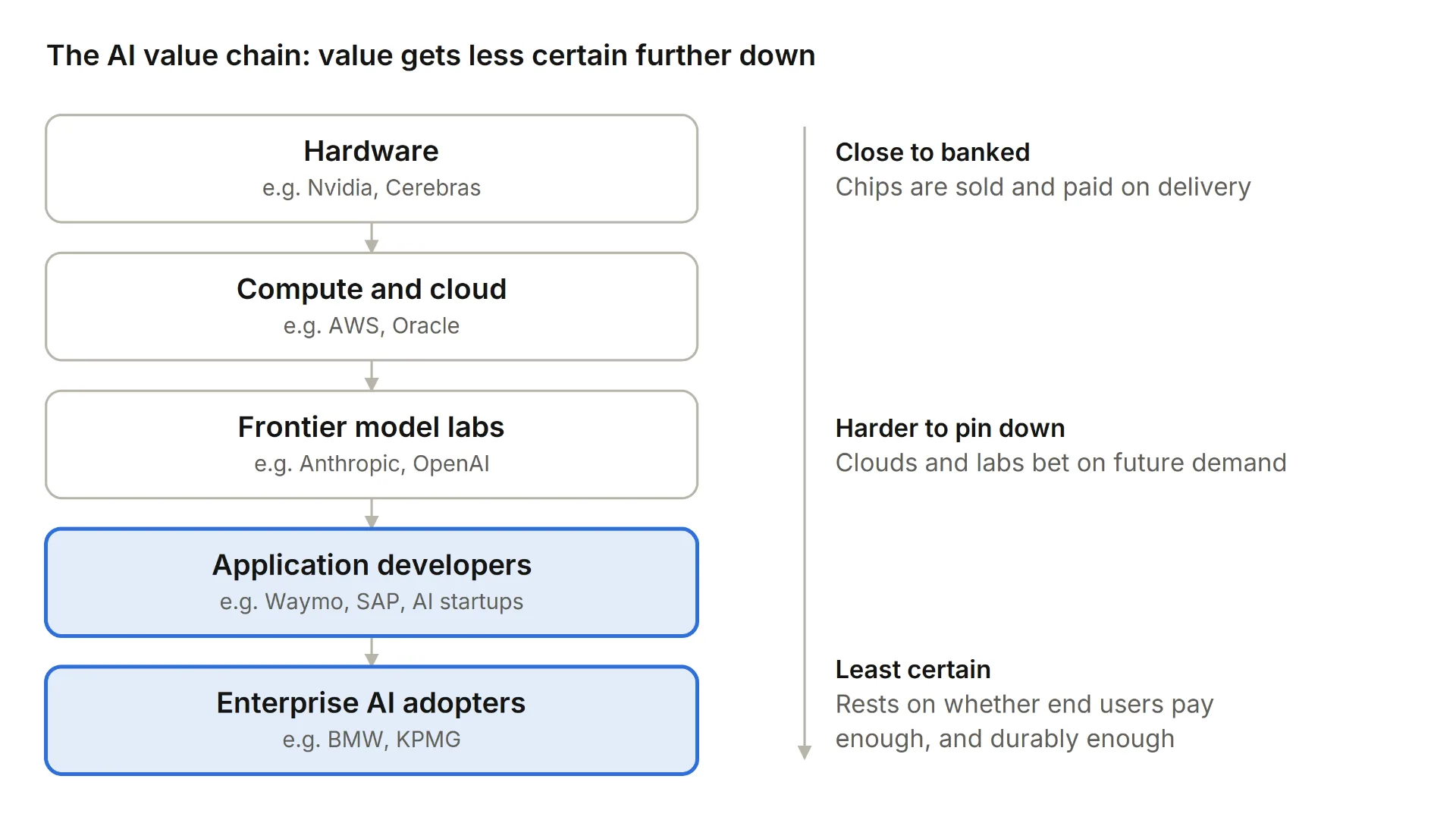
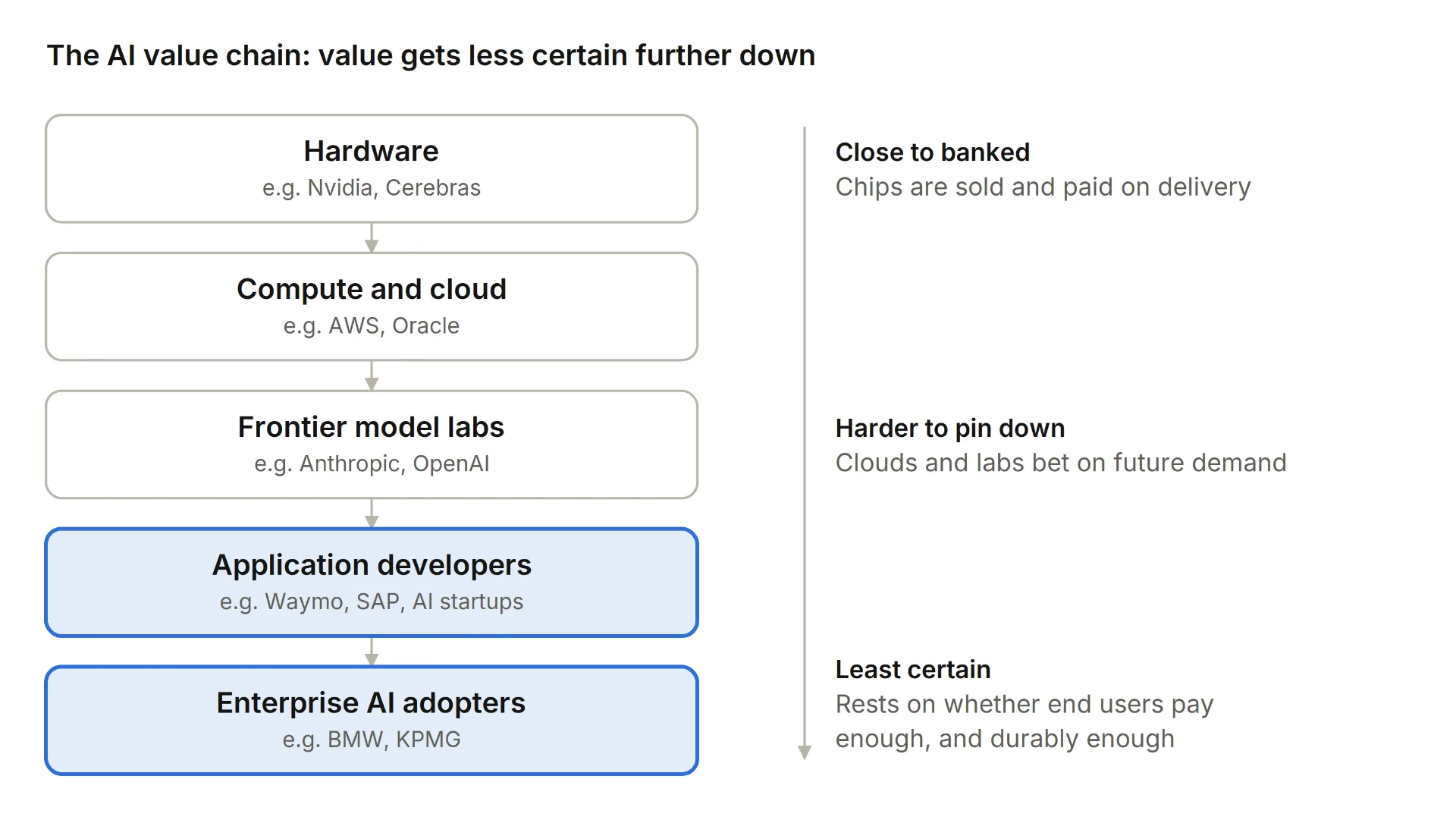
Before any product or technical leader can objectively judge an AI vendor’s claim, they must first understand where their organization sits within the broader AI ecosystem. The global AI value chain can be modeled across five distinct layers, moving from physical infrastructure to end-user application:
- Silicon & Hardware: The top layer, dominated by chipmakers and semiconductor fabricators. Returns here are largely realized; the hardware is manufactured, sold, and paid for upfront upon delivery.
- Cloud Infrastructure: Hyperscalers providing the massive compute power required to train and host frontier models.
- Model Labs: The organizations creating foundational LLMs and multi-modal neural networks.
- Tooling & Orchestration: Platforms offering agent management, vector databases, integration harnesses, and developer frameworks.
- Enterprise Adopters & End Users: The companies at the base of the pyramid attempting to put AI to work to solve actual business problems.
The Dynamics of Circular Capital
As you move down the value chain from silicon to end-users, financial returns become increasingly speculative. Much of the reported "demand" for AI infrastructure is, in reality, a closed loop of circulating capital within the ecosystem. Chipmakers fund AI labs; model labs commit their budgets to cloud providers; and cloud providers turn around to purchase more specialized chips.
Real, organic end-user demand is only truly tested at the very bottom of the chain—where enterprise adopters attempt to monetize these technologies.
For the enterprise consumer, the odds are frequently stacked against success. Because the ecosystem is engineered to maximize consumption at the top layers, buyers often face aggressive vendor lock-in, inflated performance benchmarks, and a lack of standardized metrics for success. Consequently, the "last mile" of AI integration—translating raw model capabilities into reliable, profitable enterprise software—remains largely unpaved.
Supporting Data: The Reality Gap in Enterprise AI
The empirical data gathered throughout 2025 and 2026 paints a stark picture of enterprise AI adoption, revealing a profound gap between marketing promises and operational outcomes.

- The Profitability Gap: According to McKinsey’s comprehensive 2025 global survey on the state of AI, more than 80% of companies utilizing generative AI reported that they had not yet seen a clear, measurable impact on their overall bottom-line profits.
- High Project Failure Rates: Research published by the RAND Corporation indicates that AI project failure rates exceed 80%. While this figure encompasses projects that stall before ever reaching full production, it underscores the immense technical and organizational friction involved in operationalizing machine learning systems.
- The Measurement Void: Dataiku’s 2026 CIO survey revealed a systemic issue within enterprise governance: a vast majority of deploying companies still lack reliable, standardized methodologies to measure whether AI integrations genuinely improve business results, leaving feedback loops permanently open and unverified.
Official Perspectives and Industry Insights
Industry analysts, CIOs, and enterprise architects are increasingly speaking out against the unbridled optimism promoted by software vendors. The consensus among pragmatic technologists is not that artificial intelligence lacks utility, but rather that its application must be governed by rigorous engineering standards rather than executive panic.
"When executives ask for an AI agent, they are usually expressing a desire for automation, speed, or reduced operational friction," notes one enterprise product consultant. "Our job is to separate the underlying business goal from the prescribed technical implementation. More often than not, a well-structured relational database query or a traditional script will solve the problem faster, cheaper, and with zero hallucination risk."
Furthermore, enterprise leaders are beginning to scrutinize the marketing playbooks of high-profile tech firms. Observers point to the contrast between companies that rely on heavy outbound sales and aggressive "AI washing"—marketing traditional software under the guise of revolutionary autonomous intelligence—versus those whose products experience organic adoption due to immediate, verifiable utility.
Implications for Product Teams and Technical Leadership
For organizations striving to remain competitive without falling victim to costly technological misadventures, building internal judgment is paramount. Experts recommend three core disciplines to fortify teams against the hype cycle:
1. Build a Foundational Knowledge Base
Subjectivity and emotional appeals—fueled by FOMO, urgency, and hyperbolic media headlines—routinely exploit cognitive blind spots. To strip away this emotional layer, product teams must master the fundamental mechanics, limitations, and failure modes of machine learning models. Without a rigorous baseline of technical literacy, an organization builds a metaphorical house of cards, where every new vendor claim acts as an unverified card propping up the next.

2. Consume Information with Intentionality
When evaluating new AI frameworks, tools, or research papers, leaders must invert the traditional consumption model and ask: Who benefits from this narrative? Recognizing the commercial incentives behind white papers, surveys, and case studies allows technical leaders to extract useful empirical data while discounting self-serving conclusions.
3. Implement a Rigorous Concept Filter
Before allocating engineering hours to a newly hyped architectural pattern—such as autonomous agents or complex orchestration frameworks—teams should subject the idea to a stringent evidentiary filter. Does the concept solve a validated, high-friction user problem? Can its performance be measured objectively? Is there a simpler, non-AI solution that achieves 80% of the result with 20% of the complexity?
Conclusion: Pushing Back Without Being Anti-AI
Pushing back against an uncritical AI roadmap does not mean adopting a cynical or anti-innovation stance. Rather, it requires establishing a rational decision-making framework that holds up regardless of market bubbles or paradigm shifts.
By understanding their precise position in the AI value chain, building unshakeable technical fundamentals, and evaluating vendor claims through a lens of strict empirical evidence, product leaders can transform themselves from passive consumers of hype into strategic, clear-eyed partners.
The next time a viral demo lands on your desk, the objective response is simple: decode the claim, demand the underlying data, and focus relentlessly on delivering verified value to your users.



