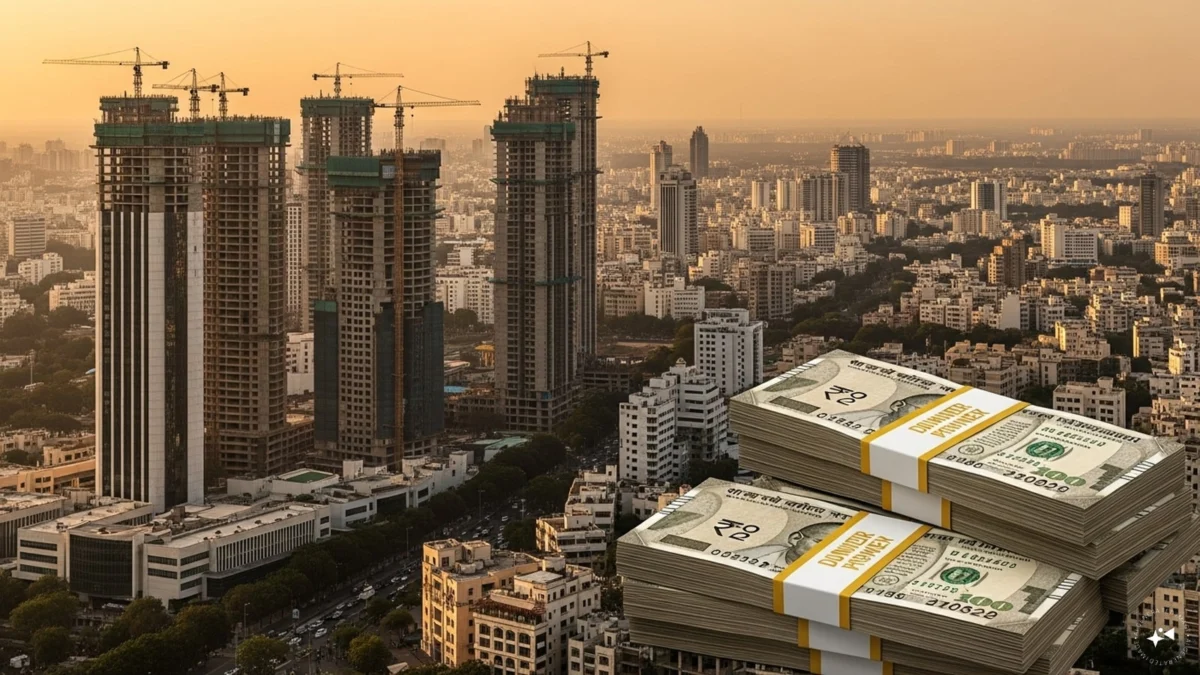
NEW DELHI — India’s commercial real estate landscape is experiencing a fascinating dichotomy. While net absorption, or net leasing of office spaces, registered a 20% year-on-year decline across the country’s eight major metropolitan areas during the first nine months of the year, gross leasing activity hit an all-time high. According to comprehensive data released on Saturday by prominent real estate consultant Cushman & Wakefield, net office leasing slumped to 36.7 million square feet between January and September, down from 46 million square feet during the corresponding period of the previous year.
Industry analysts attribute this contraction primarily to a high base effect from a phenomenal preceding year and a constrained availability of quality, ready-to-occupy workspaces during the first half of the year. However, underlying market fundamentals remain extraordinarily robust. Gross leasing—a broader metric that encapsulates all leasing transactions, including fresh absorption, open market renewals by corporate occupiers, and pre-commitments—grew by 1% to scale a record-breaking 64.6 million square feet.
The divergence between net and gross leasing figures highlights a mature, rapidly evolving commercial property market where corporate occupiers are actively restructuring portfolios, locking in spaces ahead of time, and expanding their footprints despite localized supply crunches.
1. Main Facts: Decoding the Numbers
To fully grasp the current trajectory of India’s office market, it is essential to distinguish between the two primary metrics utilized by real estate consultants: net absorption (net leasing) and gross leasing.
- Net Absorption (Net Leasing): This measures the net change in physically occupied office space within a defined market over a specific period, accounting for both move-ins and move-outs. For the January–September period, net leasing across the top eight cities dropped by 20% to 36.7 million square feet, compared to 46 million square feet in the same period last year.
- Gross Leasing Volume: This encompasses all leasing transactions completed during a period, including fresh space take-up, renewals of existing leases by occupiers, and pre-commitments for under-construction properties. Gross leasing rose by 1% year-on-year to touch a historic high of 64.6 million square feet for the first nine months.
- Geographic Divergence: The cooling off in net leasing was heavily concentrated in five major economic hubs—Mumbai, Delhi-NCR, Pune, Chennai, and Kolkata. Conversely, three key cities bucked the national trend to register significant growth: Bengaluru, Hyderabad, and Ahmedabad.
- Third-Quarter Performance: Highlighting the resilience of occupier demand, net absorption during the third quarter alone stood at a healthy 14.1 million square feet, supported by a notable acceleration in office completions during the July–September period.
2. Chronology of Market Dynamics: From a Record High Base to Supply Squeezes
The narrative of India’s commercial real estate market over the past two years can be broken down into distinct chronological phases characterized by surging demand, subsequent supply shortages, and a strategic pivot by corporate real estate planners.
The 2025 Benchmark and High Base Effect
Throughout the previous year, India’s commercial real estate sector witnessed an unprecedented post-pandemic resurgence. Buoyed by rapid corporate expansions and the aggressive scaling up of Global Capability Centres (GCCs), net leasing figures soared to record heights. This established a exceptionally high statistical base for 2026. Consequently, even as absolute leasing volumes remained remarkably strong by historical standards, year-on-year growth comparisons faced a stiff challenge.
H1 2026: The Supply Crunch
During the first half of the year, the market encountered a temporary bottleneck: limited fresh completions of Grade-A quality workspaces. Developers had delivered significant inventory in prior cycles, but the pipeline for newly completed, high-specification buildings experienced a lag during the early months. This constrained options for corporate occupiers seeking immediate expansions, directly dampening net absorption figures across several Tier-1 cities.
Q3 2026: Recovery and Fresh Completions
The tide began to turn significantly in the third quarter. According to Cushman & Wakefield’s data, completions of new office spaces surged during the July–September quarter. This influx of fresh inventory not only provided much-needed breathing room for constrained occupiers but also laid the groundwork for the next phase of market expansion. Furthermore, third-quarter net absorption rebounded sharply to 14.1 million square feet, underscoring that occupier appetite had not diminished, but was merely waiting for quality supply to materialize.
3. Supporting Data: City-Wise Breakdown of Net Office Leasing
The nationwide 20% decline in net leasing was not uniformly distributed. Regional variations reveal distinct economic currents flowing through India’s primary commercial real estate corridors.
Cities Experiencing a Decline in Net Leasing (January–September)
- Delhi-NCR: The National Capital Region witnessed the sharpest absolute and percentage drop among major hubs. Net leasing plummeted by 48% to 5 million square feet, down from 9.6 million square feet in the corresponding period of the previous year.
- Chennai: Mirroring the capital region, Chennai also suffered a 48% decline in net absorption. Net leasing fell to 2.8 million square feet from 5.4 million square feet year-on-year.
- Mumbai India’s Financial Capital: Mumbai experienced a 46% reduction in net office leasing. Occupiers leased 4.1 million square feet during the first nine months of the year, compared to 7.6 million square feet previously.
- Pune: A key IT and manufacturing hub, Pune recorded a 39% dip, with net leasing dropping to 4.2 million square feet from 6.9 million square feet.
- Kolkata: The eastern commercial hub saw a relatively modest 12% decrease, with net absorption sliding to 1.1 million square feet from 1.2 million square feet.
Cities Registering Growth in Net Leasing (January–September)
- Ahmedabad: Displaying the most dramatic surge among all tracked cities, Ahmedabad witnessed an 81% spike in net office leasing. Absorption climbed to 1.2 million square feet, up from 0.7 million square feet in the year-ago period, reflecting emerging micro-markets and local economic dynamism.
- Hyderabad: Continuing its strong run as a technology and pharmaceutical powerhouse, Hyderabad registered a 41% increase in net leasing, reaching 7.3 million square feet compared to 5.2 million square feet previously.
- Bengaluru: Retaining its crown as India’s largest office market, Bengaluru posted a solid 16% growth in net office leasing. Absorption rose to 11 million square feet from 9.5 million square feet, proving the city’s enduring appeal to tech giants and multinational corporations.
4. Official Responses and Industry Perspectives
Senior leadership at Cushman & Wakefield offered profound insights into the macroeconomic drivers and structural strengths underpinning the Indian commercial property ecosystem.
Anshul Jain, Chief Executive, India, SEA, MEA & APAC Office and Retail at Cushman & Wakefield, emphasized that the structural integrity of India’s office market remains unshaken despite global headwinds.
"With 64.6 million sq ft of gross leasing in the first nine months of the year, the highest ever for this period, the market continues to demonstrate remarkable depth and resilience, despite persistent macroeconomic and geopolitical uncertainty," Jain stated.
Jain specifically pointed to the unstoppable momentum of Global Capability Centres (GCCs) as the primary engine driving long-term demand. He noted that India’s unmatched talent pool, coupled with significant cost competitiveness, continues to make the country the premier destination for multinational corporations looking to establish and expand their global operational hubs.
Echoing these sentiments, Veera Babu, Executive Managing Director, Tenant Representation-India at Cushman & Wakefield, provided granular context regarding the temporary moderation in net leasing numbers.
"India’s office market continues to see healthy occupier demand, with net absorption reaching 14.1 million sq ft during the third quarter and 36.7 million sq ft during the first nine months of the year," Babu explained.
Addressing the year-to-date decline, Babu clarified: "While year-to-date net absorption moderated compared to last year, this was against a strong 2025 base and was also influenced by limited supply additions during the first half of the year, which constrained occupier options across several markets."
Babu also highlighted positive forward-looking indicators, pointing out that the notable acceleration in third-quarter completions has successfully created new capacity. Furthermore, he observed a behavioral shift among corporate tenants: "We are also seeing occupiers plan further ahead, with pre-commitments gaining traction and businesses considering a broader set of locations, including those beyond established office hubs, as part of their growth plans."
5. Strategic Implications for the Commercial Real Estate Sector
The latest data from Cushman & Wakefield carries profound implications for real estate developers, institutional investors, and corporate tenants navigating India’s commercial corridors.
Shift Toward Pre-Commitments and Strategic Planning
Because ready-to-occupy, high-grade inventory experienced tight supply constraints during the early part of the year, corporate tenants are no longer waiting until the eleventh hour to secure real estate. The rising wave of pre-commitments indicates that businesses are adopting proactive, long-term real estate strategies. Tenants are willing to lock in spaces in under-construction projects to guarantee prime locations and favorable lease terms.
Decentralization and Expansion Beyond Core Hubs
As traditional Central Business Districts (CBDs) and established secondary business hubs face space crunches and escalating rentals, occupiers are increasingly looking outward. Businesses are evaluating a broader geography—exploring peripheral micro-markets and emerging Tier-2 or extended suburban corridors. This decentralization is helping fuel exceptional growth in alternative markets like Ahmedabad while supporting steady expansion in cities like Bengaluru and Hyderabad.
The Indispensable Role of GCCs
Global Capability Centres have evolved from mere back-office operational units into strategic innovation hubs for Fortune 500 companies. Their sustained expansion in India insulates the domestic commercial real estate market from localized economic fluctuations and Western market slowdowns. As long as India maintains its cost arbitrage and engineering talent advantage, GCC-led demand will remain the bedrock of office leasing volumes.
Outlook for the Remainder of the Year
With a strong rebound in third-quarter completions and robust gross leasing figures pointing to active market engagement, the commercial real estate sector is well-positioned to close out the year on a solid footing. Developers who successfully deliver sustainable, tech-enabled, and wellness-focused Grade-A spaces will capture the lion’s share of occupier demand as corporate India continues its upward growth trajectory.