











New Delhi — In a major development unfolding ahead of the BRICS summit in New Delhi, Russia’s state-owned United Aircraft Corporation (UAC) has signed initial agreements to supply 85 regional turboprop aircraft to two Indian entities. The pacts, formalised at the INNOPROM.India trade exhibition, signal a concerted push by Moscow to secure a foothold in one of the world’s fastest-growing civil aviation markets as Western sanctions severely restrict its traditional economic avenues.
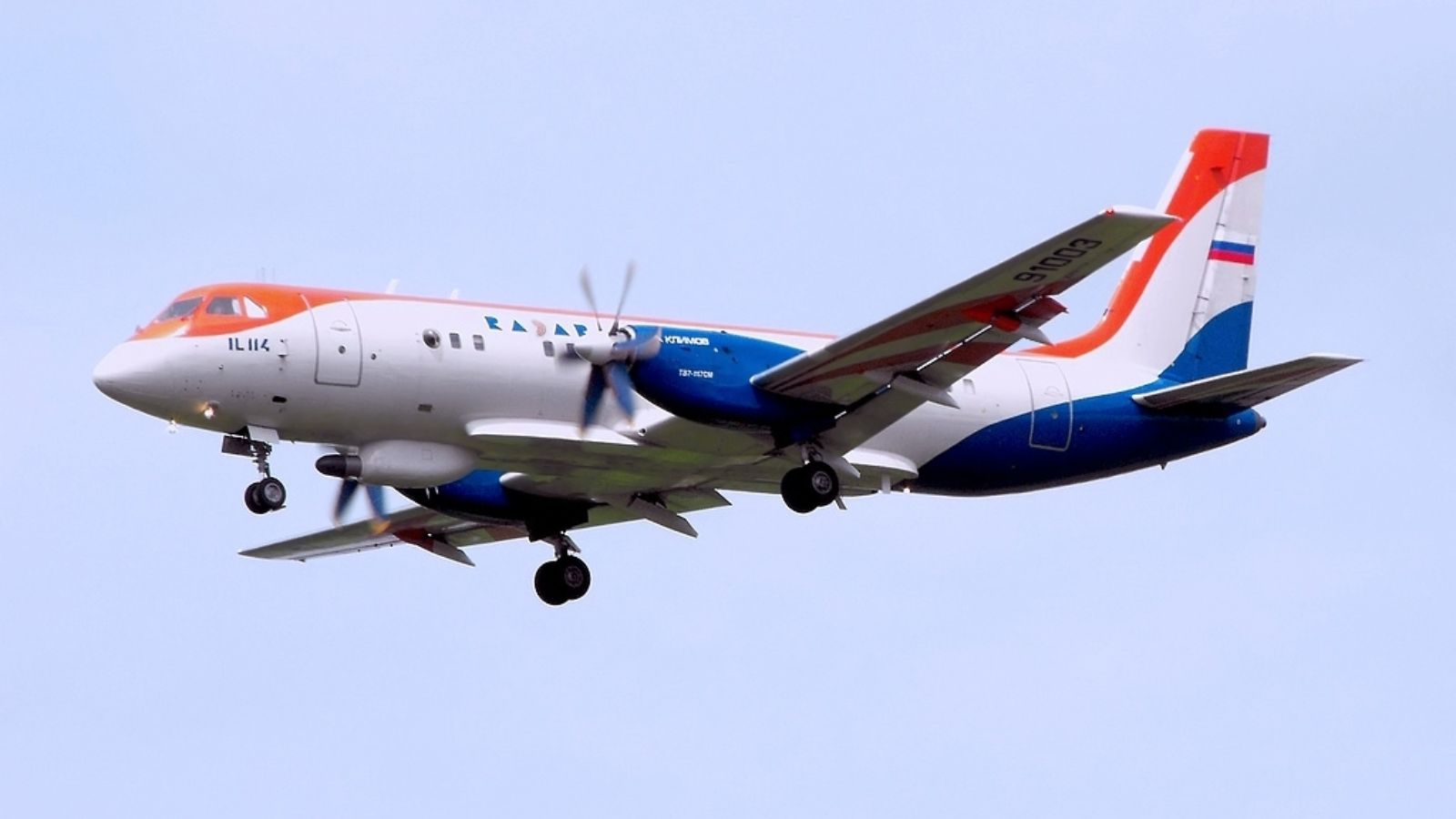
The preliminary deals, announced by UAC’s parent conglomerate Rostec, cover the delivery of 68-seater Il-114-300 aircraft. While the agreements do not yet constitute firm, binding orders, they represent a concrete expression of commercial interest that Russian officials hope to translate into definitive contracts by the close of the year.
Main Facts
The agreements concluded in New Delhi involve two distinct Indian enterprises that currently do not operate commercial airlines:
- Pinnacle Air: Signed a Letter of Intent (LoI) for the potential delivery of 50 Il-114-300 turboprop aircraft. Pinnacle Air is primarily known as a charter helicopter operator, while its wider business portfolio spans aviation consulting, aircraft sales, and management.
- Sleek Aviation: Signed a Memorandum of Understanding (MoU) for the delivery of 35 aircraft. The pact also includes provisions for establishing an advanced training center equipped with a full-flight simulator at the operator’s facility. Sleek Aviation is a Gurugram-based company directed by aviation entrepreneur and former Indian Air Force pilot Dilawer Singh Basraon.
The aircraft at the center of these agreements, the Il-114-300, is a twin-turboprop regional airliner positioned as a direct competitor to widely used Western counterparts like the ATR 72-600. Promoted heavily by Russian industrial architects, the aircraft is billed as entirely domestically produced—utilising Russian-made avionics, engines, and airframe components—to insulate the manufacturing pipeline from external geopolitical disruptions.
Beyond commercial passenger transport, Rostec has highlighted the versatility of the platform, noting its utility for cargo and mail delivery, as well as specialized medical evacuation and rescue operations.
Chronology of Events
The diplomatic and industrial trajectory leading to the New Delhi agreements reflects a multi-year pivot in Russian aerospace marketing:
- June 2022: In the wake of Russia’s invasion of Ukraine, the United States, alongside the European Union, the United Kingdom, Canada, Switzerland, and Japan, slaps sweeping economic sanctions on Rostec and UAC, cutting off Russian manufacturers from Western aerospace supply chains and financial systems.
- January 2026: UAC officially showcases the Il-114-300 at the Wings exhibition, generating initial inquiries from international operators.
- Late 2025 – Early 2026: Concurrently, UAC advances separate talks with state-owned Hindustan Aeronautics Limited (HAL) to explore the localized manufacturing of its SJ-100 regional jets in India, laying the groundwork for deeper industrial integration.
- September 11, 2026: At the INNOPROM.India trade exhibition in New Delhi, held just ahead of the high-profile BRICS summit, UAC finalizes the LoI with Pinnacle Air and the MoU with Sleek Aviation for a combined total of 85 Il-114-300 aircraft.
Supporting Data and Market Context
The Indian domestic aviation sector presents a compelling backdrop for such ventures. India currently stands as the third-largest domestic aviation market globally and boasts the fastest growth rate among major aviation economies. The government’s regional connectivity initiative, the UDAN (Ude Desh ka Aam Nagrik) scheme, has spurred demand for cost-effective turboprops capable of serving secondary and tertiary cities with limited infrastructure.
However, the commercial viability of introducing a completely Russian-designed and manufactured fleet into India faces deep structural hurdles, according to aviation analysts:
- Sanctions and Supply Chains: UAC and Rostec remain heavily sanctioned by Western powers. Although India maintains a policy of strategic autonomy and has historically opposed unilateral Western sanctions, Indian corporations navigate a complex risk matrix to avoid triggering US secondary sanctions.
- Production Delays: The historical record of Russian civil aviation projects reveals chronic challenges, including extended delivery timelines, component shortages, and severe capital pressures. Even as Moscow pushes import substitution—developing planes exclusively with Russian parts—these programs have encountered notable domestic delays.
- Precedent with the SJ-100: The Il-114-300 agreements follow earlier maneuvers involving the SJ-100 regional jet (formerly the Sukhoi Superjet 100). The SJ-100, which has a range of 3,530 km and a 103-passenger capacity, has been the subject of ongoing negotiations between UAC and HAL to potentially establish India’s first fully manufactured passenger jet production line.
Despite these industrial ambitions, industry watchers note that assembling or operating Russian aircraft involves navigating regulatory and technological bottlenecks, particularly regarding the substitution of certified Western avionics and engine parts with domestic Russian alternatives.
Official Responses and Perspectives
Speaking on the sidelines of the INNOPROM trade event, Russian Deputy Minister of Industry and Trade Gennady Abramenkov emphasized the strategic alignment between Russian manufacturing capabilities and India’s infrastructural needs.
"India has significant potential for developing regional air travel, and the Il-114-300 is well suited to expanding the route network and improving transport accessibility," Abramenkov said. "The agreements reached today confirm the Indian airlines’ interest in the Russian aircraft and open up new opportunities for our cooperation."
UAC Chief Executive Vadim Badekha detailed the roadmap following the initial signings, emphasizing that firm contracts remain the ultimate objective.
"Today’s signings are the culmination of extensive work that began after the Il-114-300’s unveiling at the Wings exhibition in January of this year," Badekha noted. "We plan to conclude the first firm contracts by the end of this year. As our cooperation develops, we are prepared to move forward and transition to an industrial partnership for service, maintenance, personnel training, and even localisation of Il-114-300 production in India."
Dmitry Lelikov, Deputy General Director (Investment Activity) and Board Member at Rostec, underscored the multi-role capabilities of the aircraft, suggesting it could support India’s civil infrastructure goals beyond simple passenger hauling by addressing emergency medical and postal transport requirements.
Broader Implications
The preliminary deals for the Il-114-300, alongside ongoing discussions regarding the SJ-100, carry significant geopolitical and economic implications:
- Diversification for Russian Aerospace: Cut off from Western maintenance markets, sales networks, and component suppliers, Russian state-backed aerospace firms are pivoting heavily toward friendly non-Western economies, with India acting as a primary partner.
- Aviation Ambitions vs. Geopolitical Risk: India harbors explicit ambitions to position itself as a global aerospace manufacturing hub, pressing international OEMs to set up final assembly lines within its borders. While the prospect of domestic production—whether for the SJ-100 or potential localization of the Il-114-300—aligns with New Delhi’s "Make in India" initiative, it forces local private entities and defense contractors to carefully weigh commercial upside against the latent risks of international compliance.
- Uncertainty Over Airline Intentions: With neither Pinnacle Air nor Sleek Aviation currently operating commercial passenger airlines, market observers remain cautious. It remains to be seen whether these entities intend to launch new regional carriers to capitalize on the UDAN scheme or act primarily as leasing, trading, or general aviation intermediaries.
As UAC works toward finalizing firm contracts by the end of the year, the execution of these agreements will serve as a critical test case for whether technological isolation and industrial collaboration can successfully intersect within India’s booming aviation ecosystem.