









In the rapidly evolving landscape of data and artificial intelligence, the divide between "promising technology" and "proven business value" is widening. Organizations are increasingly wary of complex, fragmented data architectures that bleed budget and stifle innovation. A new study, however, offers a compelling empirical case for a unified approach: the co-engineered, first-party integration of Microsoft Azure Databricks.
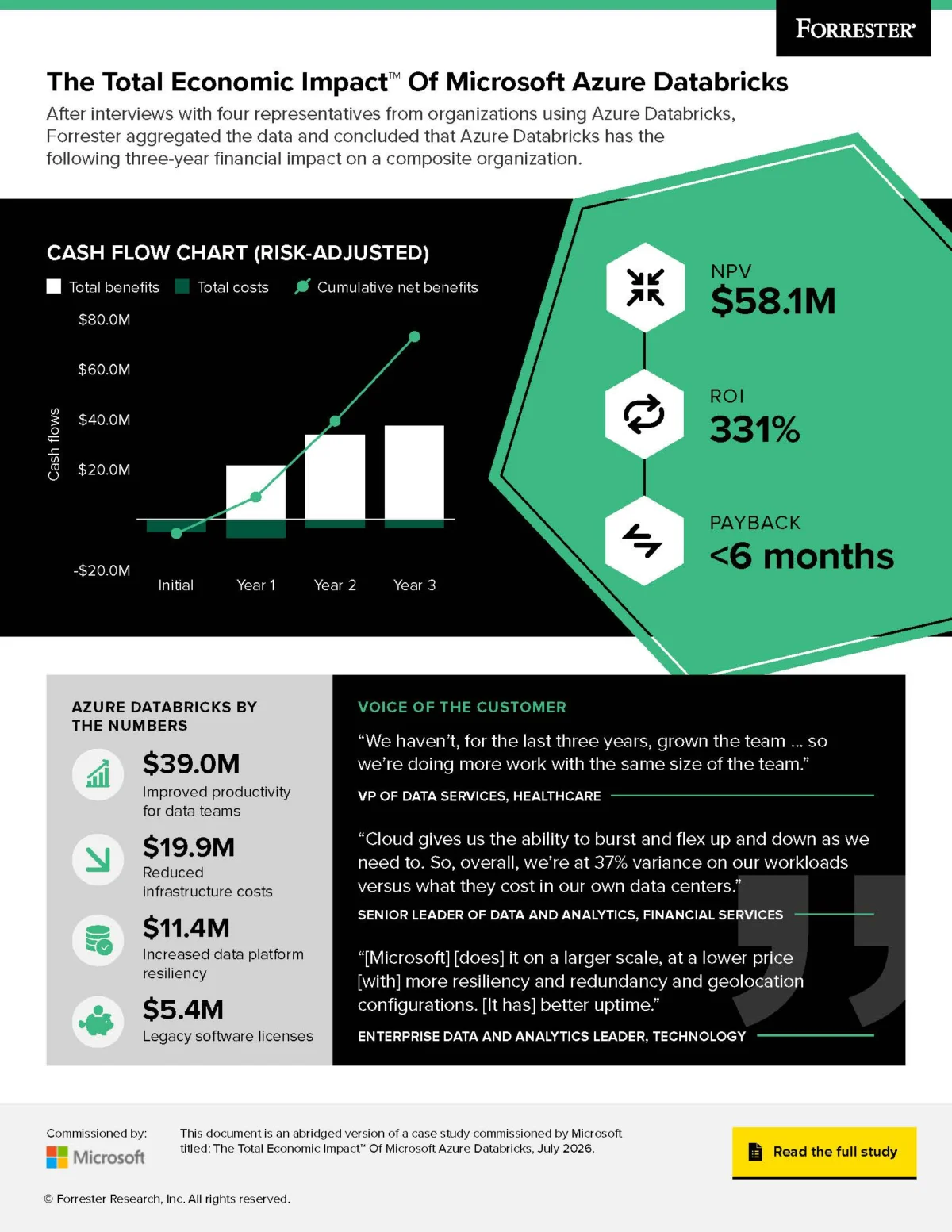
Recent findings from a commissioned Forrester Total Economic Impact™ (TEI) study have quantified what many industry leaders have long suspected: deep native integration within the Azure ecosystem is not merely a technical convenience—it is a significant financial engine. According to the research, a composite organization leveraging Azure Databricks can realize a staggering 331% return on investment (ROI) over three years, with a total net present value (NPV) of $58.1 million.
Main Facts: The Power of a Co-Engineered Ecosystem
The core value proposition of Azure Databricks lies in its architecture. Unlike third-party solutions that are "bolted on" to cloud environments, Azure Databricks is a first-party service. This means it is co-engineered by Microsoft and Databricks, sharing a unified integration roadmap, a single procurement motion, and a consolidated support path.
For the modern enterprise, this translates into three distinct advantages:
- Operational Efficiency: By fitting natively into existing Microsoft identity, governance, and security protocols, IT teams avoid the "integration tax"—the time and money spent bridging incompatible systems.
- Performance Superiority: Because the platform is optimized at the infrastructure layer, it delivers faster data processing and query performance compared to fragmented or non-native deployments.
- Financial Predictability: With one bill and a single support ecosystem, organizations reduce the risk and overhead associated with managing multi-vendor data estates.
Chronology of an Integration Evolution
The current state of Azure Databricks is the result of years of strategic alignment between Microsoft and Databricks.
- The Foundation: The partnership began with the goal of bringing the power of Databricks’ Apache Spark-based processing to the enterprise-grade reliability of the Azure cloud.
- The Governance Era: The introduction of Unity Catalog marked a pivot toward unified governance. It allowed organizations to manage data, analytics, and AI assets across their entire estate from a single control plane, solving the historical problem of "data silos."
- The AI/Copilot Integration (2025–2026): Recent advancements have seen the integration of Genie—a conversational interface—with Microsoft 365 Copilot and Copilot Cowork. This milestone represents a shift from simple data storage to "intelligent data flow," where business users can query the lakehouse using natural language within their existing workflow applications like Microsoft Teams.
- The Validation Milestone (June 2026): The publication of the Forrester TEI study serves as the current benchmark, providing a longitudinal look at how these technical integrations have matured into quantifiable business outcomes.
Supporting Data: The Anatomy of the $58.1 Million ROI
To determine the fiscal impact of Azure Databricks, Forrester Consulting analyzed a composite organization—a $6 billion company operating in a highly regulated industry with 10 petabytes of data. Before transitioning to Azure Databricks, this organization struggled with a fragmented, high-cost, and unreliable data infrastructure.
The transformation yielded a $75.6 million benefit against $17.5 million in total costs over a three-year period. The financial drivers were categorized into several key areas:
1. Cost Consolidation and Infrastructure Optimization
The elimination of redundant tooling and manual data pipelines significantly reduced the total cost of ownership (TCO). By moving away from a disjointed stack, the company slashed the operational burden on data engineers, allowing them to pivot from maintenance to value-generating projects.
2. Accelerated Time-to-Value
The native integration with Microsoft’s security and governance frameworks meant that data became "ready for use" faster. Without the need to rebuild security policies for every new tool, data scientists and analysts could access the insights they needed in days rather than months.
3. Performance Benchmarks
Beyond the Forrester study, independent testing by Principled Technologies provided technical validation of these financial gains. Using a 10-terabyte TPC-DS-like dataset, the firm found that Azure Databricks completed a single query stream 21.1% faster than the same platform running on AWS (with autoscale disabled). In concurrent query scenarios, the Azure-native version outperformed its counterpart by more than nine minutes.
Official Responses and Strategic Implications
For decision-makers, the implications of this data are clear: the "cost of complexity" is often the hidden killer of digital transformation projects.
"We didn’t just want a data platform; we needed an engine for our business strategy," noted a lead data architect from a participating organization in the study. "The fact that Azure Databricks is a native service means we spend less time managing the ‘plumbing’ and more time building models that impact our bottom line."
Microsoft and Databricks have emphasized that this is a long-term commitment. By aligning their engineering roadmaps, they ensure that every new feature—whether it is an advancement in Delta Lake technology or a new capability in Genie—is immediately available to Azure customers with full support for Microsoft’s enterprise security standards.
Implications: The Future of the Intelligent Lakehouse
As we look toward the remainder of the decade, the integration of generative AI into the data fabric is no longer an optional luxury. The integration of Genie with Microsoft 365 Copilot is a prime example of how "intelligence" is being democratized. By grounding these AI agents in trusted, governed data via Unity Catalog, organizations can now allow business users to interact with massive datasets securely.
The Governance-Utility Paradox
A major hurdle in previous data initiatives was the tension between access and governance. If data was easy to access, it was often insecure; if it was secure, it was impossible to access. The Forrester study highlights that the native Azure Databricks model resolves this by applying granular, role-based access control (RBAC) at the service level, ensuring that AI-driven insights are always constrained by the user’s permissions.
Long-Term Strategic Planning
Choosing a data platform is a multi-year commitment. The evidence suggests that for organizations already invested in the Microsoft stack, the "first-party advantage" is the most logical path for future-proofing their data estate.
The metrics—331% ROI, a sub-six-month payback, and nearly $60 million in net value—provide a robust business case. However, the qualitative benefits, such as enhanced team productivity, faster query response times, and the ability to scale to petabytes without breaking the governance model, are the factors that will likely define the long-term success of early adopters.
Conclusion: Moving Forward
The path to a mature, AI-ready data estate is rarely a straight line, but the data is increasingly pointing toward consolidation and native integration. For enterprises dealing with fragmented data environments, the Forrester report serves as both a roadmap and a justification for the shift toward a unified, co-engineered lakehouse.
As the digital landscape becomes more crowded and competitive, the ability to turn petabytes of data into actionable business intelligence—without the drag of high-overhead, disjointed tooling—will separate the market leaders from the rest. The Azure Databricks partnership, backed by its clear performance and financial metrics, represents a mature, high-ROI solution for organizations ready to scale their data ambitions.
Explore Further Resources: