










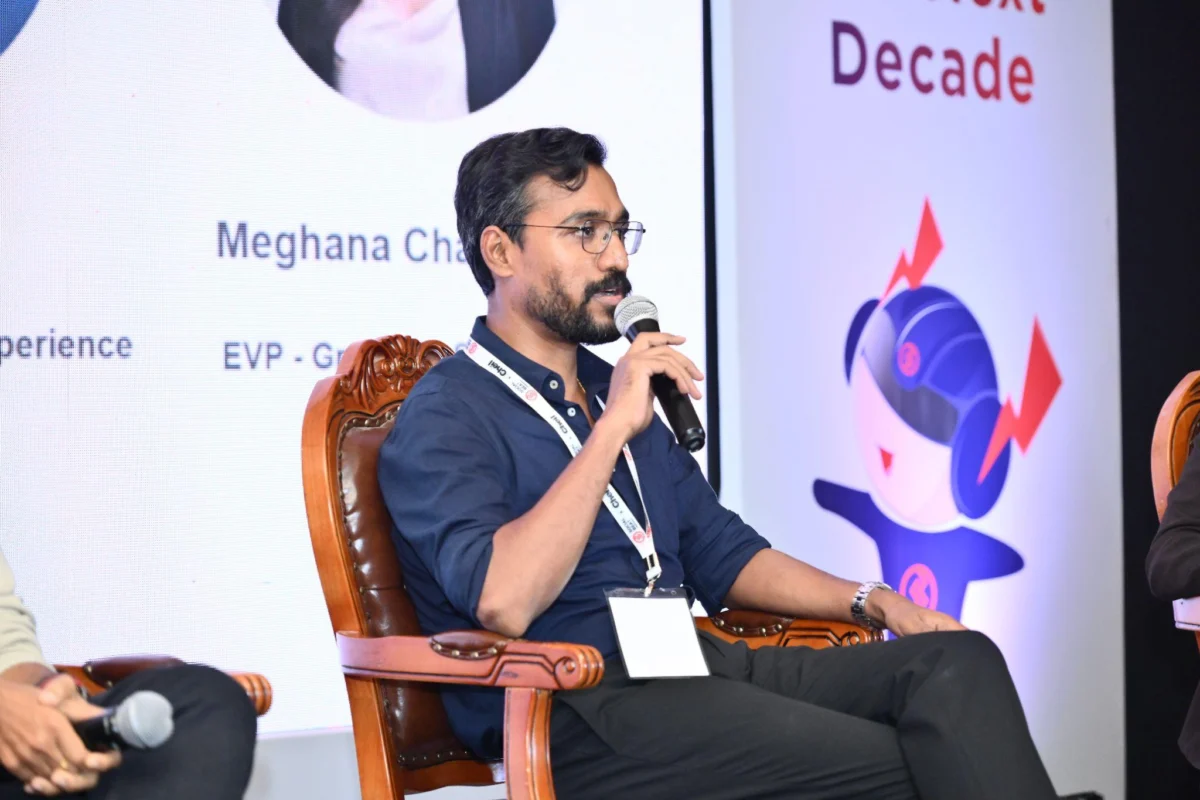
Reflections from the 17th Digital Leadership Summit, Bengaluru, July 31, 2026.
For the better part of two years, the marketing industry has been trapped in a binary echo chamber regarding Artificial Intelligence. One camp envisions a future where autonomous agents steer the entire marketing apparatus, from creative conception to budget allocation. The opposing camp dismisses the technology as a source of "mediocre" output, predicting a return to traditional human-only workflows as the hype cycle inevitably collapses.
However, the reality emerging from the front lines of India’s most innovative consumer businesses suggests both narratives are incomplete. At the 17th Digital Leadership Summit, held at the Taj MG Road in Bengaluru, leaders from NoBroker, Oolka, First Club, Orange Health Labs, and UNext moved beyond speculative forecasting. They presented a grounded, pragmatic framework for AI integration: a model where machines handle the "middle" of the work, while humans retain total control over the "bookends"—the initial brief and the final, accountable decision.
The Chronology of Integration: From Experimentation to Operational Strategy
The dialogue at the summit underscored a significant shift in how AI is being deployed across the Indian digital landscape.
In the early phases of the AI revolution, companies viewed the technology as a "magic button" for content generation or cost-cutting. Today, the conversation has matured into a discussion about architectural boundaries.
Rahul Datta of NoBroker illustrated this with a sophisticated conversational AI ecosystem. By training voice agents on the company’s highest-performing human staff, NoBroker has created a system that not only manages customer inquiries but also provides real-time, context-aware support to human agents on live calls. Yet, Datta was unequivocal about the limits: NoBroker prohibits AI from launching or altering campaigns. The reasoning is foundational: an algorithm lacks the cultural nuance to understand brand tone or the specific emotional resonance of language in a regional market.
Similarly, Oolka and First Club provided a roadmap for how growth functions are being partitioned. The consensus is that AI has successfully moved from a novelty experiment to an essential analytical engine, yet the execution layer remains stubbornly tied to human intuition.
Supporting Data: Where AI Succeeds and Where It Fails
The summit revealed a stark divide between AI’s cognitive capabilities and its operational reliability.
The "Middle" vs. The "Ends"
The most compelling takeaway from the summit is the "Layer Rule." Organizations are finding that AI excels at synthesis, research, and data processing, but struggles with the accountability of execution.
- Research and Content: Companies like Orange Health Labs report that AI consistently gets their teams 70–80% of the way toward a final product. It is an unparalleled tool for distilling complex diagnostics data and shaping strategic direction.
- Execution at Scale: Sandesh Gupta of Oolka offered a blunt reality check. Despite months of testing automated execution across Meta and Google, the results were insufficient. The "tactical calls" required to pivot in real-time during a campaign remain a human domain.
- The Trust Gap: Lucky Saini of First Club highlighted a critical distinction: in the business of trust—specifically, fresh food—machine-generated creative is a liability. However, in paid media deployment, automation is not just welcomed; it is required.
These insights suggest that most marketing teams currently have their priorities backwards. They use AI for creative because it is visible and impressive, while relying on manual processes for media buying—which is where the actual efficiency gains could be found.
Official Responses: The Philosophy of Accountability
The recurring theme across all sessions was the concept of "the neck to catch."
"You need a neck to catch," Rahul Datta noted, succinctly summarizing the primary constraint on AI in marketing. It is no longer a question of technical capability; it is a question of ownership. In a corporate environment, someone must answer for the outcome of a campaign. If an AI makes a decision that results in a public relations crisis or a massive loss of ad spend, the machine cannot be held accountable.
This is the essence of the "Human-in-the-Loop" philosophy. It is not merely a compliance checkbox; it is a structural mandate. By defining specific decision rights, organizations are ensuring that every automated process has a named human sponsor who owns the result.
Implications for the Future: The Shift to Generative Engine Optimization (GEO)
Perhaps the most disruptive insight came from Kiran Kumar R of UNext, who identified a fundamental shift in the digital funnel.
Traditional SEO is evolving into Generative Engine Optimization (GEO). As users increasingly turn to AI models like ChatGPT, Gemini, and Perplexity for answers, the "search results page" is becoming secondary to the "AI-generated answer."
The Winner-Takes-All Market
Kapil Thukral of Tally noted that as zero-click results become the norm, the search landscape is transforming into a winner-takes-all ecosystem. If your brand is not cited within the AI’s answer, you are effectively invisible.
The implication for marketing teams is clear: SEO is no longer just about keywords and meta-tags. It is about structuring content so that AI engines can extract, credit, and quote the information directly. This requires a shift in content strategy toward clear, question-based headers and authoritative, verifiable data that AI models prioritize.
Strategic Recommendations for Leadership
To navigate this new reality, organizations should implement a three-stage tactical plan:
- Define Decision Rights: Formally document which marketing decisions are delegated to machines and which are reserved for humans. Without a written policy, organizations will continue to cycle through the same arguments regarding AI’s role.
- Apply the Layer Rule: Audit your AI budget. If you are automating creative work while manually running media, you are misallocating resources. Automate the tasks where the output is a quantifiable number; keep humans in the loop where the output is a brand promise.
- Audit AI Visibility: Conduct a "Buying Question Audit." Query major AI engines about your category and observe whether your brand is cited. If you haven’t checked, you are likely losing market share to competitors who have already optimized for the generative era.
Frequently Asked Questions
What is the most critical risk of AI in marketing today?
The primary risk is the "Accountability Vacuum." When organizations deploy AI without a clear, named human owner for every outcome, they lose the ability to manage brand reputation and operational success.
How does GEO differ from traditional SEO?
SEO focuses on ranking on a list of results. GEO (Generative Engine Optimization) focuses on getting your brand mentioned or cited within the AI’s direct answer, which is where the user’s attention is increasingly concentrated.
Should I automate my ad campaigns entirely?
The practitioners at the summit suggest not. While you can automate deployment and policy, the strategic, tactical adjustments during a campaign require human intervention. Fully automated, end-to-end execution remains unreliable in current market conditions.
How do I ensure my content is "AI-friendly"?
Focus on "writing for extraction." Use direct, question-based headers, provide concise answers in the first two sentences, and use highly structured, verifiable data. An FAQ section is one of the most effective tools for this.
Are marketers going to be replaced?
The evidence suggests that the "middle-of-the-road" marketer—whose role was primarily task-based execution—is at risk. However, the marketer who defines the brief, manages the brand promise, and holds the "neck to catch" is more valuable than ever.
As the summit concluded, the final challenge to the audience was poignant: "Which decision in your marketing is a machine already making that nobody formally agreed it should make?" Answering that question is the first step toward reclaiming strategic control in the age of AI.



