
Main Facts: Bridging the Gap Between Functional Code and Visual Taste
Artificial intelligence coding agents have fundamentally altered how software is built. Modern developers can prompt tools like Claude Code, Cursor, and Codex to spin up functional applications, complex database schemas, and robust backend logic in seconds. Yet, a glaring friction point has persisted: while these agents are exceptional at writing operational code, their default aesthetic output is remarkably uniform and often uninspired.
Left to their own devices, AI coding agents default to a predictable visual formula—ubiquitous purple gradients, aggressively rounded corners, the Inter font family applied universally, and layouts that fulfill technical requirements without artistic conviction. The root cause is not a failure of logic or processing power; the agent simply lacks a sense of taste.
This paradigm is rapidly shifting through the introduction of AI skills. By integrating specialized markdown files and configuration directories into development environments, engineers can now instill specific design languages, color sciences, and typographic hierarchies directly into their coding assistants. Rather than relying on generic defaults, an agent equipped with these skills can construct interfaces grounded in Swiss grid systems, governed by advanced color theory, and animated with professional timing curves. This development marks a transition in the software industry: design knowledge is moving away from static, human-read style guides and transforming into executable rulesets that AI agents can run autonomously.
Chronology: The Rise of Agentic Design Capabilities
The evolution from rigid code generators to taste-aware design partners has accelerated significantly over the past several years, driven by the modular architecture of modern AI developer tools.
- Late 2022 – 2023 (The Era of Raw Utility): Generative coding tools entered the mainstream, prioritized entirely on syntax correctness, algorithm generation, and boilerplate reduction. Visual styling was largely treated as an afterthought, restricted to basic utility classes or unrefined CSS stylesheets.
- Early 2024 (The Rise of Modular AI Assistants): Platforms like Cursor, Claude Code, and various terminal-based coding agents introduced support for custom instructions and workspace-level markdown files, allowing users to inject persistent context into their development loops.
- Late 2024 – Present (The Modular Design Skill Ecosystem): A wave of specialized repositories, open-source utilities, and community directories emerged. Developers and design engineers began packaging their personal aesthetic philosophies—ranging from perceptual color spaces to vintage international typographic standards—into plug-and-play skills. Tooling evolved to support simple CLI installations (such as
npx skills add), turning complex aesthetic philosophies into instantly executable agent behaviors.
Supporting Data and Directory Breakdown: Top 10 Design-Focused AI Skills
To combat the "default AI look," the developer community has curated a robust ecosystem of design skills and directories. Integrating these tools shifts an agent’s output from generic scaffolding to polished, production-ready interfaces.
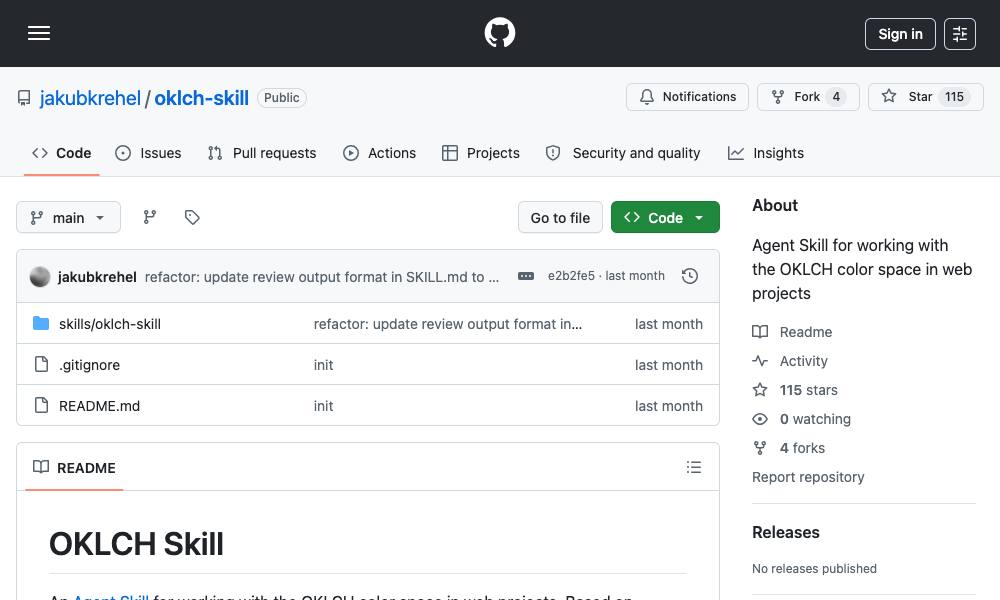
1. OKLCH Color Skill
- The Focus: Perceptually uniform color science.
- Functionality: Bypasses unpredictable HSL combinations and arbitrary hex guessing. It trains agents to generate balanced palette scales (50 to 950), calculate dark-mode variants through precise lightness manipulation, and verify color contrast against WCAG 2 and APCA standards while building Tailwind CSS v4 tokens.
- Installation:
npx skills add jakubkrehel/oklch-skill
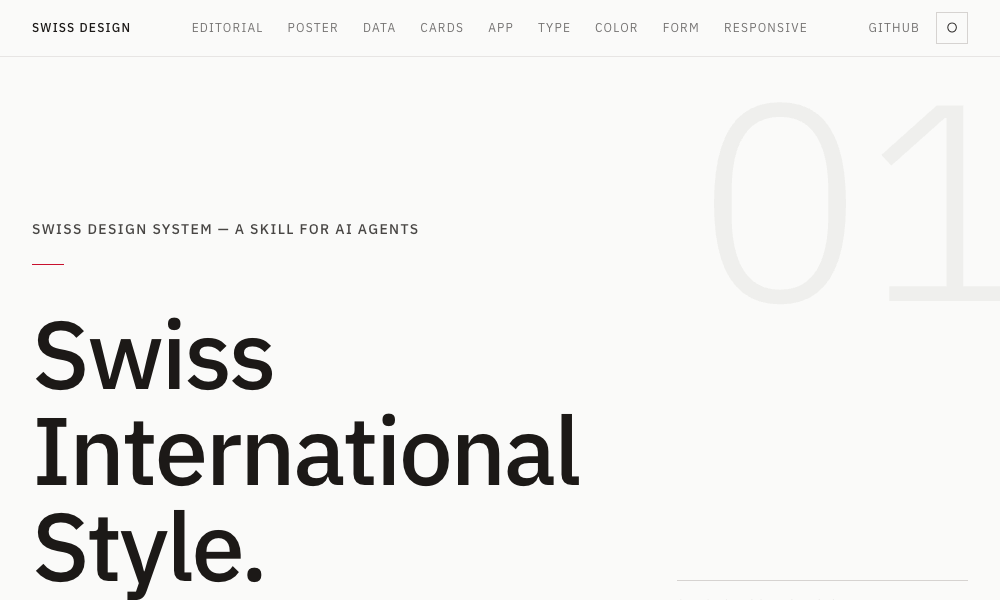
2. Swiss Design System Skill
- The Focus: International Typographic Style (Swiss Design).
- Functionality: Introduces grotesque sans-serif typefaces (Helvetica, Univers, Neue Haas Grotesk), rigorous grid systems derived from Josef Müller-Brockmann, and generous whitespace. It maps these classic principles directly to Tailwind utility classes.
- Installation:
npx skills add zeke/swiss-design-skill
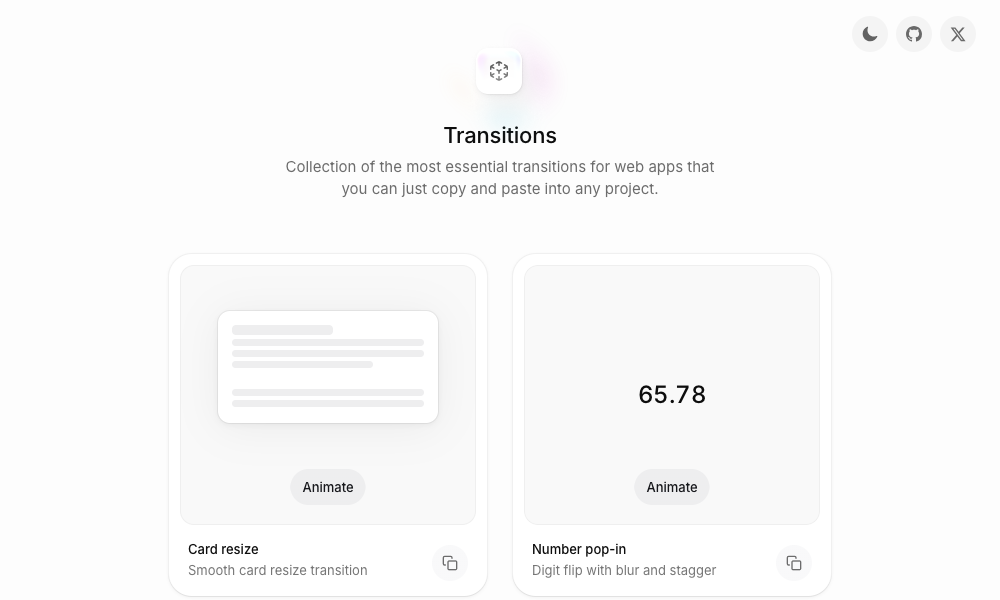
3. Transitions.dev
- The Focus: Micro-interactions and motion design.
- Functionality: A library of nine core UI transitions—ranging from dynamic card resizes and number-flip counter animations to diagonal sliding notification badges. It supplies pre-optimized CSS that eliminates abrupt, jarring layout shifts.
- Installation: Sourced directly via GitHub (
github.com/Jakubantalik/transitions.dev).
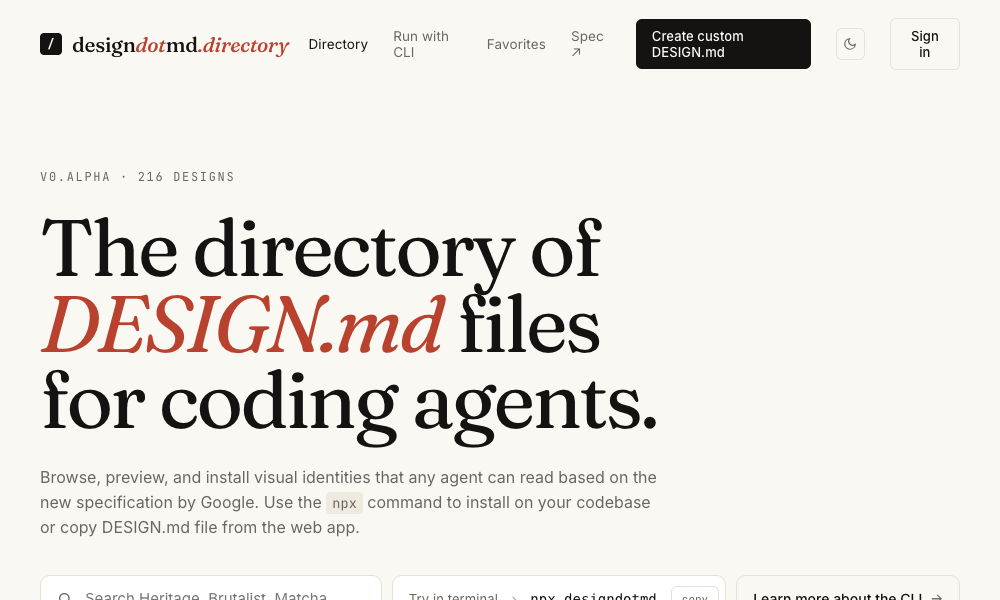
4. DESIGN.md Directory
- The Focus: Zero-friction design system integration.
- Functionality: A curated collection of standalone markdown files that encapsulate complete design systems (colors, spacing rules, typography scales). Dropping a chosen
DESIGN.mdinto a project root allows the agent to immediately absorb and apply the aesthetic without requiring command-line installations.
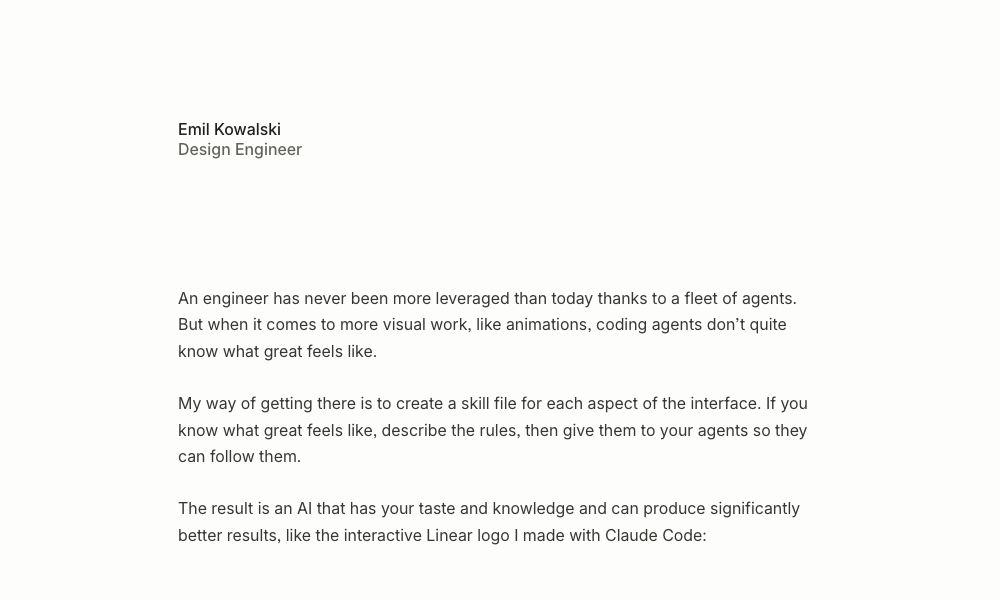
5. Agents with Taste (by Emil Kowalski)
- The Focus: Professional design engineering and animation pacing.
- Functionality: Encapsulates practical rules for easing curves, strict typographic constraints (such as capping body text width at 65 characters), and context-aware duration guidelines (e.g., 100-150ms for micro-interactions, 200-300ms for modals).
- Installation:
npx skills add emilkowalski/skill
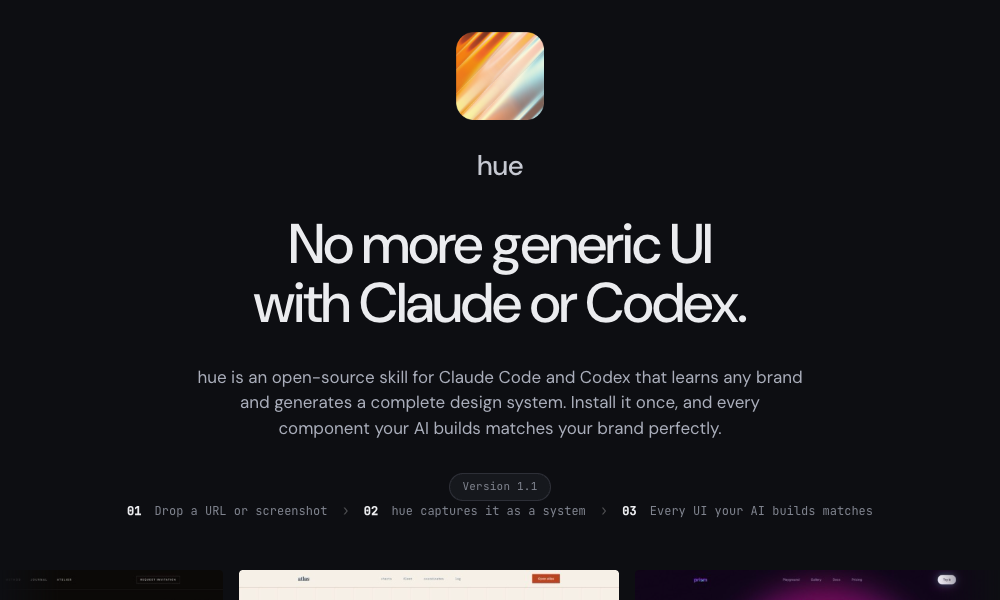
6. Hue
- The Focus: Brand cloning and automated design system extraction.
- Functionality: Analyzes a specified URL, brand name, or screenshot to reverse-engineer a comprehensive design system—complete with color tokens, typography, spacing, and icon recommendations. It ships with 17 built-in brand models.
- Installation:
git clone https://github.com/dominikmartn/hue ~/.claude/skills/hue
7. Refero Styles
- The Focus: Real-world product pattern matching.
- Functionality: Connects agents to a visual search engine indexing over 150,000 real application screens and user flows from industry leaders like Stripe, Linear, and Notion, enabling on-the-fly pattern retrieval.
8. TypeUI Design Skills
- The Focus: Multi-framework aesthetic distribution.
- Functionality: A broad library of optimized
SKILL.mdandDESIGN.mdfiles compatible with Claude Code, Cursor, Codex, and local OpenClaw agents. - Installation:
npx typeui.sh pull [name]
9. UI/UX Pro Max Skill
- The Focus: Comprehensive end-to-end design generation.
- Functionality: The most feature-dense option available, featuring 161 reasoning rules and 67 UI styles. It analyzes project requirements to generate complete, multi-stack design systems (HTML/Tailwind, React, Next.js) alongside anti-pattern warnings.
- Installation:
npx ui-pro init
10. AI UX Playground
- The Focus: Specialized AI product interactions.
- Functionality: Documents UX patterns built specifically for conversational interfaces, prompt-driven applications, and LLM workspace tools like ChatGPT, Claude, and Perplexity.
Official Perspectives and Industry Insights
Design engineers and AI tool maintainers have increasingly emphasized that the bottleneck in AI-assisted development is no longer technical execution, but intentional curation.
Industry consensus points out that while foundation models are trained on vast stretches of the public internet—which inherently includes both brilliant and mediocre design—their default generation weights often lean toward over-saturated, hyper-modernized clichés to satisfy generic prompts. By packaging human expertise into discrete, executable skills, the developer community is reclaiming editorial control.
Early adopters report that injecting structured constraints—such as strict typographic scales or math-backed color tokens—dramatically reduces the iteration time required to bring an AI-generated prototype up to enterprise production standards. Rather than spending hours tweaking generated inline styles to fix poor contrast or awkward padding, developers can establish guardrails that ensure the agent makes sound design choices on the very first pass.
Implications: The Future of Design Systems and Human Creativity
The mainstream adoption of design-focused AI skills carries profound implications for the software development and design industries.
1. The Shift from Static Documentation to Executable Rules
For decades, design systems have lived as massive Figma libraries, Storybook components, or multi-page PDF guidelines that humans consult manually. As these systems are translated into markdown-based agent skills, they become active participants in the code generation pipeline. The documentation is the compiler constraint.
2. Redefining the Role of the Designer
Designers are transitioning from pixel-pushers and asset creators to system architects and curators of taste. Writing effective agent skills requires deep articulation of why certain spacing rhythms, color spaces, or motion curves matter. Those who master the translation of aesthetic philosophy into structured logic will exert unprecedented leverage over automated software production.
3. Democratization of High-End Aesthetics
Historically, achieving meticulous visual polish required dedicated design teams and extensive manual front-end tuning. By equipping accessible coding assistants with professional-grade skills—such as Swiss grid discipline or OKLCH color harmony—individual developers and small teams can ship software that competes visually with top-tier tech enterprises.
As the ecosystem matures, the current rough edges of agent-driven design will smooth out. The core trajectory, however, is unmistakable: the future belongs to developers and designers who teach their AI agents not just how to write code, but how to care about how it looks and feels.