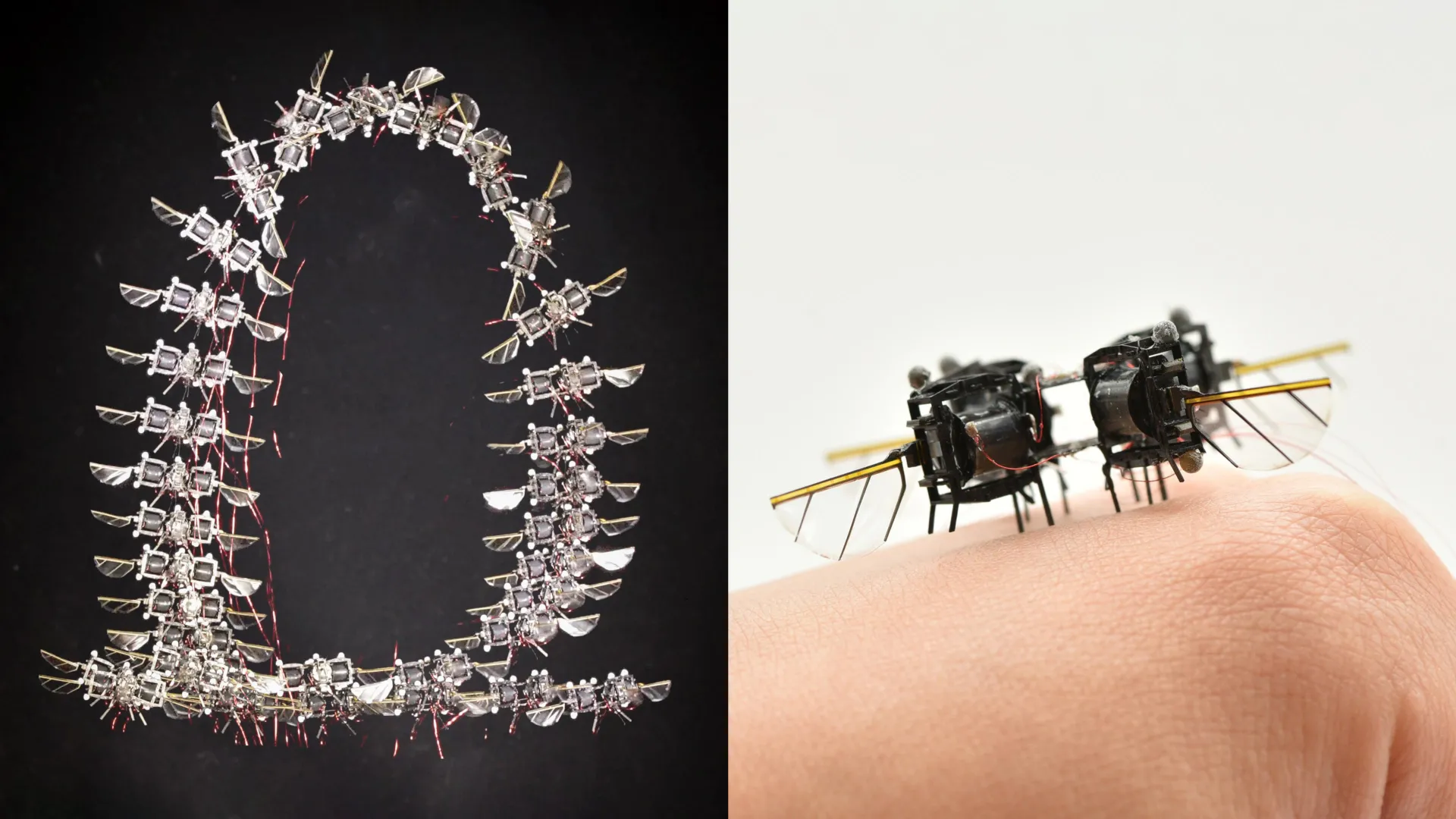
CAMBRIDGE, Mass. — In the chaotic aftermath of a catastrophic earthquake, every second counts. When high-rise buildings collapse or subterranean infrastructure fractures, traditional search-and-rescue teams often face insurmountable hurdles. Large quadcopter drones, while remarkably capable in open airspace, are far too bulky to navigate the treacherous, narrow crevices of a shattered concrete maze. Furthermore, sending human first responders into dangerously unstable structures risks additional loss of life.
For years, roboticists have envisioned a different solution: swarms of tiny, insect-scale flying robots capable of slipping through microscopic gaps, dodging falling debris, and locating trapped survivors. Until recently, however, this vision remained largely out of reach. While natural insects effortlessly execute complex aerial acrobatics, their artificial counterparts have historically been sluggish, fragile, and limited to simple, predictable flight paths.
That paradigm is now shifting. In a major milestone published in the journal Science Advances, a multidisciplinary team of researchers at the Massachusetts Institute of Technology (MIT) has demonstrated a new approach that dramatically increases the speed, agility, and responsiveness of insect-scale flying robots. By developing an innovative, two-part artificial intelligence (AI) control framework, the MIT researchers have successfully bridged the gap between natural biology and mechanical engineering, empowering a micro-robot to perform demanding aerial maneuvers—including rapid, consecutive body flips—with unprecedented precision.
Main Facts: Engineering the Next Generation of Micro-Flight
The breakthrough centers on a newly refined aerial microrobot roughly the size of a microcassette and weighing less than a standard paperclip. Developed by MIT’s Soft and Micro Robotics Laboratory, the machine features expanded flapping wings driven by high-performance soft artificial muscles. These muscles contract rapidly enough to produce the hyper-fast wingbeats required for aggressive flight dynamics.
However, upgrading the hardware was only half the battle. The true bottleneck lay in the robot’s "brain"—its flight controller.
Because microrobots operate under wildly complex aerodynamic conditions at minuscule scales, designing a controller capable of navigating severe environmental uncertainty while maintaining real-time processing speeds has long vexed roboticists. Traditional high-performance controllers require immense computational power, making them impossible to run locally on lightweight, resource-constrained machinery.
To overcome this, researchers from MIT’s Department of Electrical Engineering and Computer Science (EECS) and the Department of Aeronautics and Astronautics (AeroAstro) joined forces. They engineered a pioneering two-tier control architecture:
- The Expert Planner: A model-predictive controller that utilizes mathematical models to plan complex, high-speed maneuvers while accounting for physical torque and force limits.
- The Real-Time Policy: A deep-learning neural network trained via imitation learning to encapsulate the complex computations of the expert planner into a streamlined, ultra-fast decision-making model suitable for real-time execution.
The results of this synergy are staggering. Compared to the laboratory’s previous generation of microrobots, the new AI-driven system yielded a 450 percent increase in speed and a 250 percent increase in acceleration. Most impressively, the robot demonstrated the stability required to complete 10 consecutive somersaults in just 11 seconds, maintaining its intended flight path despite disruptive artificial wind gusts.
Chronology: A Five-Year Journey from Fragile Bugs to Agile Flyers
The path to this technological leap was paved over half a decade of painstaking interdisciplinary research.
- The Foundation (2019–2021): Kevin Chen’s Soft and Micro Robotics Laboratory began focusing heavily on soft actuator technology, recognizing that traditional rigid motors were too heavy and inefficient for insect-scale applications. Early iterations proved capable of basic flight, but suffered from severe durability issues and sluggish response times.
- Hardware Maturation (2022–2023): Over several years, the team engineered a significantly more robust micro-robot chassis. By enlarging the flapping surface area and refining the soft artificial muscles, the physical hardware finally gained the raw mechanical potential to support aggressive maneuvers. Yet, manual human tuning of the flight controllers restricted the robot’s operational envelope.
- The Collaboration (2023–2024): Recognizing that software limitations were capping the hardware’s potential, Chen’s lab partnered with Professor Jonathan P. How’s laboratory, renowned for advanced control systems and decision-making algorithms. Co-lead authors Yi-Hsuan Hsiao, Andrea Tagliabue, and Owen Matteson spearheaded the effort to merge complex predictive modeling with machine learning.
- The Breakthrough (Late 2024): By implementing imitation learning—training a deep-learning policy using data generated by a heavy-duty model-predictive controller—the team successfully synthesized a real-time brain capable of managing extreme aerial stunts. The resulting paper, detailing the unprecedented 450% speed increase and multi-flip capabilities, was formally accepted and published in Science Advances.
Supporting Data: Quantifying the Leap in Performance
To appreciate the magnitude of MIT’s achievement, one must examine the hard metrics governing micro-robotics. Operating at millimeter and centimeter scales introduces physics that radically differ from macro-scale aviation; air can feel viscous, and micro-scale turbulence can easily destabilize lightweight frames.
Below is a breakdown of the performance metrics achieved by the new AI-controlled microrobot compared to previous generations:
| Performance Metric | Previous Generation | New AI-Controlled System | Percentage Improvement |
|---|---|---|---|
| Maximum Flight Speed | Low / Baseline | High-speed cruise | ~450% increase |
| Acceleration Capability | Gradual | Explosive thrust response | ~250% increase |
| Consecutive Somersaults | 0 (Infeasible) | 10 consecutive flips | Infinite relative improvement |
| Time per 10 Flips | N/A | 11 seconds flat | Maintained trajectory within 4–5 cm |
| Environmental Stability | Highly susceptible to drift | Resilient against wind disturbances | Drastic error reduction |
Furthermore, the robot successfully simulated an insect behavior known as a saccade. In nature, flying insects use saccades to pitch their bodies sharply, rapidly transition to a new spatial coordinate, and apply immediate counter-pitch to halt. This rapid acceleration and deceleration cycle not only allows biological bugs to navigate dense canopies effortlessly but also stabilizes their optical fields—a crucial hint at how future micro-drones will process visual data.
Official Responses and Expert Perspectives
The research community has reacted with immense enthusiasm to the published findings, viewing the work as a foundational shift in how micro-scale machines are programmed.
"We want to be able to use these robots in scenarios that more traditional quadcopter robots would have trouble flying into, but that insects could navigate," says Kevin Chen, associate professor in EECS, head of the Soft and Micro Robotics Laboratory within the RLE, and co-senior author of the study. "Now, with our bioinspired control framework, the flight performance of our robot is comparable to insects in terms of speed, acceleration, and the pitching angle. This is quite an exciting step toward that future goal."
The collaborative nature of the project was heavily emphasized by co-senior author Jonathan P. How, the Ford Professor of Engineering in AeroAstro and a principal investigator in LIDS.
"The hardware advances pushed the controller so there was more we could do on the software side, but at the same time, as the controller developed, there was more they could do with the hardware," How notes, highlighting the symbiotic relationship between the engineering and computer science divisions.
Addressing the challenge of repetitive flips, How added: "If small errors creep in, and you try to repeat that flip 10 times with those small errors, the robot will just crash. We need to have robust flight control… The robust training method is the secret sauce of this technique."
Co-lead author Yi-Hsuan Hsiao underscored the broader implications for the field of robotics:
"This work demonstrates that soft and microrobots, traditionally limited in speed, can now leverage advanced control algorithms to achieve agility approaching that of natural insects and larger robots, opening up new opportunities for multimodal locomotion."
Implications: A Paradigm Shift for Autonomous Micro-Robotics
The successful integration of deep-learning policies with model-predictive control on a sub-gram platform carries profound implications across multiple industries.
1. Disaster Response and Urban Search and Rescue
The primary long-term motivation behind the research remains humanitarian. In the wake of earthquakes, avalanches, or industrial collapses, survivors are often trapped in air pockets beneath tons of rubble. Equipped with tiny cameras, chemical sensors, and microphones, future iterations of these insect-scale robots could autonomously tunnel through spaces impassable to search dogs or human rescue crews. By mapping voids and detecting the carbon dioxide signatures or sounds of trapped individuals, these devices could drastically reduce rescue response times.
2. Infrastructure Inspection
Beyond disaster zones, industrial infrastructure—such as jet engine turbines, nuclear reactors, and deep-sea pipelines—often features narrow internal channels that require expensive, time-consuming disassembly to inspect. Agile microrobots could be deployed to crawl or fly through these complex geometries, identifying micro-fractures and structural fatigue in real time.
3. Next Steps: Onboard Autonomy and Swarm Coordination
Presently, the micro-robot relies on an external motion-capture camera system to determine its precise location in space—a setup that confines testing to controlled laboratory environments.
Looking ahead, the MIT team’s roadmap focuses on two major milestones:
- Onboard Sensors and Cameras: Integrating micro-sensors directly onto the robot’s chassis to eliminate the need for external tracking systems, allowing true untethered outdoor flight.
- Swarm Intelligence: Developing decentralized algorithms that enable large groups of these microrobots to communicate, coordinate exploration patterns, and avoid mid-air collisions without centralized computing infrastructure.
"For the micro-robotics community, I hope this paper signals a paradigm shift by showing that we can develop a new control architecture that is high-performing and efficient at the same time," Chen concludes.
As artificial intelligence continues to converge with soft robotics, the boundary between biological organisms and synthetic machines grows increasingly thin—bringing humanity one step closer to deploying a new generation of robotic protectors where no human can safely tread.
This research was supported and funded, in part, by the National Science Foundation (NSF), the Office of Naval Research, the Air Force Office of Scientific Research, MathWorks, and the Zakhartchenko Fellowship.