










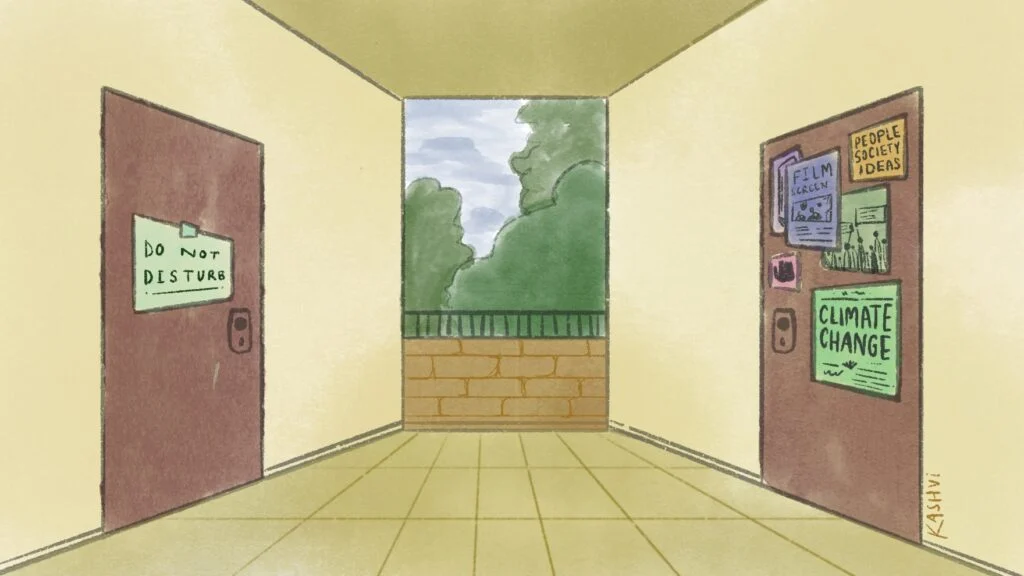
Introduction: The Ideological Fault Lines at India’s Premier Tech Institutions
For decades, the Indian Institutes of Technology (IITs) have stood as the undisputed crowns of India’s higher education ecosystem. Synonymous with rigorous scientific inquiry, elite technical prowess, and a pipeline to global corporate leadership, these campuses were traditionally viewed as insulated bubbles where academic pursuit and professional ambition reigned supreme. Politics, social friction, and ideological debates were generally secondary to problem sets, coding algorithms, and placement statistics.
However, recent events have laid bare a stark and deepening ideological fracture within these hallowed halls. A fierce culture war—simmering for years beneath the polished surface of technological excellence—has finally boiled over. At the heart of this friction is an increasingly polarized campus dynamic pitting hyper-focused engineering and management students against the Humanities and Social Sciences (HSS) departments and politically active student collectives.
What began as localized institutional discontent has mutated into a broader, highly charged national debate over the very purpose, soul, and demographic makeup of India’s premier technological institutions. As online vitriol meets real-world campus unrest, the fundamental identity of the IITs is being fiercely contested.
Main Facts: The Anatomy of a Modern Campus Crisis
The latest escalation in this ongoing culture war can be traced directly to a volatile sequence of events at IIT Bombay’s Powai campus, triggered by a profound human tragedy.
In late 2023, the death by suicide of student Sahil Wakode sent shockwaves through the institution. The aftermath saw immediate, impassioned protests sweep across the campus. These demonstrations—many of them organized or spearheaded by HSS doctoral students and leftist campus collectives—focused heavily on systemic accountability, caste dynamics, and the institutional response to marginalized students. The epicenter of the anger pointed toward a specific faculty member against whom provisions of the Scheduled Castes and the Scheduled Tribes (Prevention of Atrocities) Act (SC/ST Act) were invoked.
The pressure culminated in significant administrative action: the professor in question was stripped of his deanship and sent on immediate leave.
Yet, the reverberations of these protests extended far beyond administrative disciplinary measures. Off-campus observers, digital commentators, and large factions of the engineering student body began to conflate the protesting collectives entirely with the humanities and social sciences departments.
Online platforms quickly became echo chambers of hostility. In September, a post on IIT Bombay’s Reddit community board captured the simmering anti-humanities sentiment with brutal candor:

“Leave IITs for the top brains of India, people who excel in STEM and management only… We don’t want stupid narrative-pushing socio-drama queens on this campus anymore!”
This online rhetoric mirrors a casual yet pervasive attitude on the ground. Students across premier campuses note that terms like "HSS" have transformed from mere department acronyms into derogatory adjectives. At IIT Madras, a former development studies student remarked, "If someone says something woke, or socially aware, a frequent response would be ‘oh you’re being so HSS’."
Chronology of Escalation: From Grievance to Institutional Polarization
To understand how a technical institution reached this boiling point, it is necessary to trace the chronology of how academic silos and ideological differences hardened into open hostility.
- The Pre-existing Divide (The Formative Years): The divergence begins long before students ever set foot on an IIT campus. Prospective engineering candidates spend anywhere from two to four grueling years preparing for the Joint Entrance Examination (JEE), often living isolated lives away from home, hyper-focused on mathematics, physics, and chemistry. Upon arrival, they enter an intense, high-pressure environment geared explicitly toward corporate placements, coding competitions, and technological innovation.
- The Catalyst (The Wakode Tragedy): The friction transformed from passive eye-rolling to active conflict following the tragic death of Sahil Wakode. The ensuing demonstrations brought systemic societal issues—caste discrimination, mental health infrastructure, and administrative accountability—to the forefront of campus life.
- The Counter-Mobilization (Protesting the Protests): As left-leaning student groups and HSS researchers rallied across IIT Bombay, a visible counter-movement emerged. Tired of what they perceived as disruptions to academic calendars, exams, and high-stakes placement preparations, engineering cohorts staged what some observers described as a "protest in front of the protest."
- Official Distancing (Early October): The institutional split formalized in early October when the IIT Bombay student council officially distanced itself from the protesting groups. In an explicit public statement, the council declared that the demonstrators did not represent the broader student body and criticized the protests for derailing regular classes, examinations, and crucial campus placements.
Supporting Data and Demographics: Two Worlds Colliding
The clash at the IITs is not merely cultural; it is structural. It brings together two demographic and intellectual groups that arrive at the exact same geographic location via radically different trajectories.
The Engineering Pipeline
The overwhelming majority of IIT students are products of India’s hyper-competitive coaching factory ecosystem. They are trained to view problem-solving through a binary, empirical lens. Paradoxically, despite spending years mastering advanced engineering concepts, a massive percentage of these graduates pivot away from core engineering altogether.
Recent institutional data reveals a striking irony: almost as many IIT Bombay graduates gravitate toward management consulting, high-finance, and quantitative trading firms as take up traditional engineering jobs. This realization creates a complex psychological profile among tech undergraduates—they are fiercely protective of the IIT brand as a golden ticket to corporate wealth, viewing any social agitation or political disruption as a direct threat to their career pipelines.
The Humanities Infiltration
Conversely, the Humanities and Social Sciences departments within IITs—historically established to provide a well-rounded, holistic education to future technologists—have evolved into vibrant centers of critical theory, developmental economics, sociology, and political critique. HSS doctoral candidates and master’s students often engage deeply with structural inequalities, labor rights, and social justice.
Placing these two cohorts in close residential and academic proximity has created an ideological powder keg. According to qualitative research and interviews conducted across multiple IIT campuses by media outlets like The Ken, engineers frequently describe their environments as "hyper-apolitical." In these circles, political engagement is widely regarded as the "fastest way to lose friends" and compromise professional networking opportunities.

Official and Academic Responses: Finger-Pointing Across the Aisle
As the culture war spills into the public eye, faculty members and institutional leaders find themselves deeply divided over diagnosis and remedy.
Humanities professors have been vocal in criticizing what they perceive as a profound intellectual deficiency among their engineering counterparts. Several senior HSS educators trace the root hostility to what they term "a very myopic, shallow understanding about education." From this perspective, the hostility stems from an educational framework that over-indexes on technical output while entirely neglecting civic literacy, historical context, and empathy.
However, introspection is not entirely absent from the humanities side. Some HSS faculty members privately concede that their own cohorts have occasionally exacerbated the divide. They point to an underlying, sometimes rigid "obsession with moral purity" among certain humanities scholars, which can alienate engineering students rather than invite constructive, cross-disciplinary dialogue.
Meanwhile, institute administrations walk a tightrope. Bound by the imperative to maintain campus harmony, ensure uninterrupted academic cycles, and protect lucrative placement seasons, administrations have largely favored institutional stability. By allowing student councils to disavow disruptive protests and emphasizing a return to core academic operations, leadership attempts to quiet the storm—though critics argue this merely suppresses deep-seated structural grievances rather than resolving them.
Implications: What Lies Ahead for India’s Elite Tech Temples?
The boiling over of the culture war at the IITs carries profound implications not just for the institutions themselves, but for India’s broader socio-political and economic landscape.
- The Erosion of Interdisciplinary Harmony: The original intent behind integrating humanities departments into elite technical institutes was to foster well-rounded innovators capable of understanding the human and social impact of technology. If "HSS" becomes a term of abuse, the bridge between technical capability and social responsibility collapses, producing brilliant engineers who are entirely disconnected from the societal implications of their code, products, and algorithms.
- Mental Health and Campus Well-being: The intense polarization makes it increasingly difficult to address genuine crises of mental health, equity, and inclusion on campus. When structural grievances are instantly flattened into partisan culture-war talking points—either dismissed as "woke socio-drama" or weaponized for ideological purity—vulnerable students fall through the cracks.
- The Global Reputation of IITs: Globally, premier institutions like MIT and Stanford pride themselves on fostering rigorous debate at the intersection of technology, ethics, and society. If Indian IITs calcify into purely technocratic, apolitical corporate pipelines that actively purge or stigmatize critical social thought, their long-term evolution into world-class, holistic research universities could be severely stunted.
Conclusion
The culture war at the IITs is far more than a localized spat between disgruntled engineering undergraduates and socially conscious humanities scholars. It is a microcosm of a broader national anxiety: the tension between unbridled technocratic ambition and complex socio-political realities. Until the leadership, faculty, and students across these elite institutions find a way to bridge the chasm between the laboratory and the lecture hall, the IITs will remain a high-stakes crucible where the battle for India’s intellectual future is fought out day by bitter day.



