







In the world of high-performance athletics, the difference between a good player and an elite champion is rarely found on game day. It is found in the off-season—the grueling, repetitive, and highly technical hours spent refining skills, studying opponents, and adjusting to new variables.
Artificial Intelligence is currently undergoing a similar transformation. As the industry shifts from static generative models—which merely respond to prompts—to "agentic" models capable of autonomous planning and tool use, the lifecycle of these systems is fundamentally changing. The era of "train once, deploy forever" is over. We have entered the era of continuous post-training, a paradigm where intelligence is not a static asset, but a dynamic, evolving capability that must be sharpened in real-time.
The Shift to Agentic Autonomy
To understand why post-training has become the central workload of modern AI, one must first distinguish between traditional generative models and agentic ones. A standard LLM acts like a library: you ask a question, and it retrieves information. An agent, by contrast, acts like an employee. It is given a high-level goal, and it must navigate shifting environments, unexpected edge cases, and evolving toolsets to achieve that objective.
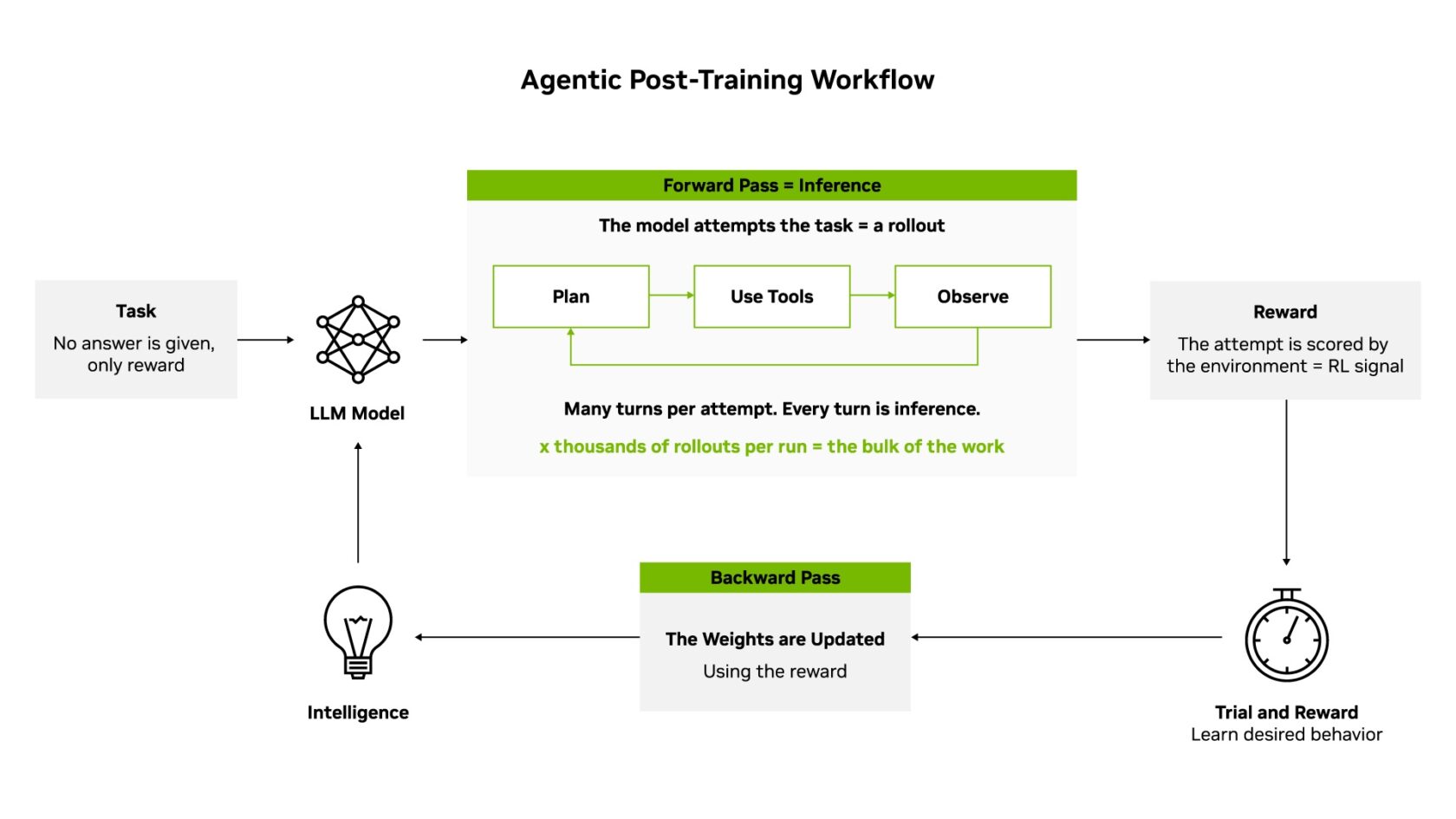
If an agent encounters a broken API, a misunderstood policy, or a complex coding error mid-run, it cannot simply return an error message. It must plan, recover, and adapt. Because the environments in which these agents operate change from week to week, the "finishing step" of post-training—the process of refining a model after its initial exposure to raw data—has evolved from a one-time event into a continuous, iterative loop.
Chronology: From Static Training to the Continuous Loop
The trajectory of AI development has moved through distinct phases, each requiring more sophisticated compute orchestration:
- Phase 1: The Pre-Training Era: Early AI development focused on "next-token prediction." By ingesting massive datasets, models achieved linguistic fluency. However, they lacked the reasoning capacity to solve complex, multi-step problems.
- Phase 2: The Instruction Tuning Phase: As developers realized fluency wasn’t enough, models were fine-tuned on curated datasets to follow basic commands. This made them "useful," but they remained brittle when faced with tasks outside their training distribution.
- Phase 3: The Agentic Revolution: Today, we are in the era of autonomy. Models are being trained using Reinforcement Learning (RL) to "think" in terms of goals rather than just tokens.
- Phase 4: The Continuous Loop: We have now arrived at a state where production feedback serves as the fuel for the next training cycle. As edge cases surface in the real world, they are fed back into the model, forcing a constant state of weight adjustment.
The Economics of Intelligence: Intelligence per Dollar
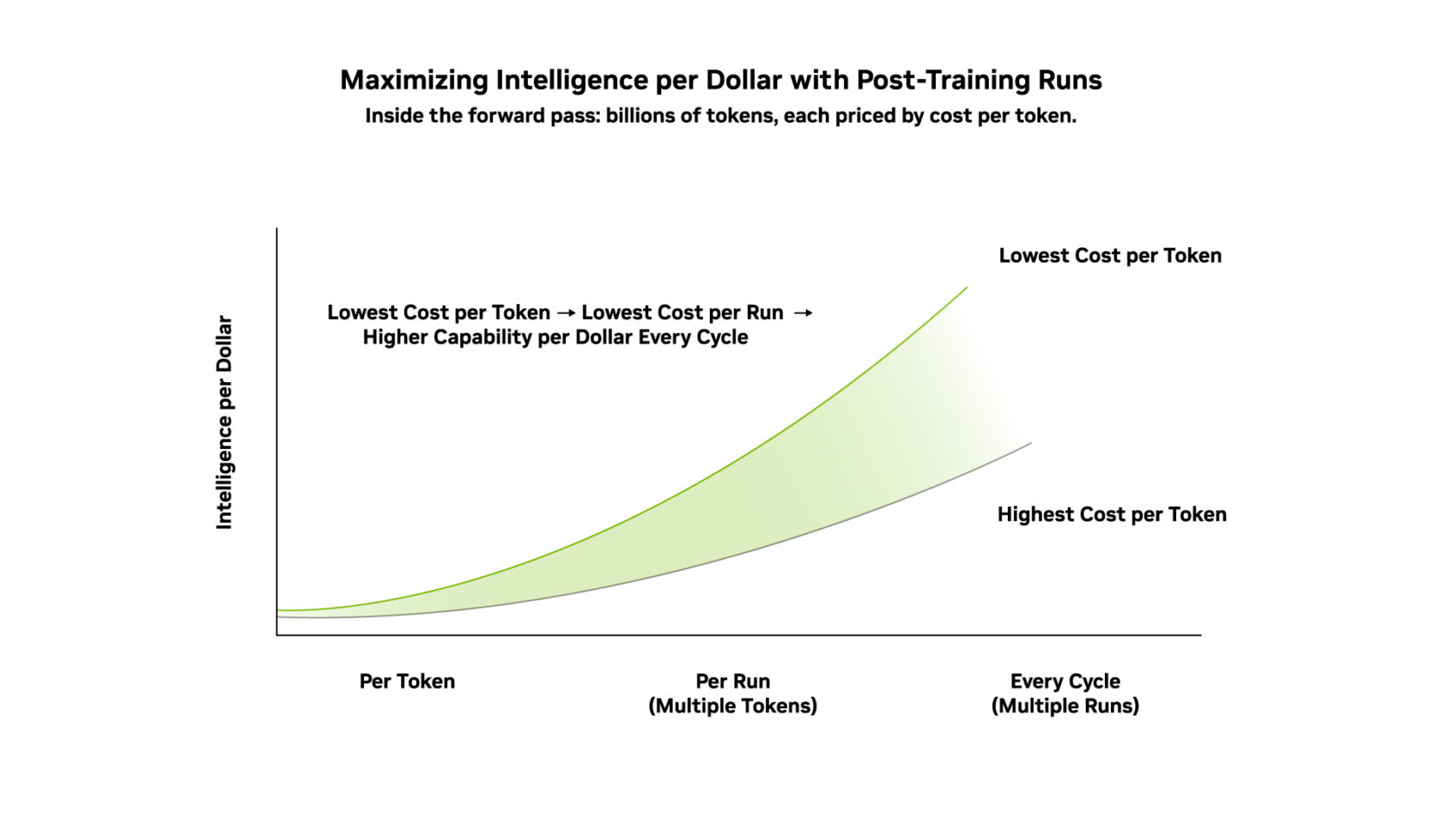
For years, the industry’s North Star metric was "cost per token"—the price of delivering one million tokens to an end-user. While vital for operational efficiency, it only measures the cost of serving the model, not the value of its output.
NVIDIA, through its latest platform architectures, has introduced a new, more holistic metric: Intelligence per Dollar.
This metric acknowledges that while inference (the forward pass) is the revenue engine, post-training (the backward pass) is the value multiplier. A model that is 10% more intelligent might be worth 50% more to a business, even if it costs slightly more to run. By maximizing the "yield" of every forward and backward pass, organizations can ensure that their infrastructure investment is not just reducing costs, but actively compounding the capability of their digital agents.
Supporting Data and Technical Infrastructure
The technical challenge of continuous post-training is an orchestration nightmare. It requires thousands of simulated environments running rollouts in parallel, constant verification of rewards, and seamless weight synchronization—all while keeping expensive accelerators fully utilized.
To solve this, the industry is moving toward standardized infrastructure. The NVIDIA NeMo ecosystem, specifically NeMo Gym and NeMo RL, has emerged as the standard for turning bespoke research into repeatable, scalable engineering.
The data confirms the necessity of this shift. Consider the performance of NVIDIA Nemotron 3 Ultra. A 550-billion-parameter Mixture-of-Experts (MoE) model, it achieved a 71.7% success rate on the SWE-bench verified coding benchmark. This means that for roughly seven out of every 10 real-world software bugs found in open-source projects, the model could produce a functional, test-verified fix. This is not just "chatting"; this is autonomous engineering.
The compute requirements for this are massive. Illustrative models suggest that a single high-performance cycle might require 20 billion rollout tokens, building upon millions of individual attempts. Without platforms like the NVIDIA Blackwell or the newer Vera Rubin architecture, this frequency of training would be economically prohibitive. Vera Rubin, in particular, has been co-designed to allow for one-fourth the GPU count of previous generations, drastically lowering the barrier to entry for continuous, high-intensity post-training.

Official Perspectives and Industry Adoption
The shift toward agentic, continuously trained models is already being validated by early adopters in the AI-native space.
Prime Intellect, a leader in the field, has been utilizing the NVIDIA Blackwell platform to create a sandbox for continuous post-training. Their internal analysis shows that by integrating the NVIDIA Vera CPU into their stack, they achieve a 30% increase in throughput per CPU compared to standard x86 architectures. This efficiency is exactly what allows them to run tighter, faster iteration loops—moving from a bug discovery in production to a model update in record time.
Perplexity AI has similarly adopted an asynchronous RL stack. By utilizing an RDMA-based weight transfer engine, they can sync trillion-parameter models across hundreds of GPUs in under two seconds. This level of synchronization is essential for ensuring that the "lessons" learned by an agent in one environment are instantly applied to the entire fleet of agents globally.
Together AI has also integrated these post-training methodologies into their "Post-Training as a Service" offering. By exposing the complexities of RL and Direct Preference Optimization (DPO) through an API, they are democratizing access to the same high-end training techniques previously reserved for the largest frontier labs.
Implications for the Future of Enterprise AI
What does this mean for the average enterprise? The implications are three-fold:
- The End of "Static" AI: Businesses should stop viewing AI as a software purchase and start viewing it as a talent acquisition. Like an employee, your AI agent needs to be onboarded, monitored, and—most importantly—continually trained on the specific nuances of your codebase and business policies.
- Infrastructure as a Competitive Moat: The companies that win in the next decade will be those that have the most efficient "intelligence loop." If your competitor can iterate their model’s logic in 24 hours while you take a month, you are effectively operating in a different technological century.
- The Rise of the "AI Factory": We are seeing the birth of the AI Factory—a facility where raw data is the input, and "intelligence" (in the form of updated model weights) is the output. The efficiency of this factory is determined by how well it manages the balance between inference and post-training.
In conclusion, the transition to agentic AI is not just a change in how we prompt computers; it is a fundamental shift in how we build them. By prioritizing "intelligence per dollar" and embracing continuous post-training, organizations can move beyond the hype of generative chatbots and into an era of reliable, autonomous, and constantly improving digital intelligence. The champions of this new era will not be those with the biggest models, but those with the fastest, most efficient, and most consistent learning cycles.