








SAN FRANCISCO — In a milestone development that signals a profound shift in how digital commerce is constructed and consumed, e-commerce infrastructure titan Shopify and front-end development platform Vercel have joined forces. The collaboration is engineered to build the next generation of online storefronts—platforms optimized equally for human shoppers and autonomous artificial intelligence agents.
The partnership took center stage at Vercel’s annual Ship 26 conference in San Francisco. Shopify CEO Tobi Lütke and Vercel CEO Guillermo Rauch stepped onto the podium to unveil a shared vision for "agentic commerce." Their joint presentation introduced the newly rebuilt Shopify Hydrogen software development kit (SDK) alongside Vercel Shop, a cutting-edge, AI-enabled open-source storefront template.
This alliance bridges the gap between Shopify’s battle-tested backend architecture and Vercel’s agile, modern application development tools. By doing so, the two tech leaders are laying the groundwork for a web where human-to-screen interaction is complemented—and frequently initiated—by machine-to-machine transactions.
Main Facts
The core of this partnership centers on two technological releases designed to simplify custom storefront development while making them machine-readable:
- The Rebuilt Shopify Hydrogen SDK: Hydrogen provides developers with a robust library of reusable components and tools to build high-performance Shopify storefronts across various JavaScript frameworks and runtimes. It abstracts away the heavy lifting of complex e-commerce functions.
- Vercel Shop Template: This open-source template packages Hydrogen’s tools into a fully customizable, ready-to-deploy storefront. Crucially, it embeds agent-readable product data and integrated shopping utilities directly into the architecture.
- Dual-Agent Architecture: Vercel Shop features a two-pronged approach to AI. First, it accommodates external AI agents—autonomous bots operating on behalf of human consumers to search, filter, and compile carts without needing to parse traditional visual HTML elements. Second, it includes an optional store-native shopping assistant designed to guide human visitors through product discovery, variant selection, and cart management via a conversational chat interface.
- Security and Payment Boundaries: While AI agents and internal assistants can modify carts, check real-time pricing, and verify stock availability via Shopify’s secure systems, they lack the authorization to finalize checkouts or process payments, ensuring human oversight remains mandatory at the point of purchase.
Chronology of Collaboration
The October unveiling at the Ship 26 conference was not an isolated event, but rather the culmination of months of engineering alignment between the two companies.
The groundwork for this partnership was officially laid earlier in the year on June 30, when Vercel and Shopify announced a major overhaul of the Hydrogen SDK. That summer release was designed to free developers from proprietary constraints, allowing them to leverage Shopify’s storefront infrastructure using whichever JavaScript frameworks they preferred.
Following the summer infrastructure updates, both engineering teams worked rapidly to conceptualize how these developer tools could be packaged for the emerging era of generative AI. By mid-October, that conceptual work materialized as the Vercel Shop template—a working blueprint that transformed abstract SDK functions into a tangible, deployable product showcased live on stage by Lütke and Rauch.
Supporting Data and Technical Architecture
Building custom e-commerce storefronts has historically been a notoriously complex and resource-intensive undertaking. Developers are forced to painstakingly integrate multiple disparate systems: catalog databases must feed product pages; inventory engines must supply real-time pricing and stock availability; and secure checkout pipelines must reliably retrieve and process selected items.
The combined architecture of the rebuilt Hydrogen SDK and the Vercel Shop template streamlines this heavy lifting by organizing commerce functions into standardized, reusable modules. According to technical documentation released by Vercel and Shopify, the architecture solves integration hurdles in three pivotal ways:
- Decoupled Presentation and Logic: Developers retain total creative freedom over the user interface (UI) and user experience (UX), building distinct frontend experiences while relying on Shopify’s rock-solid backend for inventory management, tax calculations, and order processing.
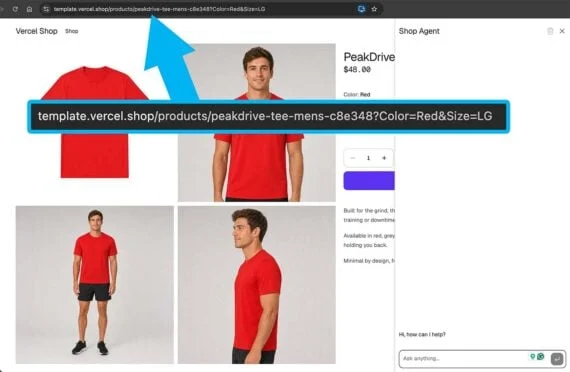
- Structured, Machine-Readable Data: Traditional websites rely on visual layouts, requiring scrapers to parse complex HTML or take screenshots to extract data. Vercel Shop exposes clean, structured product data and URL parameters (such as
template.vercel.shop/products/peakdrive-tee-mens?Color=Red&Size=LG) that external AI agents can instantly query, understand, and interact with programmatically. - Unified Cart State Management: Whether an item is added to a cart manually by a human browsing the visual storefront or programmatically by an internal or external AI assistant, the cart state remains universally synchronized. If a human shopper adds a jacket to their cart and then asks the store’s native AI assistant to swap the size or recommend a matching hat, the cart updates dynamically across both interfaces in real-time.
Official Responses and Industry Insights
The partnership underscores a shared philosophy between Shopify and Vercel regarding the distribution of labor in modern software development: let developers focus on user experience while relying on foundational infrastructure built over decades.
Elaborating on this strategy during their Ship 26 keynote, Shopify CEO Tobi Lütke addressed the sheer difficulty of building resilient e-commerce infrastructure, particularly when it comes to checkout systems.

"Checkouts are ridiculously hard to get right," Lütke told the audience. "It’s one of those pieces of software that actually does need 20 years of tinkering with. And Shopify has always been very open, and so we invite people to remix pieces from our checkout just as much as you want. Basically taking all the infrastructure that Shopify built, and you can build whatever you want with it."
By opening up these underlying systems, Shopify enables developers to concentrate entirely on how shoppers discover products, interact with brand narratives, and navigate custom storefronts—all while resting on a secure, enterprise-grade foundation.
Vercel CEO Guillermo Rauch echoed these sentiments, emphasizing that the modern web must evolve to accommodate non-human traffic. As autonomous agents become primary actors in digital spaces, storefronts can no longer afford to treat browsers as exclusively human-operated. Vercel’s live deployment of its own merchandise store (vercel.store) serves as a working testament to this philosophy, acting as a live sandbox for developers eager to test the template’s dual-nature capabilities.
Implications for the Future of E-Commerce
The Shopify-Vercel collaboration carries profound implications for merchants, developers, and consumers alike.
For Merchants
Online merchants have spent the last decade optimizing their sites for human eyes and search engine crawlers (SEO). The rise of agentic commerce demands a new discipline: optimization for AI agents (often referred to in the industry as Generative Engine Optimization or GEO).
Because Vercel Shop provides structured, agent-accessible product data out of the box, merchants utilizing this template are instantly positioned to capture traffic from autonomous shopping assistants, AI-driven comparison tools, and consumer-facing bots. Furthermore, because the internal store assistant is fully customizable—allowing developers to configure access via Vercel’s AI Gateway—merchants can tailor brand voice, policy explanations, and product recommendations to match their exact business model.
For Developers
For front-end engineers, the partnership drastically lowers the barrier to entry for building high-performance, bespoke e-commerce experiences. Instead of writing custom logic from scratch to connect catalogs, carts, and checkout APIs, developers can leverage Hydrogen’s modular tools within their preferred JavaScript frameworks. This accelerates time-to-market and allows engineering teams to focus on bespoke branding and advanced AI integrations rather than foundational plumbing.
For Consumers
Shoppers stand to benefit from unprecedented flexibility. Human buyers can enjoy fast, visually rich, highly customized web stores complete with optional conversational assistants—comparable to enterprise solutions like Amazon’s Alexa for Shopping or Walmart’s Sparky—to help navigate complex product variants and policies.
Simultaneously, consumers who prefer delegation can deploy their own personal AI shopping agents. These bots can autonomously scour merchant domains built on templates like Vercel Shop, evaluate options, negotiate specifications, and compile carts efficiently, stripping away the friction of manual browsing.
However, by maintaining a strict firewall that prevents AI agents from executing final payments or accessing sensitive financial data, Shopify and Vercel ensure that security and consumer trust remain paramount.
As the lines between human intent and machine execution continue to blur, the Shopify and Vercel alliance marks a definitive turning point. E-commerce is no longer just a digital catalog for people sitting behind screens; it is rapidly evolving into an interconnected, intelligent ecosystem where humans and algorithms shop side-by-side.