







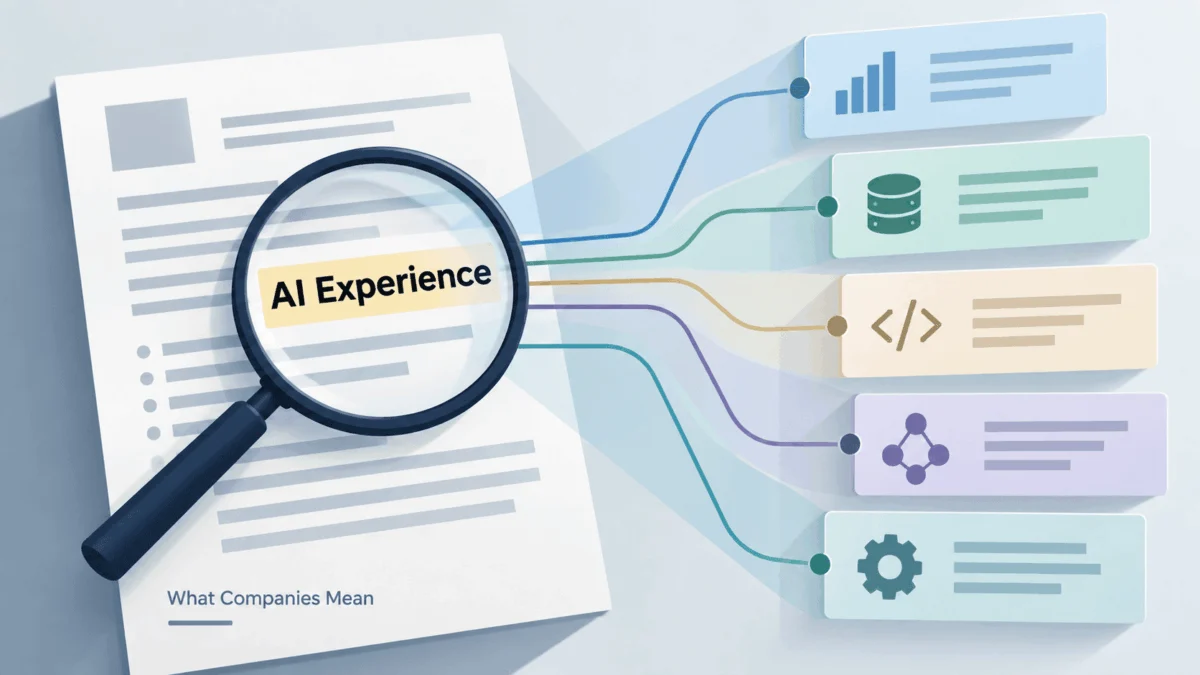
In the contemporary job market, the landscape for data analysts, statisticians, and researchers has been fundamentally reshaped by two words: "AI experience." A quick scan of platforms like LinkedIn or Indeed reveals this phrase as a ubiquitous, almost mandatory, bullet point in job descriptions across nearly every sector. Yet, for the seasoned professional, this requirement often triggers a sense of ambiguity. Does it demand the ability to train a Large Language Model (LLM) from scratch? Does it mean proficiency in using generative AI tools like ChatGPT or Copilot? Or is it merely a signaling mechanism for a company’s desire to appear technologically forward-thinking?
As the demand for AI-literate talent reaches a fever pitch, the term has become increasingly diluted. For candidates, the challenge is no longer just about possessing the skills; it is about interpreting the disparate, often vague expectations of hiring managers who may not even be in total agreement on what "AI experience" truly entails.
The Semantic Mirage: Why "AI Experience" Lacks a Standard Definition
To navigate this terrain, one must first recognize that "AI experience" is, at its core, a marketing term rather than a technical specification. Unlike requirements such as "five years of experience in Python" or "proficiency in Bayesian statistics"—which carry specific, measurable expectations—"AI experience" is a chameleon.
When a retail giant lists it as a requirement, they may be looking for someone to optimize inventory supply chains using predictive modeling. Conversely, a biotech startup might be looking for someone capable of integrating pre-trained neural networks into drug discovery workflows. A financial services firm might simply want an analyst who understands the ethical risks of automated credit scoring.
This ambiguity is rarely an accident. Hiring teams often utilize the term to signal modernity and to filter for candidates who are keeping pace with the rapid evolution of the field. It is a broad net cast to catch talent that is "in the loop." Consequently, the burden falls on the applicant to act as a cryptographer, decoding the intent behind the listing by examining the industry context, the seniority level, and the specific duties outlined in the job description.
The Taxonomy of AI Requirements
To translate your background into the language of the modern recruiter, it is essential to categorize what a company is actually asking for. Most roles labeled with "AI experience" fall into one of four buckets:
- AI-Augmented Productivity: The focus here is on leveraging existing tools (e.g., GitHub Copilot, ChatGPT, Claude) to accelerate data cleaning, code writing, or report generation.
- Informed Consumer of AI: The employer wants a professional who understands the inputs and outputs of AI systems, specifically how to evaluate model performance and detect bias.
- Applied Machine Learning: The role involves building, tuning, and deploying traditional ML models—often utilizing frameworks like Scikit-learn or XGBoost—to solve specific business problems.
- Domain-Specific AI Innovation: The most advanced tier, requiring deep knowledge of specialized models, such as computer vision, NLP, or reinforcement learning, applied to a niche industry problem.
Bridging the Gap: From Statistician to AI Practitioner
One of the most persistent myths in the industry is that a professional with a background in traditional statistics must "reboot" their entire skill set to be considered an AI candidate. This is a fallacy. The foundation of almost everything classified as "AI" in a business context—whether it is predictive analytics, classification, or recommendation systems—is rooted in statistical training.
The gap between a traditional statistician and an "AI practitioner" is predominantly one of vocabulary and tooling, not underlying reasoning. A statistician understands variance, bias, p-values, and overfitting—the very pillars upon which robust AI models are built.
Translating Your Resume for Maximum Impact
Rather than overhauling your resume with buzzwords, focus on translation. If your resume states, "Built predictive regression models to forecast quarterly demand," a hiring manager seeking AI experience sees someone who understands supervised learning and feature engineering.
To bridge this gap:
- Frame through Outcomes: Instead of focusing on the tool used, emphasize the reasoning process. Describe how you identified a business problem, selected the appropriate model, evaluated the accuracy, and—crucially—managed the limitations of the output.
- Highlight Data Quality: AI models are only as good as the data they consume. Emphasize your experience in data cleaning, anomaly detection, and handling missing values. These are, and will remain, the most critical "AI" skills.
- Connect to Business Value: AI is a means to an end. Explain how your models led to cost savings, increased revenue, or improved operational efficiency.
Decoding the Job Posting: A Statistical Approach
Treat a job description as you would any other dataset. It is a noisy signal that requires careful analysis to extract the ground truth. A common error is to obsess over the "Headline Requirements." These are often aspirational, a "wish list" written by HR teams hoping to attract a unicorn candidate.
Instead, look for the "Body of Evidence":
- The Responsibilities Section: This is the most accurate reflection of the role’s daily reality. If the responsibilities involve "data pipeline maintenance" and "automating manual reports," the role is likely focused on AI-augmented productivity. If they mention "model deployment" and "latency optimization," you are looking at an applied machine learning role.
- Modifier Clues: Pay attention to the language used. "AI experience preferred" often acts as a tie-breaker. "AI experience required" without further detail usually points to Category 1 or 2. "Hands-on experience with PyTorch/TensorFlow" is a clear signal that the company is looking for a Category 3 or 4 practitioner.
The Seniority Signal: Adapting Your Narrative
The expectations for "AI experience" scale significantly with the seniority of the position. Understanding these expectations allows you to tailor your interview performance effectively.
| Seniority Level | The Core Requirement | What It Looks Like in Practice |
|---|---|---|
| Junior | Adaptability | Comfort with new tools, a "growth mindset," and the willingness to learn internal frameworks without fear of AI outputs. |
| Mid-Level | Informed Collaboration | The ability to work alongside engineering teams, interpret model performance, and act as a bridge between technical outputs and business needs. |
| Senior | Strategic Judgment | Knowing when to avoid AI, communicating risks and limitations to stakeholders, and ensuring the organization deploys AI responsibly and cost-effectively. |
Dispelling Common Misconceptions
As the industry matures, several myths have taken hold, potentially deterring qualified candidates from applying for high-impact roles.
Myth 1: "I must list every AI tool I have ever touched."
In practice, this is counterproductive. Hiring managers value candidates who demonstrate judgment—the ability to choose the right tool for the problem—rather than those who simply provide a laundry list of software. Focus on the problems you solved and the reasoning behind your choice of methodology.
Myth 2: "I am disqualified if I haven’t built a model from scratch."
For the vast majority of companies, the ability to build a model from scratch is less important than the ability to think critically about data quality and result interpretation. If you can explain why a model might fail in production, you are already ahead of most candidates who can simply write the code to train it.
Myth 3: "I need an expensive certification to be considered."
While credentials can be helpful for networking, most hiring managers are primarily evaluating your reasoning. Can you explain the limitations of your approach? Can you explain a complex result to a non-technical stakeholder? These "soft" skills are far more persuasive than a list of completed online courses.
Implications for the Future of Work
The rise of "AI experience" as a standard job requirement marks a permanent shift in the labor market. It signals that companies are moving beyond the hype phase and into the implementation phase. They are no longer just looking for "data scientists"; they are looking for "AI-enabled thinkers."
For the professional, the path forward is clear: lean into your foundational knowledge. AI tools will continue to evolve, and the frameworks we use today may be obsolete in three years. However, the ability to interpret data, apply rigorous statistical reasoning, and solve complex business problems will remain the gold standard. By treating "AI experience" as a conversation starter rather than a rigid barrier, you can position yourself not just as a user of technology, but as a strategist who can navigate the complexities of an AI-driven future.