








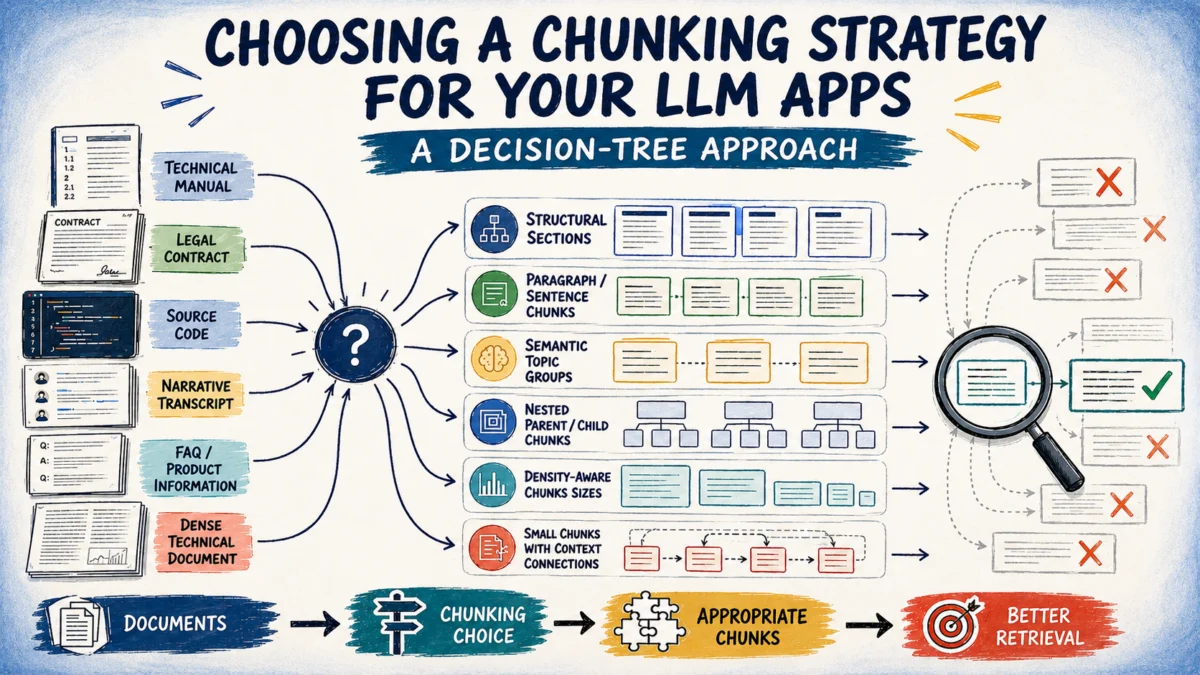
In the rapidly evolving landscape of Retrieval-Augmented Generation (RAG), the efficacy of an AI system is often determined long before the first prompt is sent to an LLM. While developers often obsess over model selection or fine-tuning, a critical bottleneck frequently lies in the preprocessing phase: chunking.
As organizations move from experimental prototypes to production-grade RAG applications, they encounter a fundamental challenge—the "Goldilocks" problem of data segmentation. Documents often exceed the token limits of embedding models, necessitating a strategy to break them into manageable units. However, arbitrary splitting can destroy semantic coherence, rendering the most advanced LLMs ineffective. This article provides a definitive, decision-tree-based framework to help developers align their chunking strategy with their specific document architecture and retrieval requirements.
The Core Problem: Why Boundary Matters
The premise of RAG is to provide an LLM with relevant context extracted from a vector database. If the retrieved "chunk" is missing crucial information or contains noise, the LLM’s response will inevitably suffer—a phenomenon often referred to as "garbage in, garbage out."
Poorly chosen boundaries can lead to two primary failure modes:
- Context Fragmentation: A chunk ends mid-sentence or mid-thought, cutting off the vital context required for the model to understand a concept.
- Semantic dilution: A chunk is so large that it contains multiple unrelated topics, confusing the embedding model and leading to imprecise vector representations.
Selecting a strategy is not merely a technical preference; it is a strategic decision that balances retrieval accuracy, computational latency, and financial overhead.
Chronology of Strategy Development
To understand the current state of chunking, one must look at how the field has evolved from rudimentary methods to sophisticated, agentic architectures.
- Phase 1 (The Baseline): Fixed-size chunking. This was the early standard, treating text as a stream of tokens. It was fast and easy to implement but frequently ignored the semantic structure of the underlying content.
- Phase 2 (The Structural Pivot): Recursive and document-based chunking. Developers realized that human-authored content follows rules—paragraphs, headers, and code blocks. By honoring these, retrieval accuracy increased significantly.
- Phase 3 (The Semantic Era): With the advent of better embedding models, the industry pivoted to "Semantic Chunking," which uses vector distance to determine where a topic ends and another begins.
- Phase 4 (The Current Frontier): Adaptive, Hierarchical, and Agentic chunking. Modern systems now utilize LLMs to analyze documents dynamically or maintain multi-level representations of data, allowing for both broad summary retrieval and granular fact-checking.
A Decision-Tree Framework for Selection
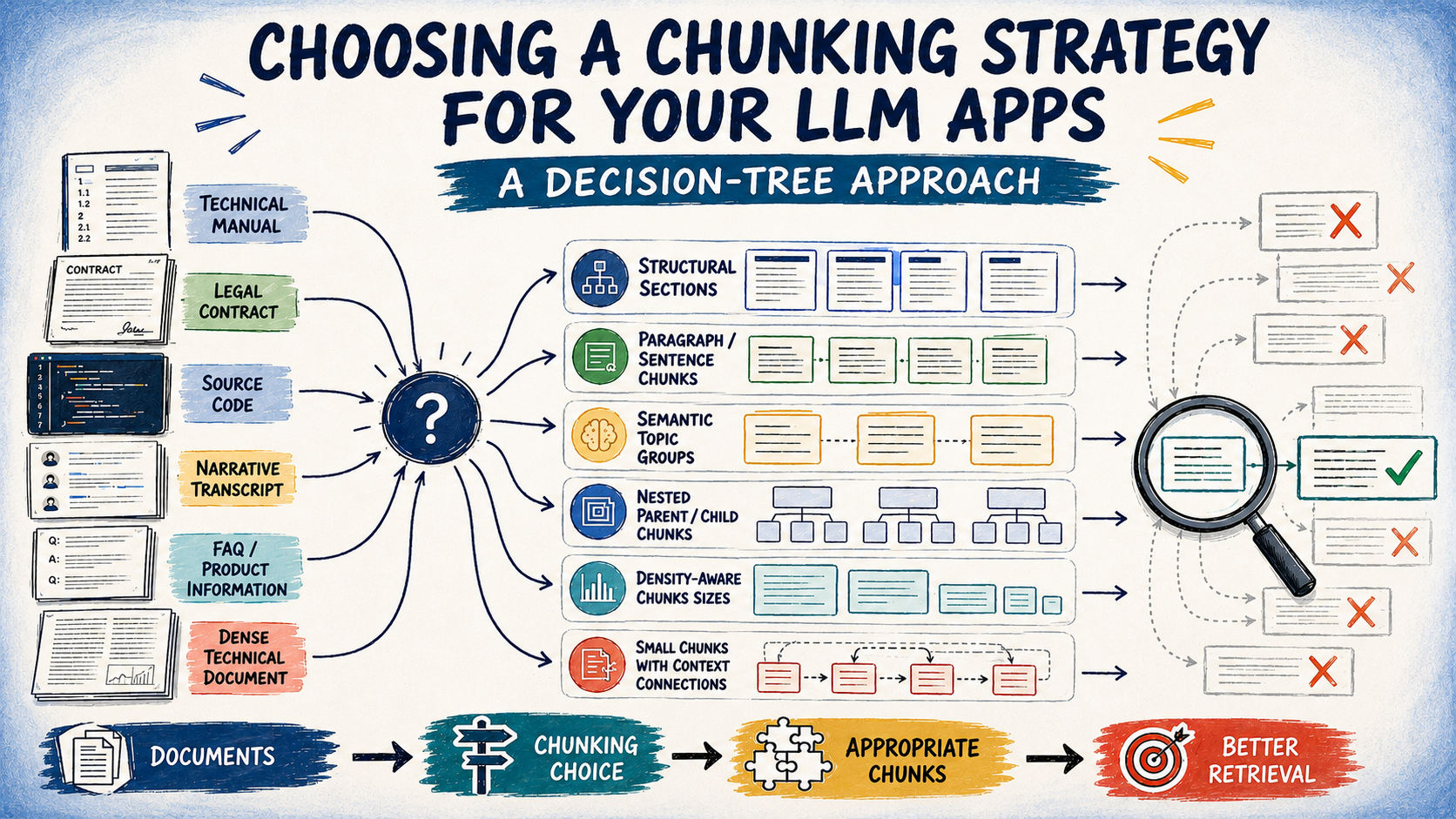
Choosing the right strategy is best approached as a series of diagnostic questions. By following this decision tree, you can move away from guesswork and toward an evidence-based configuration.
Q1: Is Chunking Actually Required?
Before implementing complex pipelines, assess the documents themselves. Short, self-contained assets—such as FAQ entries, individual configuration files, or brief product descriptions—are often better served as "whole-document" embeddings. If the content is coherent and fits comfortably within your model’s context window, skip chunking. Adding unnecessary complexity increases latency and can dilute the quality of the vector search.
Q2: Is there a Formal Document Structure?
If the data follows a pattern—such as Markdown, HTML, or code repositories—utilize Document-based chunking. This leverages the natural headers, function definitions, or XML tags to define boundaries. By respecting these logical units, you ensure that the retrieval engine returns meaningful, cohesive segments rather than arbitrary strings of text.
Q3: Are there Cross-Document Dependencies?
Some documents, particularly legal contracts or technical specifications, rely on definitions established in earlier sections. If a specific chunk loses its meaning when removed from the broader document, Late Chunking is the superior choice. This involves embedding the entire document using a long-context model, then deriving chunk-level embeddings from that comprehensive representation, ensuring each chunk retains a "memory" of the document-wide context.
Q4: How Variable is Information Density?
When dealing with a corpus where some sections are dense with facts while others are verbose filler, a one-size-fits-all approach fails.
- If you need both high-level summaries and granular details, Hierarchical Chunking allows you to retrieve both parent summaries and child snippets.
- If the information density varies wildly, Adaptive Chunking dynamically adjusts the size of the segment to maintain a consistent level of semantic information per chunk.
Q5: What is the Priority: Quality or Cost?
This is the ultimate business trade-off.
- LLM-based chunking is the "gold standard" for high-stakes environments where accuracy is paramount. An LLM acts as an editor, identifying logically distinct points. It is expensive but highly precise.
- Semantic Chunking offers a middle ground. It uses embedding distances to identify topic shifts without the heavy compute cost of a full LLM pass.
Q6: Heterogeneous vs. Uniform Collections
If your system must process a mix of document types—for instance, a library containing both technical manuals and marketing blurbs—Agentic Chunking is the solution. An agent (a small, fast LLM) inspects each document type and selects the optimal strategy (e.g., Document-based for manuals, Semantic for marketing). If the collection is uniform, Recursive Chunking remains the most practical, robust default.
Supporting Data: Comparative Analysis of Strategies
| Strategy | Computational Overhead | Semantic Precision | Best Use Case |
|---|---|---|---|
| Fixed-size | Very Low | Low | Rapid Prototyping |
| Recursive | Low | Moderate | Uniform, text-heavy corpora |
| Document-based | Moderate | High | Structured files (Markdown/HTML) |
| Semantic | Moderate/High | High | Unstructured, topic-shifting text |
| LLM-based | Very High | Excellent | High-stakes legal/technical docs |
| Agentic | High | Superior | Mixed-media/Hybrid collections |
Implications of Strategic Misalignment
Failure to choose the correct strategy results in "Retrieval Drift." When a system uses a structure-blind method (like fixed-size) on a highly structured document (like a code repository), the resulting chunks are often orphaned from their parent functions or classes.
Common Symptoms and Remedies:
- Mid-sentence cut-offs: Switch from Fixed-size to Recursive or Document-based.
- Inconsistent retrieval quality: If Semantic chunking produces erratic results, the similarity threshold is likely miscalibrated; consider tightening the threshold or incorporating LLM-assisted validation.
- Compute budget overruns: If Agentic chunking is proving too expensive, cache the strategy decisions. Do not re-analyze the same document structure every time the index is updated.
Conclusion: The Path Forward
The architecture of your RAG pipeline is a reflection of your data’s inherent nature. There is no "perfect" chunking strategy, only a strategy that is perfectly aligned with your retrieval goals.
Begin by auditing your document repository. Are they structured or fluid? Do they contain cross-references? Once these questions are answered, apply the simplest method that meets your accuracy threshold. Remember that as your system scales, you can move toward more advanced, agentic approaches. By thoughtfully engineering your boundaries, you provide your LLM with the most reliable foundation, ultimately delivering superior, contextually accurate answers to your users.
As the RAG ecosystem matures, the focus will continue to shift toward smarter preprocessing. Those who master the art of data segmentation today will build the most resilient and capable AI systems of tomorrow.