






In the digital age, YouTube has become the world’s largest, most accessible university. From DIY home repair and software engineering tutorials to complex psychological frameworks and geopolitical analysis, the platform hosts an inexhaustible supply of knowledge. However, for many, the "YouTube learning curve" is fraught with frustration. Creators often move at a breakneck pace, gloss over foundational concepts, or leave viewers struggling to synthesize information across disparate videos.
For years, productivity enthusiasts have relied on a fragmented ecosystem of tools—Google Keep for fleeting thoughts, Notion for complex databases, and Obsidian for long-form synthesis. Yet, these tools all shared a common failure: they required immense manual effort. The bottleneck wasn’t finding the information; it was the cognitive labor required to process, structure, and retain it.
Enter the synergy between Google’s Gemini Notebook (NotebookLM) and YouTube. By treating video content as a searchable, interactive knowledge base, users are no longer forced to manually transcribe or laboriously pause and rewind. This integration is effectively turning the passive act of watching videos into a structured, academic-style learning experience.

The Evolution of Note-Taking: Why Manual Transcription is Obsolete
To understand the magnitude of this shift, one must look at the historical trajectory of note-taking. Traditionally, the process was linear and labor-intensive. A student or professional would watch a video, hit pause, transcribe a key point, and hit play again. This "start-stop" cycle frequently breaks the flow of thought, making it difficult to grasp high-level patterns or complex arguments.
Over the last decade, we have seen a transition toward "second brain" methodologies, where individuals aim to store everything they learn in a digital archive. However, the rise of AI-driven synthesis has changed the requirement from storage to retrieval and contextualization. Gemini Notebook represents the next evolution: a tool that acts as an intelligent layer between the raw media and the user’s cognitive grasp.
By ingesting video transcripts automatically, Gemini Notebook eliminates the "blank page" syndrome. Instead of staring at a blinking cursor, the user starts with a fully summarized, indexable version of the content, allowing them to engage with the material at their own pace—effectively slowing down the fastest creators to a speed that facilitates deep learning.

Chronology of an Integrated Workflow
The transformation of YouTube from a video repository to a study tool follows a distinct, repeatable chronology:
- Curation: The user identifies a series of videos, often across a playlist, that cover a specific subject—for instance, the fundamentals of behavioral psychology or personal finance strategies.
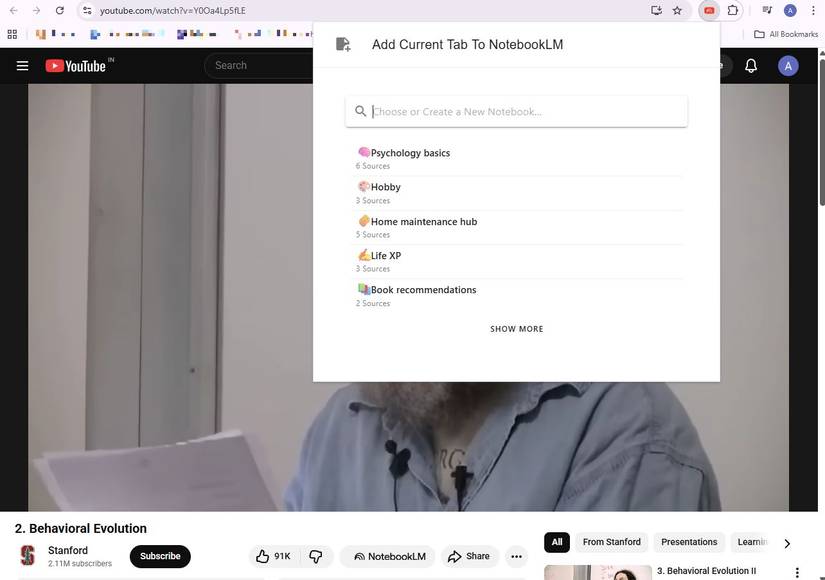
- Ingestion: Using browser-based integrations, such as the "YouTube to Gemini Notebook" Chrome extension, the user bypasses the manual process of copying and pasting individual URLs. The content is fed directly into the notebook.
- Synthesis: Gemini Notebook processes the transcripts, identifying key themes, contradictions, and commonalities across different creators.
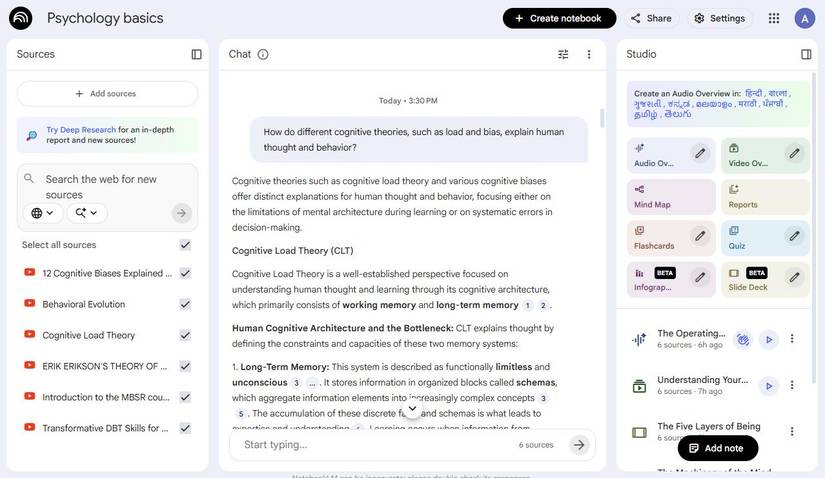
- Interactive Engagement: The user queries the notebook, asking for summaries, expansion on specific sections, or "connect-the-dot" explanations.
- Reinforcement: The final stage involves creating visual mind maps, listening to AI-generated "Audio Overviews," and testing knowledge through generated pop-quizzes.
The Mechanics of Synthesis: Turning Data into Wisdom
One of the most significant hurdles in learning from multiple sources is the lack of a cohesive narrative. If one creator discusses "confirmation bias" in the context of investment, while another discusses it in the context of interpersonal relationships, the learner often struggles to bridge the gap.
Gemini Notebook excels here by acting as a personal tutor. When fed a batch of videos, the tool doesn’t just summarize them in isolation; it cross-references the material. It can highlight where two creators might disagree or provide nuanced perspectives on the same concept. This allows the learner to construct a "master lesson" that is greater than the sum of its parts.
Building the Visual Architecture
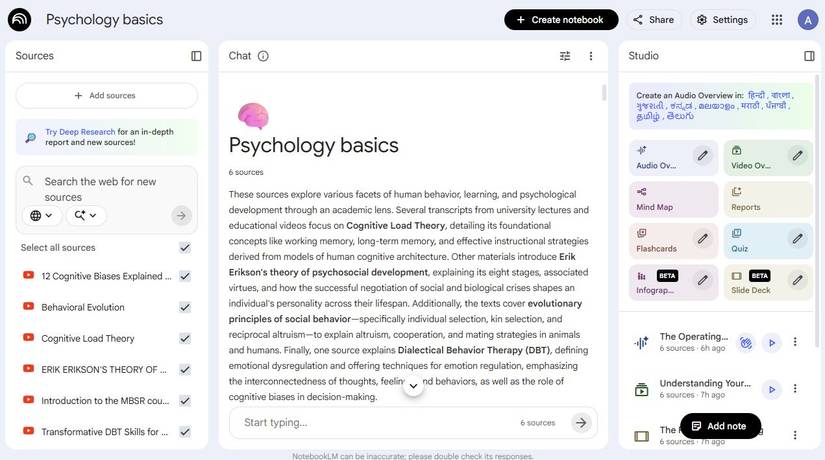
Visual learners often struggle with text-heavy notes. The introduction of automated Mind Maps within the Gemini Notebook ecosystem is a breakthrough. These maps visualize the relationship between topics, placing a core concept at the center with branches extending into sub-topics and supporting details. This spatial organization mimics how the human brain naturally associates information, making it easier to recall facts during high-pressure situations or deep-work sessions.
Supporting Data: The Impact on Retention
While traditional note-taking methods emphasize the act of writing as a memory aid, the sheer volume of content on YouTube necessitates a more efficient filtering mechanism. Studies in cognitive load theory suggest that when learners are overwhelmed by the pace of information delivery, their ability to transfer that information into long-term memory diminishes.
By delegating the summarization and structuring of data to an AI, the learner preserves their cognitive resources for high-level synthesis and application. The "Audio Overview" feature—which converts complex technical or educational content into a conversational, podcast-style summary—serves as a secondary reinforcement mechanism. Users report that listening to these summaries during commutes or physical activity reinforces concepts that might otherwise be forgotten shortly after a video concludes.
Official Stance and Technical Implications
Google’s development of NotebookLM suggests a broader strategic move toward "AI-first" productivity. By integrating these features into the Google ecosystem, the company is positioning itself as the primary infrastructure for personal knowledge management.
From an engineering perspective, this represents a move toward multimodal AI. The model is not merely reading text; it is understanding temporal relationships within video transcripts. It recognizes that a mention of a topic at the 5:00 mark is related to a point made at the 15:00 mark, even if the creator does not explicitly draw the connection. This level of semantic understanding is a significant jump from traditional keyword-based search.
Practical Strategies for Maximizing the Workflow
For those looking to adopt this system, success is heavily dependent on "prompt engineering" and preparatory curation. Here are the refined best practices:
- Contextual Framing: When querying the notebook, avoid generic prompts like "summarize this." Instead, use role-based prompting: "Explain these concepts as if you are a professor of economics teaching a beginner," or "Identify the contradictory claims between these two videos regarding tax strategies."
- The "Fresh Notebook" Rule: Avoid mixing disparate topics. Create dedicated notebooks for distinct subject matter. If you are learning about "Machine Learning," do not dilute that notebook with videos about "Home Cooking." This keeps the AI’s focus narrow and the resulting insights more precise.
- Scenario-Based Testing: Use the AI to generate practice questions based on the video content. By challenging yourself to apply the information to hypothetical scenarios, you shift from passive consumption to active application, which is the gold standard for learning.
The Future of Self-Directed Learning
The integration of Gemini Notebook and YouTube is more than a productivity hack; it is a shift in how we approach intellectual growth. We are moving toward an era where the barrier to entry for mastering complex, highly technical subjects is lower than ever before.
The limitations of the past—forgetting content, struggling to find specific timestamps, and the inability to synthesize multiple expert opinions—are being systematically dismantled. As these tools become more sophisticated, the role of the learner will evolve from a harvester of information to an architect of understanding.
By leveraging AI to handle the "heavy lifting" of data organization, individuals are free to spend their time on what truly matters: critical thinking, synthesis, and the application of knowledge to solve real-world problems. The classroom of the future is not a physical building; it is a digital space where the world’s knowledge is curated, connected, and clarified at the click of a button.