







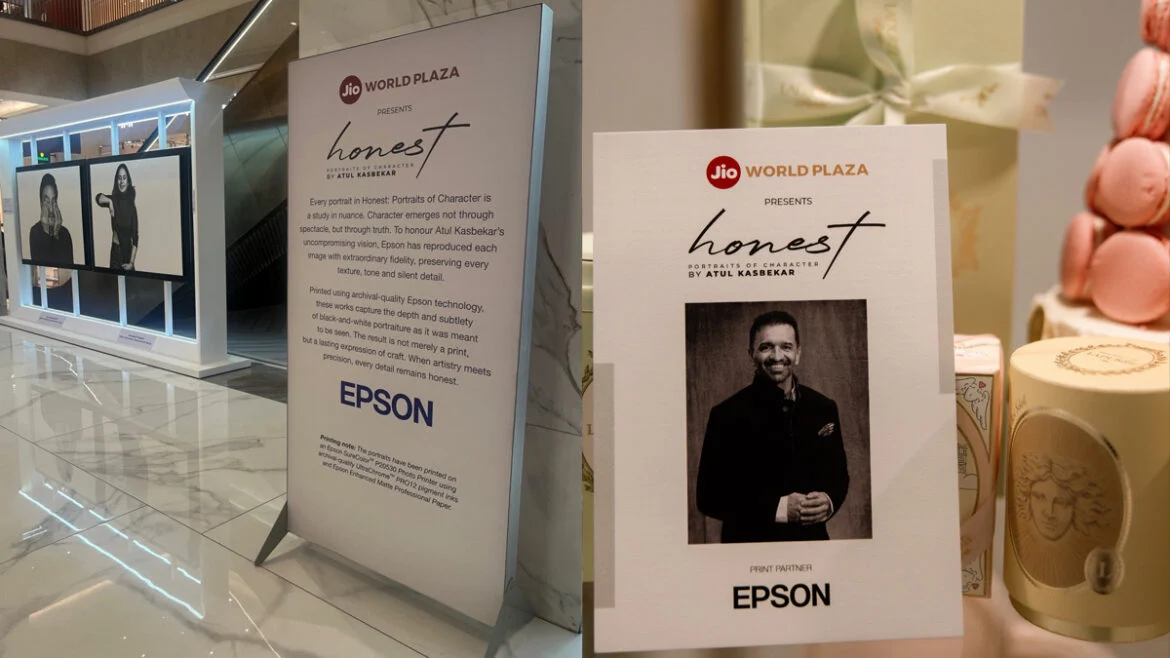
MUMBAI — In an era dominated by fleeting digital feeds and ephemeral social media content, a landmark photography exhibition in Mumbai is offering a masterclass in permanence, raw authenticity, and artistic depth. HONEST: Portraits of Character, a compelling collaboration between acclaimed photographer and film producer Atul Kasbekar and global imaging technology leader Epson, has opened its doors at the prestigious Jio World Plaza located in the Bandra Kurla Complex (BKC).
Serving as the official print partner for the exhibition, Epson has brought its cutting-edge professional printing ecosystem to a showcase that honors the bedrock of Indian cinema: its character actors. Running from June 5 to July 5, this public exhibition blends the worlds of fine-art photography, cinematic history, and storytelling. Spanning Levels 1 and 2 of the upscale retail and cultural hub, the showcase invites art lovers, cinema buffs, and photography enthusiasts to experience 56 large-format black-and-white portraits that peel back the layers of stardom to reveal the human being underneath.
1. Main Facts: The Anatomy of ‘HONEST’
At its core, HONEST: Portraits of Character is a visual tribute to 56 of India’s most accomplished, versatile, and critically acclaimed character actors. These are the performers who, decade after decade, have injected soul, realism, and nuance into Indian cinema. They have often carried the emotional weight of complex narratives while standing just outside the blinding glare of traditional leading-man or leading-lady stardom.
The carefully curated lineup features heavyweights of the Indian screen, including:
- Naseeruddin Shah
- Anupam Kher
- Pankaj Tripathi
- Boman Irani
- Arshad Warsi
- Kay Kay Menon
- Ratna Pathak Shah
- Rasika Dugal
What sets these portraits apart immediately is their deliberate rejection of modern post-processing tropes. Stripped entirely of heavy digital retouching, smoothing filters, and commercial embellishments, the images embrace raw vulnerability. Every line, shadow, wrinkle, and glare is left exposed. By doing so, Kasbekar allows the natural expression, distinct personality, and accumulated lived experience of each actor to occupy center stage.
The exhibition is open to the public free of charge, transforming Jio World Plaza from a conventional luxury shopping destination into an accessible, high-brow cultural sanctuary.
2. Chronology: Bringing the Vision to Life
The realization of HONEST represents months of meticulous planning, execution, and fine-tuning between Kasbekar’s creative team and Epson’s technical specialists.
- The Conceptualization Phase: Long before the prints touched archival paper, Atul Kasbekar envisioned a project that would honor character actors without the distraction of wardrobe gloss, heavy makeup, or studio theatrics. The photography sessions focused on intimate, uninterrupted engagement between the lens and the subject.
- The Fine-Tuning and Calibration (Pre-Exhibition): Translating digital capture into physical, gallery-grade museum pieces requires a rigorous workflow. Working closely with Epson’s technical standards, the raw monochrome files underwent precise calibration. The goal was to eliminate any digital coldness, ensuring the final output possessed organic warmth and tactile presence.
- June 5, 2025 – Opening Day: The exhibition officially launched to the public and invited media across Levels 1 and 2 of Jio World Plaza, immediately drawing critical acclaim for its stark visual honesty and impeccable print execution.
- June 5 to July 5, 2025 — The Public Run: A month-long immersive window allowing thousands of visitors to interact with the works, study the prints up close, and engage with the cultural narrative of Indian cinema.
3. Supporting Data & Technology: The Science of Monochrome Mastery
In fine-art monochrome photography, black and white are not merely the absence and presence of color; they represent an infinite spectrum of gray tones, texture gradients, and emotional resonance. Achieving museum-quality reproduction for 56 large-format prints demanded technology capable of capturing the subtlest whisper of light on skin.
To achieve this, the exhibition relied heavily on Epson SureColor large-format printers. These machines are industry-standard powerhouses designed specifically for fine-art reproduction, photography, and proofing environments where precision is non-negotiable.
Key technical components of the print production include:
- Epson UltraChrome PRO12 Archival-Grade Pigment Inks: Utilizing a 12-color ink set, these pigment inks offer exceptional density, expanded black density, and superior tonal transitions. For black-and-white photography, they eliminate metamerism (color shifting under different light sources) and ensure deep, velvety blacks without sacrificing shadow detail.
- Professional Fine-Art Media: The images were printed on specialized archival media designed to absorb ink uniformly while maintaining surface texture, giving the portraits a tactile, almost painterly depth.
- Longevity and Archival Stability: Because the works are displayed in a public plaza environment for a prolonged period, resistance to light degradation and atmospheric changes is vital. Epson’s pigment technology ensures that these prints retain their tonal integrity for decades, fulfilling the archival demands required of fine-art investments.
4. Official Responses and Leadership Perspectives
The convergence of high-end portraiture and precision printing elicited strong, reflective commentary from the creative minds steering the collaboration.
Atul Kasbekar, reflecting on the philosophical and technical alignment of the project, emphasized that the physical print is the ultimate arbiter of a photograph’s success:
"HONEST is about authenticity in its purest form. These actors bring an extraordinary honesty to the camera, and it was critical that every detail translated faithfully into print. The prints are the exhibition," stated Kasbekar. "Epson photo printers’ ability to reproduce subtle tonal gradations, especially in black and white, made them the ideal partner for this project. Without this level of precision, the raw soul of these portraits would have been compromised."
From the corporate perspective, Epson views this partnership as a powerful validation of the physical print in an increasingly digitized world. Tushad Talati, Director of Brand and Communication at Epson India, elaborated on the philosophy of photographic permanence:
"Photography does not end when a shutter clicks and an image is saved to a memory card. The final print is where the photographer’s vision truly comes to life and is shared with the world," noted Tushad Talati. "At Epson, we have spent decades advancing the art and science of photographic printing, helping photographers transform digital files into enduring works of expression. Through this collaboration with Atul Kasbekar, we are enabling audiences to experience his work with the depth, detail, and uncompromised authenticity he originally intended."
5. Implications: Redefining Retail Spaces and the Future of Print
The staging of HONEST: Portraits of Character at Jio World Plaza carries profound implications for both the Indian art market and the commercial real estate sector.
Bridging Luxury Retail and Cultural Accessibility
Historically, high-end shopping complexes in India have focused exclusively on luxury lifestyle branding, international fashion labels, and high-net-worth consumerism. By hosting a major fine-art photography exhibition that is open to the public free of charge, Jio World Plaza signals a progressive shift. Retail destinations are evolving into holistic cultural hubs where commerce and high art coexist, democratizing access to elite artistic expressions for casual shoppers and serious art enthusiasts alike.
Re-establishing the Value of Print Culture
In a digital ecosystem saturated by Instagram carousels, compressed smartphone JPEGs, and fleeting algorithmic feeds, physical photography exhibitions are experiencing a renaissance. Epson and Kasbekar’s collaboration serves as a timely reminder that digital files are merely drafts; the physical print is the definitive masterpiece. By emphasizing large-format monochrome prints, the exhibition encourages audiences to slow down, practice contemplative viewing, and appreciate the craftsmanship required to turn light into legacy.
Honoring the True Architects of Indian Cinema
Finally, the exhibition marks a vital cultural correction. While Bollywood and regional Indian film industries are often obsessively fixated on generational superstardom and box-office collections, HONEST shifts the spotlight squarely onto the foundational pillars of cinematic credibility. Actors like Pankaj Tripathi, Naseeruddin Shah, and Rasika Dugal are celebrated not for their marketability, but for their artistic integrity.
As visitors walk the corridors of Jio World Plaza between June 5 and July 5, they are invited to look past the makeup, the scripts, and the cinematic illusions—confronting instead the unvarnished truth of human character, immortalized forever through the perfect synergy of Atul Kasbekar’s lens and Epson’s printing technology.