Bridging the Divide: Why High-Performing Brands Are Unifying SEO and PPC Through the "Search Growth Loop"
Every single day, consumers use search engines as a mirror for their intent. They articulate complex problems in raw, unvarnished language, contrast competing products, pose hyper-specific questions, and seek out brands worthy of their capital. Viewed in isolation, a single search query tells only a fraction of a story. However, aggregated across millions of queries, these digital footprints expose a treasure trove of consumer psychology: the shifting vernacular of target audiences, emerging pain points, the criteria for digital trust, and, most crucially, underlying commercial intent.
Despite this reality, corporate boardrooms and marketing departments have long maintained a rigid division between Search Engine Optimization (Optimization/SEO) and Pay-Per-Click (PPC) advertising. Budgets are carved up, key performance indicators (KPIs) are siloed, and campaigns are often managed by entirely different agencies or internal teams.
According to modern marketing strategists, this is a foundational error. The most successful modern search strategies do not begin with the tired debate of "Should we invest in SEO or PPC?" Instead, they ask a far more penetrating question: "What is search already telling us about our customers?"
Main Facts: The Convergence of Organic and Paid Search
The traditional paradigm treats organic search and paid search as parallel tracks running toward the same destination but operating under entirely different rules. SEO is viewed as a long-term play focused on authority, technical health, and content depth. PPC is seen as an immediate, transactional lever—turned on when traffic is needed, turned off when budgets dry up.
However, industry thought leaders and agencies like Screaming Frog argue that treating these channels as isolated silos creates massive inefficiencies.
The Shared Foundation: Both organic and paid search fundamentally attempt to answer the exact same core question: How do we connect the right customer with the right message at the right moment?
The Diagnostic Power of SEO: Organic search serves as a continuous, low-cost focus group. When a piece of content ranks strongly, it acts as a concrete signal from search engines that a business has successfully resolved a real user need.
The Myth of Channel Independence: Businesses rarely achieve sustainable market dominance by optimizing SEO or PPC independently. True growth materializes when insights unearthed by organic performance are systematically funneled into commercial paid decisions.
Chronology: The Evolution of Search Strategy
To understand how modern marketing arrived at this cross-channel convergence, it helps to examine how search engine management has evolved over the past two decades.
Phase 1: The Wild West and Keyword Stuffing (Early 2000s)
In the nascent days of commercial search engines, SEO and PPC were handled by entirely different technical teams with virtually no overlap. SEO was largely a game of technical manipulation—keyword density, meta tags, and link-building schemes. PPC was a straightforward auction-based land grab where advertisers bid on broad keywords with basic text ads.
Phase 2: The Siloed Specialist Era (2010s)
As algorithms matured, digital marketing matured with them. Agencies specialized. Companies hired dedicated SEO agencies for long-term visibility and separate PPC agencies for immediate lead generation. Reporting dashboards were kept distinct, and cross-channel data sharing was practically non-existent, often hindered by organizational friction and agency rivalry.
Phase 3: The Algorithmic Shift and Consumer Intent (Late 2010s–Present)
Google’s rapid deployment of machine learning algorithms (such as BERT and MUM) fundamentally transformed how search engines understand human language and intent. With roughly 15% of the searches Google processes every single day being completely new, static keyword lists became obsolete. Furthermore, paid search platforms began relying heavily on automated bidding and responsive search ads, which demand dynamic, intent-rich inputs. This environment forced forward-thinking marketers to realize that organic and paid search data could no longer afford to live in separate universes.
Supporting Data: The Scale of Search and Real-World Impact
The sheer volume of human curiosity channeled through search engines underscores why unifying these strategies is no longer optional.
The Scale of Google Search: With more than five trillion Google searches taking place globally every year, the volume of behavioral data generated is staggering.
The Volatility of Language: Approximately 15% of daily searches are entirely novel—meaning consumers are constantly inventing new ways to describe products, services, and problems.
Real-World Case Study (Bridewell): A prime illustration of this unified approach in action is the cybersecurity firm Bridewell. After years of managing organic and paid search through separate partners, Bridewell’s leadership pivoted. They began leveraging insights harvested from organic search to guide their paid search messaging, test commercial intent, and identify fresh market opportunities.
The Return on Strategy: The impact of breaking down these silos was immediate. Within the first six months of deploying this unified methodology, Bridewell successfully hit its annual growth targets, proving that aligning SEO and PPC yields exponential returns rather than incremental gains.
Official Responses and Industry Perspectives
Marketing architects and agency specialists emphasize that unifying search is not about handing PPC a static list of keywords and hoping for the best. Rather, it is a systematic framework designed to eliminate guesswork.
"The most successful search strategies don’t begin by asking, ‘Should we invest in SEO or PPC?’ They begin with a different question: ‘What is search already telling us about our customers?’"
— Industry Marketing Insights
According to digital strategy experts, the integration process unlocks four critical commercial advantages:
Validating Search Demand: High organic rankings prove that an audience actively desires a specific topic, product, or service. Rather than gambling paid ad spend on speculative keywords, PPC campaigns can be deployed where demand has already been empirically proven by organic behavior.
Revealing Real Customer Language: Internal marketing teams frequently rely on corporate jargon and proprietary product names. Organic search uncovers the authentic vernacular actual users employ, which can then be seamlessly injected into paid ad copy to drastically improve click-through rates.
Mapping Commercial Intent: Not all searches hold equal value. While informational queries help map top-of-funnel exploration, transactional queries signal readiness to purchase. Analyzing organic search paths helps brands deploy PPC budgets at the exact moment a user transitions from researcher to buyer.
Spotting High-Value Gaps: If competitors dominate paid search results for a high-value category where a brand already ranks organically, or if seasonal demand spikes rapidly before an organic campaign can mature, paid search steps in to capture that fleeting market share.
Implications: The Search Growth Loop and Sustainable Growth
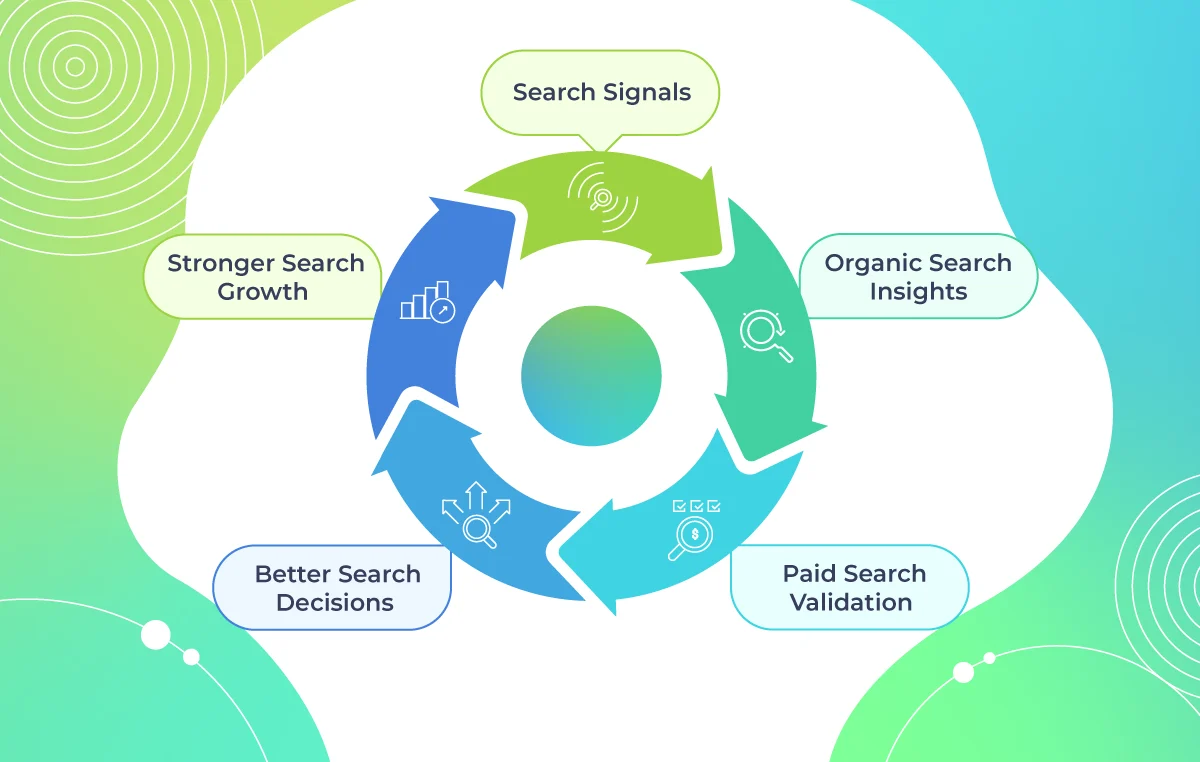
The long-term implication of this strategic shift is the establishment of what industry experts term The Search Growth Loop.
Rather than viewing SEO and PPC as static, linear tactics, the Search Growth Loop treats every search query, every ad campaign, and every customer touchpoint as an iterative learning event. Organic search uncovers long-term behavioral trends, emerging language patterns, and foundational demand. Paid search allows businesses to stress-test messaging, evaluate commercial intent, and validate new commercial ideas with speed and agility.
When these two forces feed into one another, a compounding cycle of intelligence is born.
For modern enterprises, the takeaway is clear: the classic rivalry between organic and paid search is a false dichotomy. By dismantling internal silos and allowing search data to dictate commercial decisions, companies stop guessing what their audience wants. They start listening to what their audience is already telling them—and in that listening lies the foundation of sustainable, long-term business growth.