










The cybersecurity landscape is currently undergoing a paradigm shift. As organizations grapple with an exponentially expanding digital footprint, the traditional methods of securing enterprise assets—centered primarily on static inventory and periodic scanning—are proving insufficient against the backdrop of sophisticated, AI-driven threat actors.
Addressing this critical juncture, AI SPERA, the developer of the renowned Cyber Threat Intelligence (CTI) platform Criminal IP, has announced its participation in GovWare 2026 in Singapore. More importantly, the company is set to unveil AITEM (AI-Powered Threat Exposure Management), a visionary framework designed to move the industry beyond the limitations of legacy Attack Surface Management (ASM). By integrating advanced artificial intelligence into the core of threat exposure lifecycle management, AITEM aims to convert raw visibility into rapid, decisive action.
The Evolution of the Digital Perimeter
The Limitations of Traditional ASM
For the past decade, Attack Surface Management (ASM) has been defined by the "discovery" phase. Security teams have utilized various tools to catalog their internet-facing assets—IP addresses, domains, cloud buckets, and exposed admin panels. While this provided a necessary map of the corporate perimeter, the sheer volume of data produced has often led to "alert fatigue."
Organizations are now seeing more of their infrastructure than ever, yet they remain paralyzed by the inability to distinguish between a benign misconfiguration and a high-risk entry point. In the current threat landscape, discovery is merely the baseline. The real challenge—and the primary objective of AITEM—is understanding the context of these exposures and accelerating the response to them.
The AI-Driven Arms Race
The urgency for this evolution is dictated by the adversaries. The barrier to entry for cybercriminals has been significantly lowered by generative AI and automated exploitation tools. Threat actors are now capable of performing reconnaissance at machine speed, utilizing AI to identify vulnerabilities, craft bespoke phishing campaigns, and automate the deployment of exploit code before human defenders have even finished auditing their asset lists.
"Seeing a threat and responding to it are two completely different challenges," says Byungtak Kang, CEO of AI SPERA. "Building a safer cyber world requires a shift from visibility to action. Organizations today have more visibility than ever, but many still struggle to effectively prioritize and act on the risks it reveals. By applying AI to filter noise, enrich context, and guide investigations, security teams can focus on the exposures that matter most and respond in real time."
AITEM: The New Framework for Exposure Management
AITEM represents a departure from the "inventory-first" mentality. Instead, it treats the attack surface as a dynamic, evolving environment that requires continuous, AI-backed intelligence to navigate.
Defining the AITEM Scope
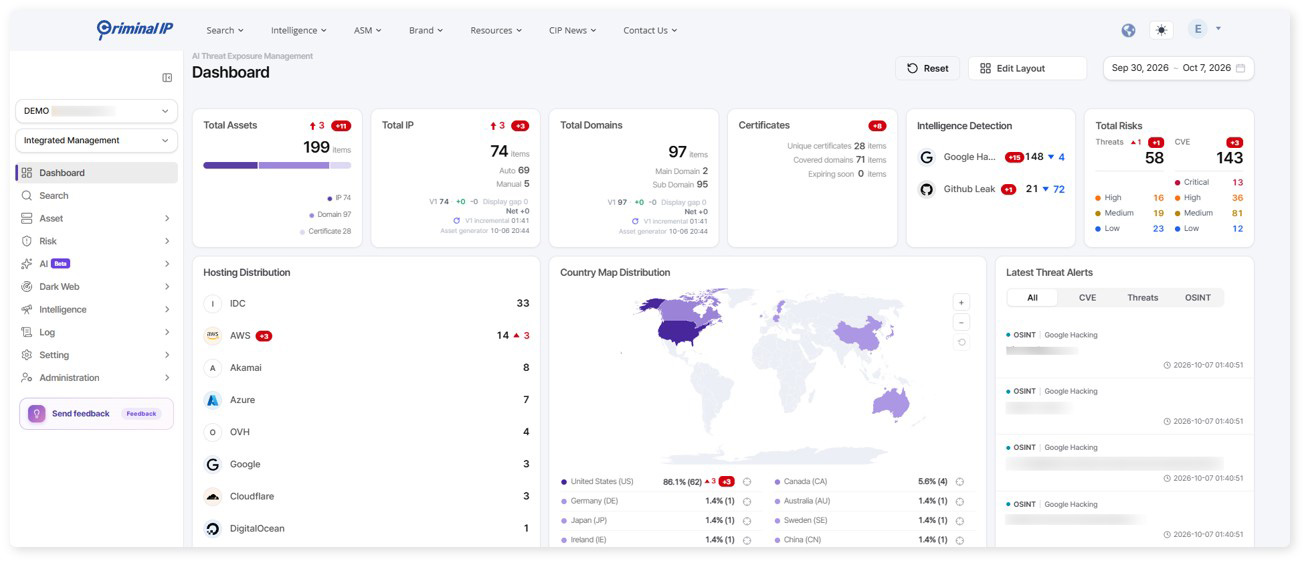
AITEM broadens the horizon of ASM by unifying disparate data streams. It does not look at external assets in isolation; rather, it correlates them with:

- Open-Source Intelligence (OSINT): Leveraging real-time data from across the web.
- Dark Web Data: Monitoring for leaked credentials or indicators of targeted reconnaissance.
- Shadow AI: Identifying unauthorized AI services being utilized by employees, which pose significant data exfiltration risks.
- Internal Infrastructure: Linking external exposures to internal network vulnerabilities.
- Emerging Vulnerabilities: Rapid integration of Zero-Day intelligence into the exposure assessment engine.
By collapsing these silos, AITEM provides security teams with a holistic view of the "threat exposure lifecycle." It transforms the process from a static spreadsheet of assets into a living, breathing map of potential attack vectors that are prioritized based on actual business risk rather than generic CVSS scores.
The Four Stages of the AITEM Lifecycle
AITEM applies machine learning across four critical pillars to ensure security teams are not just informed, but empowered:
- Continuous Discovery & Mapping: Moving beyond periodic scans to real-time, event-driven visibility.
- Contextual Enrichment: Utilizing Criminal IP’s extensive database to add "real-world" context to assets, such as whether a specific server is known to be associated with specific APT groups.
- Intelligent Prioritization: Using AI to rank vulnerabilities based on exploitability, business impact, and active threat actor activity.
- Automated Response & Orchestration: Guiding security analysts through the mitigation process, reducing the time-to-remediation from days to minutes.
Threat Intelligence at the Core
The engine driving AITEM is the underlying threat intelligence of Criminal IP. By continuously scanning the entire IPv4 and IPv6 internet, the platform creates a high-fidelity dataset that is arguably the most granular in the industry.
When an analyst examines an exposed service, AITEM doesn’t just flag it as "open." It provides a comprehensive report:
- Abuse History: Has this IP been used for C2 (Command and Control) traffic previously?
- Scanner Activity: Is this asset currently being probed by known botnets?
- Attribution: Does this asset show characteristics associated with specific threat actor infrastructure?
- Connected Assets: How does this exposure affect other, more sensitive areas of the network?
This level of intelligence allows security operations centers (SOCs) to move from a "defensive crouch"—where they constantly patch everything—to a "surgical defense," where they focus resources on the vulnerabilities that are most likely to be weaponized next.
GovWare 2026: From Visibility to Threat Hunting
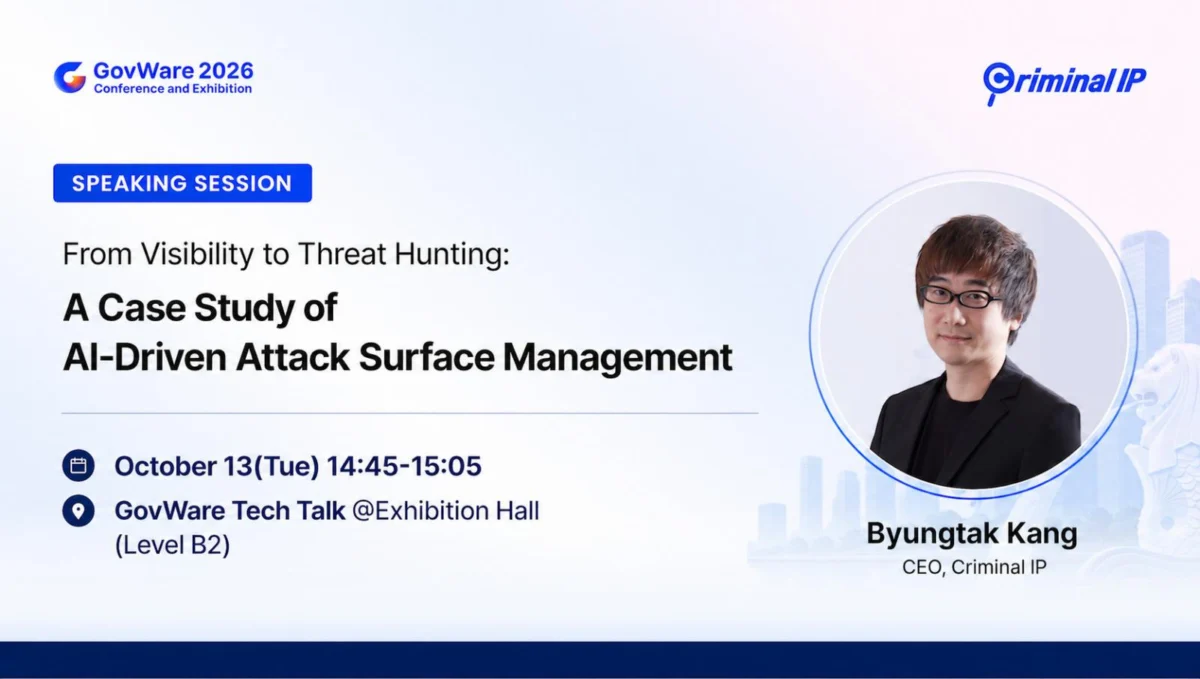
The official debut of AITEM at GovWare 2026 in Singapore serves as a focal point for the industry’s shift. During the event, CEO Byungtak Kang will present a keynote titled, "From Visibility to Threat Hunting: A Case Study of AI-Driven Attack Surface Management."
The presentation will bridge the gap between theory and practice, utilizing real-world case studies to demonstrate how organizations can move from passive monitoring to proactive threat hunting. By analyzing how intelligence-led ASM can shorten the investigation cycle, Kang intends to show how AI can handle the "repetitive analytical work," thereby freeing human security analysts to focus on high-level strategy and incident response.
Implications for the Security Industry
The introduction of AITEM is part of a much broader, industry-wide maturation. Following the trends established at RSAC 2026, where "Agentic AI" and "AI SOC" architectures took center stage, the market is signaling that the era of the "siloed tool" is coming to an end.
Moving Toward Unified Security Operations
The industry is moving toward integrated, AI-driven operations. AITEM aligns with this by acting as a bridge between the network-focused ASM and the operations-focused SOC. As security teams face increasing pressure to do more with less, AI becomes the force multiplier.
"The competition in ASM is no longer about who finds the most assets," notes Kang. "It will be about who can operate faster, respond more effectively, and mobilize the organization. AI should handle the repetitive analytical work. Humans should focus on judgment, accountability, and prioritization."
The Future of Defense
As we look toward the remainder of 2026 and into 2027, the success of platforms like AITEM will likely be measured by their ability to integrate seamlessly into the existing workflows of security analysts. The goal is not to replace the human, but to provide them with a "cognitive assistant" that understands the threat landscape as thoroughly as the attackers do.
About Criminal IP by AI SPERA
AI SPERA, the developer of Criminal IP, is at the forefront of the CTI revolution. By providing decision-ready intelligence, the company empowers organizations globally to gain real-time visibility into their cyber landscape. Through its massive, ongoing scanning infrastructure, Criminal IP processes billions of data points daily, identifying everything from malicious URLs to misconfigured cloud instances.
Their mission is clear: to democratize advanced threat intelligence, allowing security teams of all sizes to outsmart attackers. By continuously innovating—most notably through the AITEM framework—Criminal IP is setting the standard for what modern security teams should expect from their defensive stack.
For further details on how AITEM can transform your organization’s security posture, visit www.criminalip.io.
Disclaimer: This article is sponsored by Criminal IP. The content provided is for informational purposes and reflects the company’s strategic vision for the evolution of cybersecurity technology.



