










By Arun PS and Sushmita Patel
When the Government of India institutionalised the Pre-Legislative Consultation Policy (PLCP) in 2014, it was hailed as a watershed moment for Indian democracy. The policy was designed to bridge the gap between the state and its citizens, transforming India from a purely representative democracy into a vibrant, deliberative one. By mandating that draft legislation be placed in the public domain for 30 days before being introduced in Parliament, the government sought to foster discourse, enhance the quality of legislative drafting, and ensure that citizen rights and human potential were central to the policy-making process.
Nearly a decade later, however, the promise of the PLCP has largely evaporated. Far from becoming a cornerstone of democratic decision-making, the policy has become a neglected footnote, frequently bypassed or ignored by the very institutions meant to uphold it.
The Architecture of Participation: What the PLCP Promised
The PLCP was not an arbitrary creation; it was the culmination of recommendations from the National Advisory Council and the National Commission to Review the Working of the Constitution. The core mandate was clear: every ministry or department proposing a new law must proactively publish the draft on the internet.
Beyond just the text of the bill, the policy required the inclusion of essential elements: a justification for the legislation, its broad financial implications, and—most crucially—a detailed assessment of its impact on the environment, fundamental rights, and the livelihoods of those affected. Furthermore, these documents were to be presented in simple, accessible language to encourage participation from the layperson, not just legal experts. This was intended to be a robust mechanism to prevent the "closed-door" drafting that has historically plagued Indian lawmaking.
A Chronology of Non-Compliance: From Intent to Indifference
While early examples such as the Kerala Police Legislation and the Land Acquisition Bill of 2013 demonstrated the immense value of public consultation, the momentum quickly stalled. Since 2014, the implementation of the PLCP has been, at best, inconsistent and, at worst, entirely discarded.
The Era of "Closed-Door" Legislation
The decline in the culture of consultation is evident in several high-profile legislative shifts. The Right to Information (Amendment) Bill, 2019, which significantly diluted one of India’s most powerful transparency tools, was pushed through without any meaningful public consultation. When challenged, the government dismissed the necessity of public input, claiming the amendments involved no "social or financial costs"—a reductive interpretation of a law that fundamentally altered the citizen-state power balance.

Similarly, the Muslim Women (Protection of Rights on Marriage) Bill, 2017—often referred to as the Triple Talaq Bill—was passed amidst intense controversy and a refusal to refer the matter to the Parliamentary Standing Committee. The result was a piece of "historic" legislation that many stakeholders felt was drafted in a vacuum, devoid of the nuance that public debate would have provided.
The Electoral Bond Scheme, perhaps the most contentious financial policy of the last decade, serves as a textbook example of exclusionary policy-making. Despite claims that the scheme would bring transparency to political funding, the Minister of State for Finance, Shri P. Radhakrishnan, admitted that no civil society organizations were consulted during its formulation. This pattern of defiance suggests that the government views the PLCP not as a democratic imperative, but as a bureaucratic hurdle to be cleared or ignored at will.
Quantitative Evidence: The Data of Disillusionment
The failure of the PLCP is not merely anecdotal; the numbers tell a harrowing story of systemic neglect. An analysis of legislative activity between June 2014 and May 2019 reveals a stark reality: out of 186 bills introduced in Parliament, a staggering 142 underwent no public consultation whatsoever.
Of the remaining 44 bills that were placed in the public domain, 24 failed to adhere to the mandatory 30-day window for feedback. This suggests that even when consultations were "held," they were often rushed, serving as a mere box-ticking exercise rather than a genuine attempt to integrate public feedback.
Breakdown of Legislative Consultation (June 2014 – May 2019)
- Total Bills Introduced: 186
- Bills with Zero Consultation: 142
- Bills with Incomplete/Flawed Consultation: 24
- Bills with Full Compliance: 20
Even in the period following May 2019, the trend remained dismal. Between June and August 2019, out of 38 bills introduced, 26 lacked any consultation process. While the Ministry of Labour and Employment occasionally stood out as a positive outlier, most departments treated the policy with total disregard.
The Institutional Failure: Who is Guarding the Guardians?
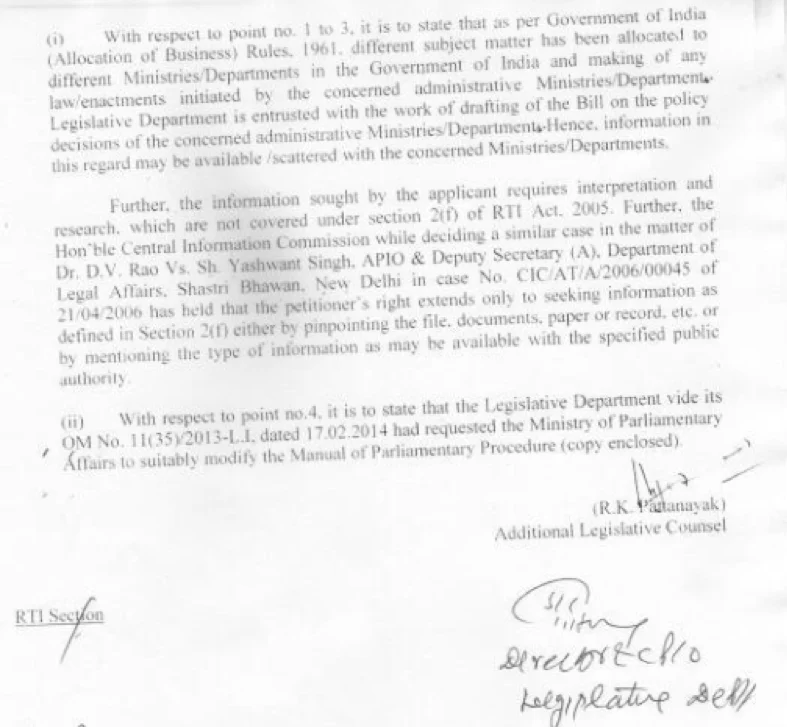
The most alarming finding in our research came through a Right to Information (RTI) request addressed to the Legislative Department. We asked for a database of PLCP compliance to track how different ministries were performing. The response was both shocking and revealing: the Legislative Department does not maintain any such database. Instead, it suggested that the information might be "scattered" across various ministries.
This is a direct violation of the policy, which mandates that the Law Ministry ensure compliance across all departments. Furthermore, the Ministry of Parliamentary Affairs itself has been caught flouting the policy. During the amendment of the Manual of Parliamentary Procedures, the Ministry ignored direct communication from the Ministry of Law and Justice, which had requested that the manual be updated to reflect the requirements of the PLCP.

This irony is compounded by the fact that the Ministry of Parliamentary Affairs had previously requested other departments to provide suggestions for improving the manual. Such selective consultation—where the government asks for input when it suits them but ignores established protocols when it does not—is the definition of "exclusionary participation."
The Implications: Why Consultation Matters
The consequences of bypassing the PLCP extend far beyond bureaucratic inefficiency. When laws are drafted without public input, they often lack the technical rigor and social legitimacy required for effective implementation.
The Prevention of Cruelty to Animals (Regulation of Livestock Market) Rules, 2017, is a prime example. The draft was uploaded to the Environment Ministry’s website without widespread notice, leading to massive confusion and eventual backlash from various state governments and stakeholders. Had the process been transparent and properly socialized, the resulting policy might have been more practical and less prone to legal and political challenge.
By ignoring the PLCP, the government is not just failing a procedural test; it is eroding the foundational trust between the state and its citizens. A democracy that does not listen is a democracy that loses its way.
A Path Forward: Reimagining the Consultation Model
To revive the spirit of 2014, India needs more than just a policy; it needs an overhaul of its legislative culture.
- A "One-Stop" Portal: The government should develop a centralized, user-friendly portal—an evolution of the current MyGov.in—dedicated solely to policy consultations. This would allow citizens to track ongoing drafts, view past feedback, and understand the status of proposed legislation.
- Social Audit Legislation: We must move beyond voluntary guidelines. A formal social audit law is necessary to hold policymakers legally accountable. This would impose a mandatory requirement for public scrutiny and provide a mechanism to penalize officials who bypass these essential steps.
- Linguistic Inclusion: Policies cannot be deliberative if they are not comprehensible. All draft bills must be translated into regional languages to ensure that the "poorest and weakest" citizens, as invoked in Gandhi’s Talisman, have a seat at the table.
- Internal Accountability: The Rules of Procedure and Conduct of Business in both houses of Parliament must be amended to require a "Consultation Certificate" for every bill introduced. Without proof that a bill has undergone the requisite public review, it should not be admitted for parliamentary debate.
As we look back on the ideals that birthed the PLCP, it is time to stop viewing public input as an obstacle to progress. True nation-building is not a top-down mandate; it is a collaborative project. If the government is truly committed to the democratic ethos it claims to represent, it must stop treating the Pre-Legislative Consultation Policy as a suggestion and start treating it as the law of the land. Democracy is not a spectator sport; it requires the active, informed, and invited participation of the people it serves.



