










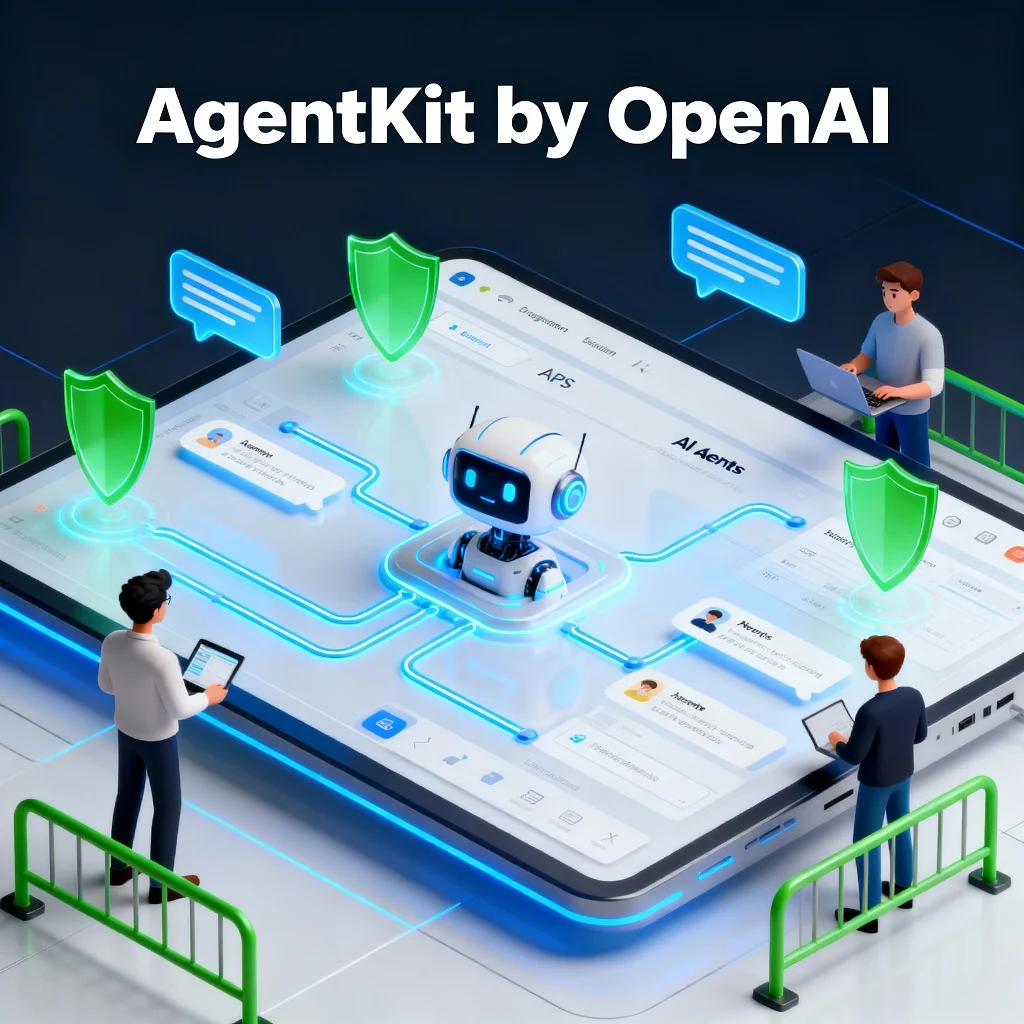
On October 6, 2025, OpenAI fundamentally altered the landscape of artificial intelligence development with the official unveiling of AgentKit. For years, the promise of autonomous AI agents—systems capable of reasoning, executing complex workflows, and interacting with the real world—was often hampered by a fragmented, "DIY" approach. Developers were forced to act as architects of disparate systems, manually stitching together orchestration logic, API connectors, user interfaces, and safety protocols.
AgentKit arrives as the definitive solution to this complexity. By consolidating these essential building blocks into a single, cohesive platform, OpenAI is shifting the focus of AI development from "plumbing and infrastructure" to "product design and value creation."
The Chronology: From Fragmented Experiments to Unified Platforms
To understand the significance of AgentKit, one must look at the recent evolution of the AI agent ecosystem:
- Early 2023: The emergence of "Auto-GPT" and early autonomous experiments signaled the potential for AI to perform tasks, yet these systems were notoriously brittle, prone to infinite loops, and difficult to secure.
- Late 2023–2024: Developers began building custom "middleware" to manage agent state, memory, and tool usage. Companies invested millions in internal frameworks, essentially recreating the same infrastructure repeatedly.
- Early 2025: The industry reached a plateau where the primary bottleneck for AI adoption was no longer the intelligence of the models themselves, but the difficulty of deploying them safely and reliably at scale.
- October 6, 2025: OpenAI launches AgentKit, marking the transition of AI agents from experimental scripts to enterprise-grade production assets.
Core Pillars of the AgentKit Ecosystem
AgentKit is not merely a single tool; it is a suite of integrated services designed to handle the full lifecycle of an agent.
1. Agent Builder (Beta): The Visual Revolution
The Agent Builder provides a drag-and-drop canvas that democratizes the creation of complex agentic workflows. By visually linking decisions, tool calls, and guardrails, teams can prototype in hours what previously took months. Early adopters like Ramp and LY Corporation have reported that the visual interface allows non-technical stakeholders to collaborate on agent logic, bridging the gap between business requirements and technical implementation.
2. Connector Registry: Centralized Interoperability
Integration has historically been the "Achilles’ heel" of AI. The Connector Registry provides a centralized pane to oversee connections across workspaces. It treats APIs, data lakes, and enterprise software as first-class citizens, ensuring that security credentials, rate limits, and data schemas are managed in one location, significantly reducing the "spaghetti code" effect common in legacy agent deployments.
3. ChatKit: The "Last Mile" Interface
Building a conversational front-end that feels intuitive is a specialized discipline. ChatKit streamlines this by offering production-ready, embeddable chat interfaces. These UIs come with built-in accessibility, state management, and latency optimization, allowing developers to deploy a high-quality interface into their existing web or mobile applications with minimal overhead.
4. Advanced Evaluation and RFT
OpenAI has significantly upgraded its "Evals" system. The new framework allows for granular performance measurement, where developers can track not just the output of an agent, but the reasoning path it took to arrive at that output. Coupled with Reinforcement Fine-Tuning (RFT), AgentKit allows developers to bake organizational preferences directly into the model’s reasoning process, ensuring the agent aligns with company-specific standards.
Supporting Data and Industry Impact
The industry feedback following the announcement suggests a massive shift in resource allocation. According to preliminary internal reports from OpenAI’s early access partners, the time-to-market for enterprise-grade agents has been slashed by approximately 70%.
- Efficiency Gains: By automating the "plumbing" of agentic workflows, engineering teams are reporting a 40% reduction in maintenance hours per agent.
- Safety Metrics: The integrated guardrails within the Agent Builder have shown a 90% reduction in "hallucination-driven" API calls, where agents attempt to execute unauthorized or malformed instructions.
- Scalability: Enterprises are now testing "agent swarms"—multiple agents communicating via the Connector Registry—to manage complex customer support tickets that span across CRM, ERP, and payment platforms.
Implications: The Shift Toward "Agentic" Organizations
The release of AgentKit carries profound implications for the future of work and software development.
The Democratization of AI Logic
With the Agent Builder, the barrier to entry for creating autonomous software has dropped significantly. We are entering an era where "Citizen Developers"—business analysts, project managers, and operations leads—can define agent behavior using visual logic, rather than writing thousands of lines of Python code.
The Reliability Mandate
One of the most profound impacts of AgentKit is the institutionalization of "Safety by Design." By baking evaluation, monitoring, and guardrails into the platform, OpenAI is forcing the industry to move away from the "move fast and break things" mentality. In a corporate environment, an agent that provides a wrong answer or performs an unauthorized action is a liability. AgentKit makes these risks manageable through standardized oversight.
Competitive Consolidation
For smaller AI startups that built their business model on "wrapper" tools—tools that simply connected OpenAI models to databases—AgentKit represents a significant competitive challenge. By providing these features natively, OpenAI is essentially "platforming" the agent development space, pushing developers to focus on higher-level problems rather than infrastructure.
Critical Considerations for Adoption
While AgentKit is a milestone, it is not a "magic button." Organizations should weigh the following before migrating their infrastructure:
- Vendor Lock-in: By adopting a comprehensive suite like AgentKit, companies become deeply tethered to the OpenAI ecosystem. It is essential to ensure that data portability and exit strategies remain a priority.
- The "Black Box" Problem: As agents become more complex and their reasoning processes are abstracted by the platform, understanding why an agent made a specific decision becomes harder. Enterprises must invest in rigorous logging and auditing to maintain transparency.
- Domain Expertise Requirement: Tools do not replace strategy. An agent built with the best tools in the world will still fail if the business logic, data quality, or domain expertise underlying the agent is flawed.
Expert Recommendations for Developers
For teams preparing to implement AgentKit, the following strategies are recommended:
- Modularize Your Workflows: Even with a visual builder, design your agents to be modular. If a specific "reasoning node" in your workflow fails, you should be able to swap it out without rebuilding the entire agent.
- Prioritize RFT Early: Don’t wait until your agent is "finished" to start fine-tuning. Use the RFT integration early in the development cycle to ground the model in your company’s specific vocabulary and logic.
- Treat Agents as Employees: Approach agent development with the same rigor you would use for a new hire. Define clear roles, provide access to only the necessary data sources, and monitor their performance continuously.
The Bottom Line
OpenAI’s AgentKit represents the "industrial revolution" moment for AI agents. By moving from a fragmented collection of scripts to a unified, safe, and scalable platform, the company has provided the infrastructure necessary for the next wave of digital transformation.
As organizations begin to deploy these autonomous systems, the primary differentiator will no longer be who has the best model, but who has the best agentic architecture. AgentKit is the first true standard for that architecture. It is a tool that transforms the chaotic, often frustrating process of agent orchestration into a disciplined, professionalized engineering practice. While the human elements of design, strategy, and domain expertise remain the ultimate drivers of success, AgentKit provides the robust, reliable, and efficient foundation upon which the next decade of intelligent software will be built.



