




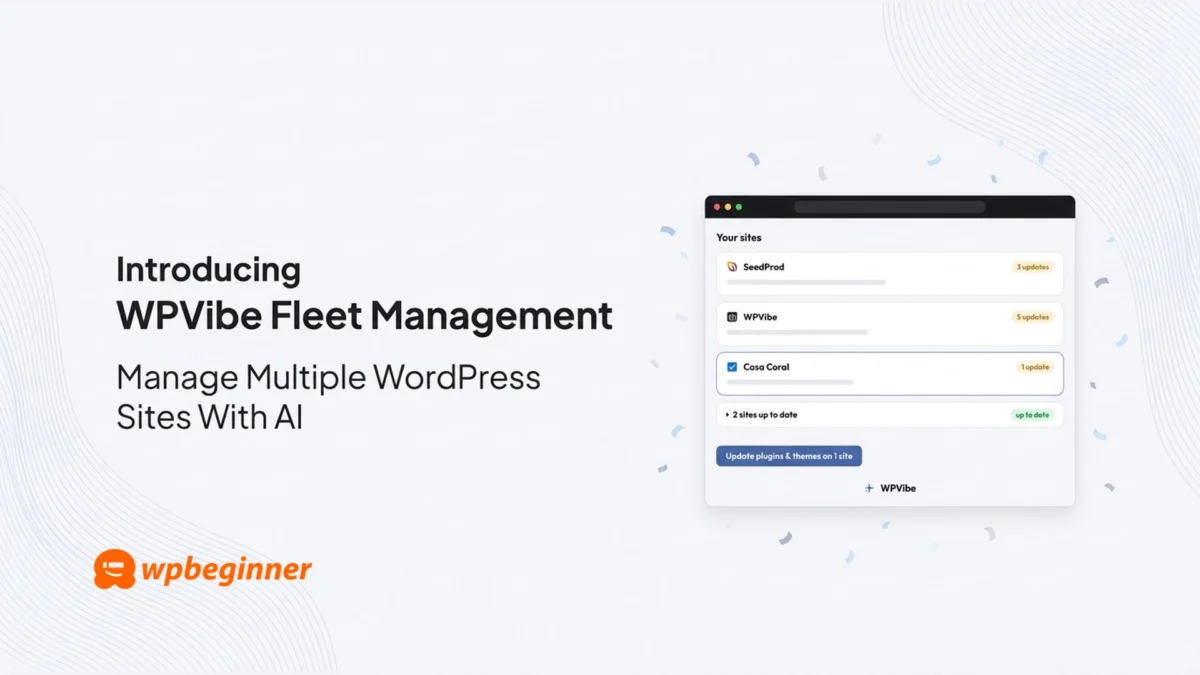
For the millions of developers, agencies, and small business owners who rely on WordPress, site maintenance has long been a "necessary evil." While the platform’s flexibility is its greatest strength, the sheer volume of repetitive tasks—updating themes, patching plugins, and verifying site integrity—can turn a manageable workload into a bureaucratic nightmare. Today, the landscape of site management shifts significantly with the launch of WPVibe Fleet Management, a revolutionary tool that promises to move WordPress administration from manual labor to AI-orchestrated automation.
The Problem: The "Maintenance Tax" of WordPress
Managing a single WordPress site is relatively straightforward. However, as an individual or agency begins to manage a "fleet" of sites, the complexity grows exponentially. The traditional workflow is tedious: log in to each dashboard, check for updates, run the updates, and perform a manual sanity check to ensure no plugins have crashed the site.
Existing site management tools have attempted to solve this, but they often come with significant trade-offs. Many are expensive, scaling their pricing models aggressively as your site count grows. Others provide a centralized dashboard that still requires manual oversight for every single click. Furthermore, most of these tools lack the "intelligence" to understand context, leading to situations where a single plugin update can break a site, requiring time-consuming manual intervention to restore.
The Evolution of WPVibe
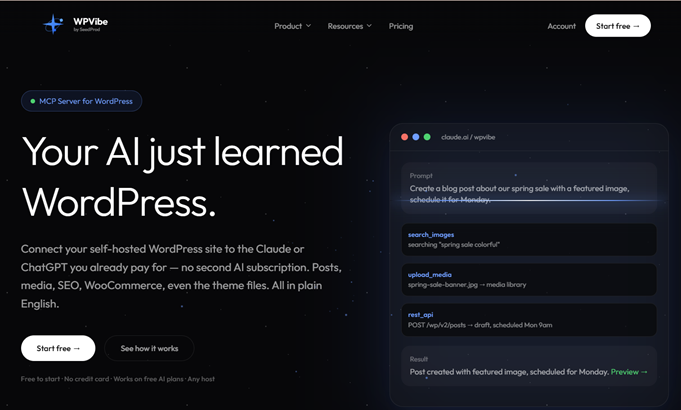
Launched earlier this year, WPVibe was designed to bridge the gap between WordPress and modern Artificial Intelligence. By leveraging the Model Context Protocol (MCP), the tool allowed users to connect their WordPress installations to powerful AI assistants like ChatGPT and Claude. The reception was immediate and substantial: within just a few months, WPVibe surpassed 20,000 active installations and maintained a stellar 4.9 out of 5 rating on the official WordPress plugin repository.

Initially, WPVibe was a "one-to-one" solution. It excelled at content generation, SEO optimization, database cleanup, and troubleshooting individual sites. However, the feedback from power users was clear: they needed the same AI capabilities, but applied at scale. The launch of WPVibe Fleet Management is the direct response to this demand, moving the AI from an assistant for individual sites to a "fleet commander" for entire WordPress portfolios.
What is WPVibe Fleet Management?
WPVibe Fleet Management represents a paradigm shift in how users interact with their web infrastructure. It transforms your AI chat interface—be it through OpenAI or Anthropic—into a centralized command center.
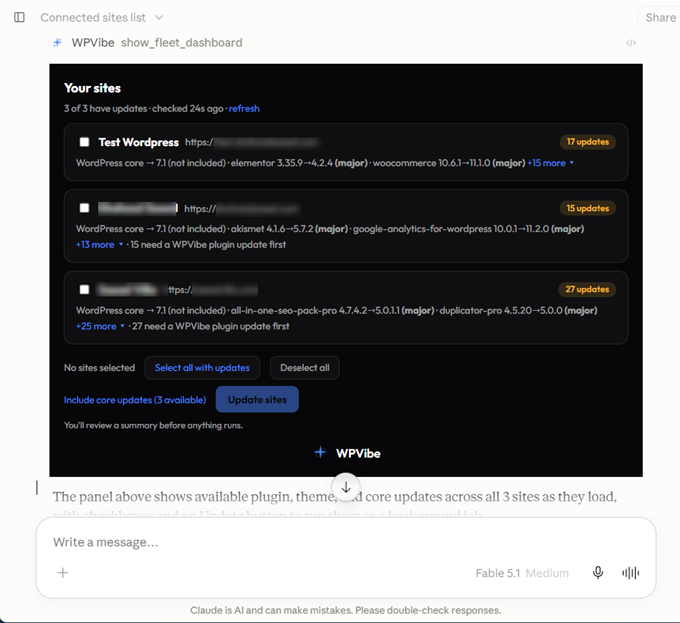
Unlike traditional management software that forces you to navigate complex, clunky UIs, WPVibe allows you to speak to your infrastructure. You can ask, "Which of my sites need plugin updates?" and receive a comprehensive, real-time list, complete with version numbers and specific component statuses. The tool doesn’t just display information; it acts on it. You can authorize a batch update across dozens of sites, and the AI handles the execution, verification, and reporting.
Core Features and Technical Capabilities
1. Unified Visibility
The primary hurdle in site maintenance is discovery. Knowing what needs to be updated is often more time-consuming than the update itself. Fleet Management centralizes this, providing a granular, bird’s-eye view of your entire network. Whether you are managing five sites or five hundred, the AI provides a unified status report, ensuring that no outdated plugin or vulnerable theme goes unnoticed.
2. Pre- and Post-Update Verification
One of the most critical aspects of the tool is its "safety-first" protocol. WPVibe doesn’t simply trigger a command and hope for the best. Before any update, the system verifies the current state of the site. If a new version is released between the time you approve an update and the moment of execution, the system pauses to prevent version conflicts. Post-update, the system performs a secondary scan to verify that the software was successfully installed and that the site remains functional, providing a concrete report for every action taken.
3. Isolated Error Handling
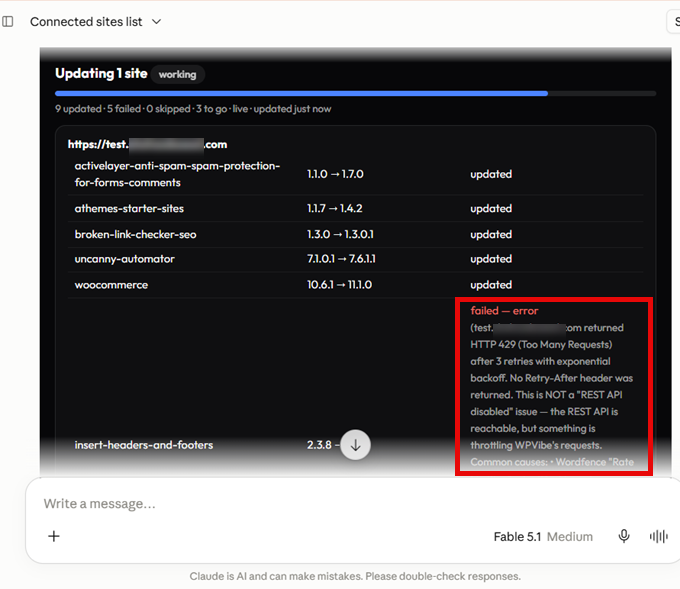
In a typical bulk-update scenario, a single failure can often cascade, causing a script to time out and leaving the rest of the updates in limbo. WPVibe handles this by isolating every action. If a specific plugin update fails on "Site A," the tool logs the error, notifies the user, and immediately moves on to "Site B." This ensures that one problematic installation doesn’t stop the progress of your entire maintenance routine.
4. The "Human-in-the-Loop" Core Policy
While automation is powerful, WordPress core updates carry a higher risk. Recognizing this, WPVibe Fleet Management enforces a strict policy: WordPress core updates always require explicit, manual confirmation from the user. While the AI manages the heavy lifting for plugins and themes, it pauses for core updates, ensuring the user has the final say. This creates a balanced ecosystem where routine maintenance is automated, but critical structural changes remain under human oversight.
5. Background Processing and Persistence
Perhaps the most requested feature for large-scale management is the ability to walk away. WPVibe Fleet Management allows users to initiate massive operations—such as bulk updates, large-scale database search-and-replace, or massive spam cleanup—and close their browser tab. The AI continues to process these tasks in the background. If the task exceeds daily execution limits, the system intelligently pauses and resumes once the limits reset, effectively removing the "time-out" frustration that plagues many PHP-based operations.
Implications for Agencies and Freelancers
For agencies, the implications of this technology are profound. Historically, maintenance has been a low-margin, high-labor service. By reducing the time required for routine tasks by upwards of 80-90%, agencies can either increase their profit margins on maintenance plans or focus their human capital on higher-value tasks, such as design, development, and strategic consulting.
Furthermore, the inclusion of client sub-accounts and per-client usage reporting in the "Agency" and "Scale" plans makes it easier than ever to prove value to clients. When you can provide a client with a clean, AI-generated report showing exactly what was updated and verified, the "invisible work" of maintenance becomes a tangible service.
The Future of AI-Driven Web Administration
As we look at the trajectory of the WordPress ecosystem, it is clear that the future is not just about having more plugins, but about having more intelligent management. Syed Balkhi, the founder of WPBeginner, notes that this tool is designed to save users from the "repetitive maintenance" that prevents them from focusing on growth.
"We want you to spend less time on maintenance and more time building your business," says the team at WPVibe. By integrating with tools like ChatGPT and Claude, they are effectively turning the AI into a junior sysadmin that never sleeps, never forgets an update, and never complains about repetitive work.
How to Get Started
Getting started with WPVibe Fleet Management is remarkably accessible. The developers have emphasized a low barrier to entry, allowing users to connect unlimited sites even on the free tier. The primary differentiation between plans is the daily execution limit, which ensures that even hobbyists can enjoy the benefits of AI-managed infrastructure, while high-volume agencies can scale their capacity to match their client base.
To begin, users simply install the WPVibe plugin on their sites and link them to their AI assistant. The AI will then generate a unique interface panel. If the user’s AI environment doesn’t support the interactive panel directly, WPVibe provides a fallback "read-only" link and a simple command-string that can be pasted into any chat interface to trigger the desired actions.
Conclusion: A New Standard
The launch of WPVibe Fleet Management marks the end of the "log-in, click, repeat" era of WordPress management. By leveraging the power of AI to handle the mundane, error-prone aspects of site maintenance, WPVibe has created a tool that feels like a natural evolution of the platform itself. For those who manage multiple sites, this is not just a productivity boost—it is a fundamental change in how we relate to the web. As AI continues to integrate deeper into our workflows, tools like WPVibe are setting the standard for what it means to be a modern, efficient web professional.