The promise of Generative AI (GenAI) in content production is intoxicating: infinite scale, rapid turnaround times, and a significant reduction in overhead costs. For many digital agencies and enterprise publishers, the workflow seems straightforward—until it isn’t. The friction emerges the moment the process diverges from the ideal path.
Consider a common, high-stakes scenario: a client flags stale or factually inaccurate content three weeks after publication and demands an immediate correction. Without a robust hosting infrastructure and rigorous governance checks in place, what should be a five-minute fix quickly devolves into a multi-hour crisis of cache clearing, version control, and site-wide errors.
As GenAI reshapes the landscape of content creation, the line between human-authored and machine-generated content has blurred to near parity. Yet, this high-volume publishing cadence, often executed without the requisite editorial oversight, has triggered a shift in how search engines view content. To survive—and thrive—in this new era, organizations must stop viewing content production as a simple writing task and start treating it as a complex software deployment operation.
The Impact of High-Volume AI Publishing on WordPress Deployments
The integration of Large Language Models (LLMs) into content workflows is not a “set-and-forget” solution. LLMs are notoriously prone to “hallucinations,” tonal shifts, and outdated data injection. When you scale your publishing frequency, you aren’t just scaling content; you are scaling the probability of error.
From an infrastructure perspective, the challenges are twofold: data integrity and propagation latency. If your caching layer is not explicitly configured to purge upon content updates, your corrected copy may languish in the database while the public sees outdated, potentially harmful information. Furthermore, if you lack a reliable, granular backup system, rolling back a batch-published AI update that contains systemic errors becomes a high-risk operation.

The stakes are compounded by search engine algorithms. SE Ranking’s research indicates that Google’s core updates are shuffling rankings with increasing volatility. Specifically, Google has begun penalizing “scaled content abuse”—a term reserved for high-volume content published with minimal editorial intervention. To remain competitive, agencies must implement a governance framework that mirrors the rigor of professional software development.
Why Staging is the New Standard for Content Review
In software engineering, pushing code directly to production without testing in a sandbox environment is considered professional malpractice. Yet, the publishing industry has long operated under a “publish-and-pray” mentality. For GenAI-driven workflows, this is a recipe for disaster.
Staging environments provide an identical, isolated replica of your production site. By funneling content through a staging phase, teams can:
- Visualize Formatting: Ensure that complex media embeds or AI-generated structures render correctly on the front end.
- Audit Plugin Interactions: Verify that new content doesn’t conflict with existing shortcodes or performance-enhancing plugins.
- Peer Review: Allow editors to view the content in its final “live” state without making it accessible to the public or search crawlers.
At Kinsta, we’ve prioritized this workflow by including free staging environments with every site. Premium environments are also available for teams requiring resources that mirror production specifications exactly. The ability to perform a “selective push”—moving files or database changes independently—is critical. It allows publishers to update text content without accidentally overwriting new, unrelated code developments or plugin configurations.
Permissions-Based Governance: Restricting the “Push”
Staging is only as effective as the discipline of the team using it. To ensure that no “cowboy” publishing occurs, organizations must enforce a strict, permissions-based hierarchy.
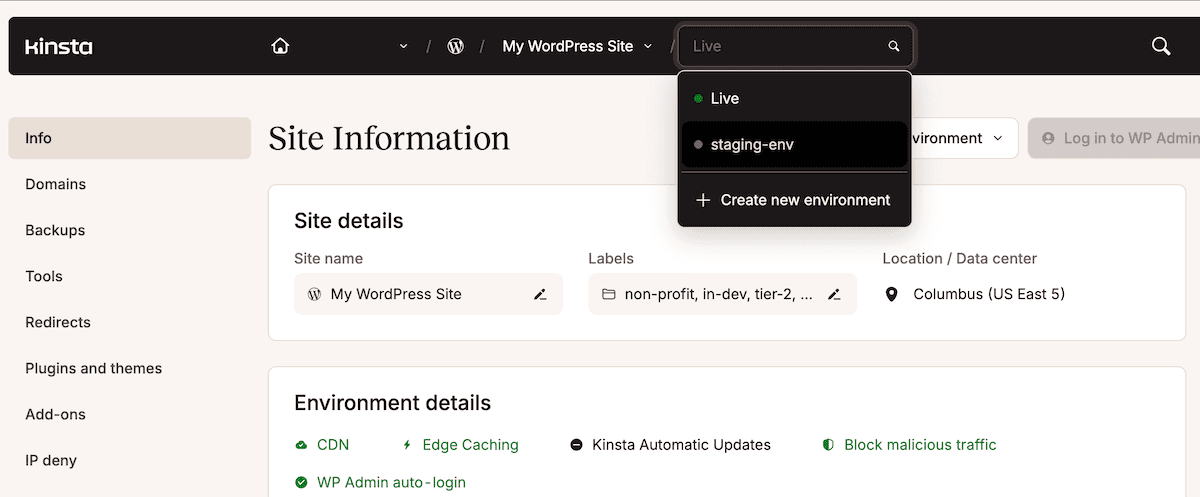
By utilizing granular user roles—such as those available in the Kinsta dashboard—you can separate the content creators from the deployment gatekeepers. A recommended structure involves:
- Site Developers (GenAI Teams): These users have access to staging environments and authoring tools but lack the permissions to push changes to the live production environment.
- Editors/Authors: Tasked with the actual drafting and fact-checking of the content.
- Site Administrators: The only tier authorized to perform the final push to production.
When combined with Two-Factor Authentication (2FA), this model creates a secure, auditable pipeline. It ensures that every piece of content published has passed through a verified checkpoint, mitigating the risks associated with unauthorized or erroneous updates.
The Critical Role of Backups in AI Error Mitigation
Even the best-governed systems face failures. When an AI-driven hallucination or a factual error slips through the net and reaches the public, the speed of recovery is your most valuable asset.
When an issue surfaces—perhaps a batch of 50 posts all citing an outdated product price—you face a binary choice: manual, post-by-post editing or a site-wide restoration. For systemic errors, the latter is almost always more efficient.
Using the Kinsta API, teams can automate their backup protocols. By programmatically tagging manual backups—for example, pre-batch-publish—teams can create a “clean state” that they can return to in seconds if the automated publishing script goes awry.
# Example of tagging a manual backup via Kinsta API
curl -i -X POST
  'https://api.kinsta.com/v2/sites/environments/env_id/manual-backups'
  -H 'Authorization: Bearer <YOUR_TOKEN_HERE>'
  -H 'Content-Type: application/json'
  -d '
    "tag": "pre-batch-publish"
  '
This level of control transforms backups from a reactive insurance policy into a proactive component of your deployment strategy.
Eliminating “Cache Stasis” in High-Volume Workflows
One of the most persistent issues in content management is the “phantom edit”—where a user updates a post, but the changes fail to appear on the front end. This is almost exclusively a caching issue.
In a high-volume AI environment, the delay between clicking “Update” and the content actually refreshing on the site can lead to confusion and redundant, unnecessary edits. Clearing the cache is not merely a maintenance task; it is an essential part of the publishing lifecycle.
Modern hosting environments allow for programmatic cache clearing. By integrating a cache-purge command into your publishing script, you ensure that the moment a human or automated system approves a change, the world sees the correct version immediately. This also ensures that search engine crawlers index the most accurate, updated data, thereby protecting your SEO rankings.
Tracking Accountability with Activity Logs
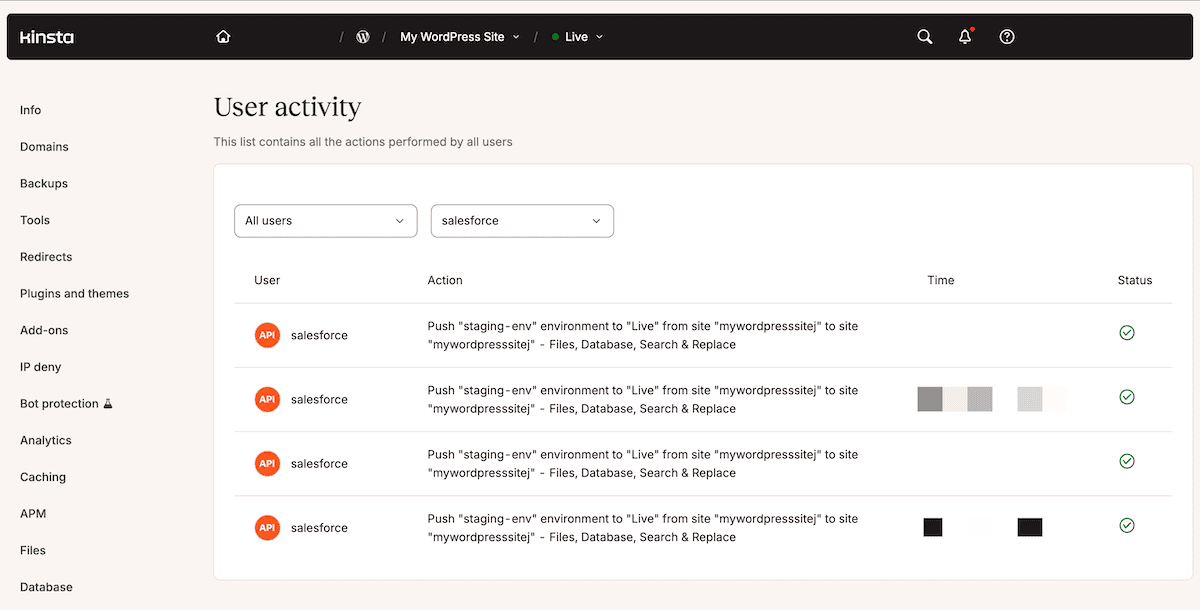
When a workflow spans dozens of team members and automated scripts, determining the origin of an error can feel like finding a needle in a haystack. MyKinsta’s activity logs serve as the ultimate audit trail.
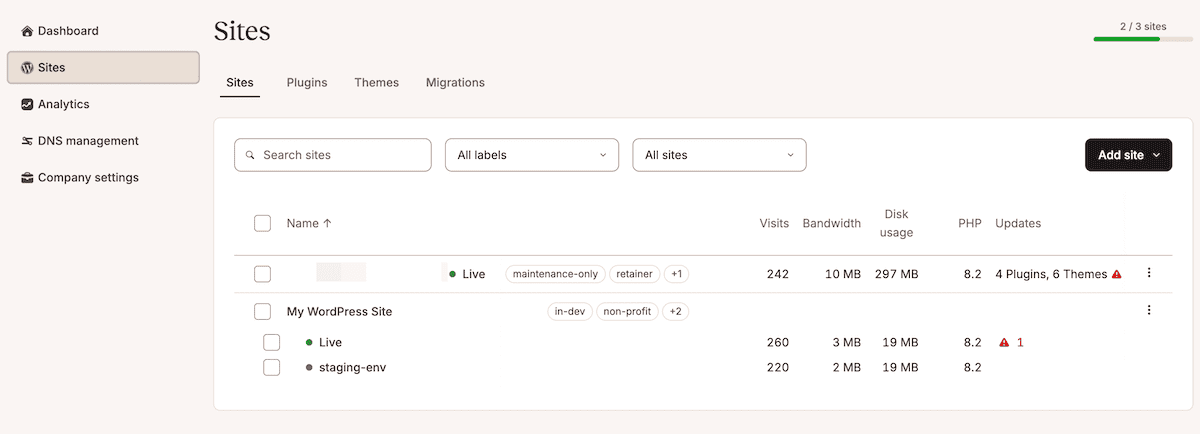
These logs provide a timestamped history of every action taken on the site. Whether an error was introduced by a specific user’s manual edit or a third-party API integration, the logs allow for forensic investigation without the guesswork. For enterprise-scale agencies, the Kinsta API enables even deeper analysis, allowing you to filter by user role, API key ID, or specific categories of site actions. This transparency is essential for fostering a culture of accountability in high-stakes content environments.
Implementing Governance: A Five-Minute Investment
Integrating these checks—staging, permissions, automated backups, and cache management—is not an overhaul; it is a refinement. By investing roughly five minutes per workflow to ensure these safety rails are active, agencies can save hundreds of hours in cleanup and crisis management.
- Verify Staging: Ensure every site in your portfolio has an active, accessible staging environment.
- Audit Permissions: Conduct a quarterly review of user roles to ensure that only authorized personnel have the ability to push to production.
- Tag Your Backups: Standardize the use of manual backup tags before any bulk publishing or plugin update.
- Automate Cache Purging: Include a cache-clear trigger in your publishing scripts.
- Review Activity Logs: Regularly monitor the user activity logs to identify and address bottlenecks or recurring errors before they escalate.
Implications for the Future of Publishing
The era of “content at all costs” is drawing to a close. As search engines grow more sophisticated at detecting and penalizing thin or error-prone AI content, the competitive advantage will shift toward those who can pair high-volume output with high-fidelity governance.
By treating content production as a technical deployment, you elevate your agency’s capabilities, protect your clients’ brands, and ensure that your digital footprint remains an asset rather than a liability. Scalable, high-volume publishing is not just about the AI tools you use; it is about the infrastructure you build to support them. With the right hosting environment and a commitment to governance, the scale you seek is not only possible—it is sustainable.