







In the startup ecosystem, the prevailing narrative is one of linear success: increase your sales, boost your revenue, and your bank account will follow suit. For many founders, the goal is to hit that "record-breaking month"—the one characterized by soaring sales figures, a backlog of orders, and the kind of metrics that look stellar on a pitch deck.
Yet, there is a silent, systemic killer lurking in the shadows of high-growth companies. It is a phenomenon that has shuttered many businesses that were, by every traditional accounting standard, incredibly successful. It is the realization that revenue is not cash.
When a supplier’s invoice hits your inbox and your operating account returns a “declined” status despite a record-setting quarter, you aren’t experiencing a business failure—you are experiencing a timing mismatch. Understanding this gap is not just an accounting chore; it is the fundamental survival skill for any entrepreneur looking to scale.
The Main Facts: The Great Disconnect
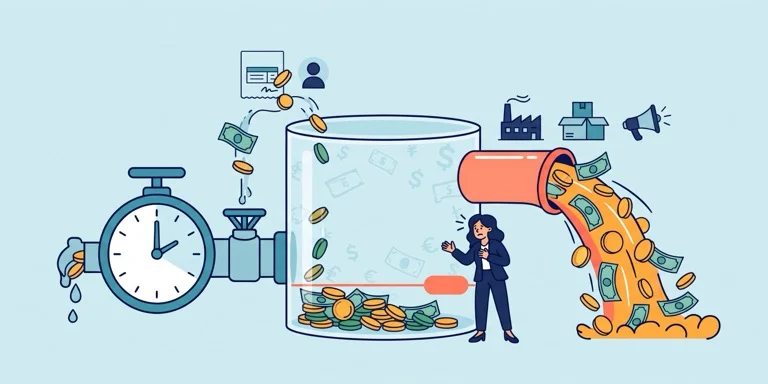
At the heart of the cash flow crisis is a simple, often misunderstood truth: revenue and cash operate on entirely different internal clocks.
The Two Clocks of Business
In accounting terms, revenue is recognized the moment a sale is made or a service is delivered. If you ship a shipment of inventory in January, your books reflect that revenue in January. However, if that customer is on “Net-30” payment terms, the actual cash—the lifeblood of your operations—won’t hit your bank account until February or later.
While your Profit and Loss (P&L) statement paints a picture of growth, your bank statement tells a story of scarcity. The danger lies in assuming these two documents are telling the same story. They are not. One measures your efficiency and market demand, while the other measures your liquidity and operational survival.
The "Profitable" Illusion
Many founders fall into the trap of equating profitability with solvency. You can be profoundly profitable on paper while being technically insolvent in the bank. Profitability is a calculation of revenue minus expenses over a specific period, but it lacks a temporal dimension. It doesn’t care if your rent is due on the 1st and your payments arrive on the 30th.
When you restock inventory to meet surging demand, you are paying cash now for goods that won’t be sold—and paid for—for weeks or months. During that interval, your business is effectively "holding its breath," existing in a state of high-value, low-liquidity purgatory.
Chronology of a Cash Crunch
To understand why this happens, it is helpful to map the timeline of a typical high-growth transaction.
- The Growth Spike (Day 0): You secure a large contract or see a massive uptick in e-commerce orders. You are elated.
- The Capital Outlay (Day 1-14): To fulfill this demand, you must purchase raw materials, pay for shipping, and perhaps increase your ad spend. Cash exits your account immediately.
- The Fulfillment Gap (Day 15-45): The product is manufactured and shipped. You have incurred all the costs of the sale, but you have yet to receive a cent in return.
- The Receivable Lag (Day 45-60): The customer receives the goods and processes the invoice. Even if they pay promptly, the payment terms ensure that the cash remains tied up in their accounts, not yours.
- The Reconciliation Crisis (Day 60+): Your next round of supplier invoices arrives. Because you poured all your previous capital into the inventory for the previous cycle, you have no runway left. Even though you are "profitable," you have reached a total standstill.
Supporting Data: Why Growth Accelerates Risk
It is counterintuitive, but growth is the primary driver of cash flow insolvency. In a stagnant business, cash flow is predictable. In a growing business, the demand for cash increases exponentially.
- The Working Capital Burden: Every unit of growth requires a corresponding increase in working capital. You are essentially front-loading your costs to chase revenue that hasn’t arrived yet.
- The Scaling Penalty: As you scale, you often need to hire staff, upgrade software, or secure larger facilities. These are fixed costs that must be paid monthly, regardless of the fluctuating arrival times of your customer payments.
- The Velocity Problem: The faster you grow, the wider the gap between spending and receiving becomes. If you grow by 20% month-over-month, your cash requirements increase by 20% before you have even seen the returns on the previous month’s investment.
Data from financial researchers suggests that nearly 80% of small business failures are directly linked to poor cash flow management. The tragedy is that these are not "bad" businesses; they are simply businesses that failed to synchronize their internal financial logistics with their external growth velocity.
Official Perspectives: Managing the Gap
Financial experts and veteran CFOs argue that the solution is not to stop growing, but to gain absolute, real-time visibility into the "cash cycle."
"The goal is to close the gap from both ends," says one industry analyst. "You must tighten the intake of cash while simultaneously increasing the granularity of your forecasting."
The "Speed" Lever
The most effective way to improve cash flow is to reduce the time between fulfillment and payment.
- Tighten Terms: Move customers from Net-60 to Net-30, or offer early-payment discounts.
- Automate Invoicing: Do not wait until the end of the month to send invoices. Send them the moment the work is complete.
- Aggressive Follow-ups: An unpaid invoice is not just a bookkeeping entry; it is a loan you are giving your customer, interest-free. Treat it with the urgency it deserves.
The "Visibility" Lever
Visibility is the antidote to the "nasty surprise" of an empty bank account. You cannot manage what you cannot see.
Modern financial tools like Xero have transformed how small to medium-sized businesses manage this. By integrating banking feeds directly with accounting software, founders gain a bird’s-eye view of their cash position. This allows for proactive planning—knowing exactly when a cash crunch is coming before it arrives—rather than reacting to a failed payment notification.
Implications: The Path Forward
The implication for founders is clear: Cash flow management is not an administrative task—it is a strategic growth lever.
If you are not watching your cash flow with the same intensity as you watch your sales KPIs, you are essentially flying blind. You must treat every dollar of incoming revenue as a race against your outgoing obligations.
Why This Matters for the Future
As markets become more competitive, the ability to manage cash flow will define which startups survive the "valley of death" and which ones thrive. Businesses that can master the timing of their finances can outlast competitors who, despite having better products or higher sales, are suffocated by their own growth.
Final Thoughts
Running out of cash is not a moral failing; it is a mechanical one. It is a sign that the plumbing of your business isn’t aligned with the scale of your ambitions. By shifting your focus from "how much money am I making" to "when is that money actually available," you transition from a reactive founder to a strategic leader.
Use the tools available to you to bridge the gap. Whether it is automated invoicing, real-time bank reconciliation, or disciplined credit management, the objective remains the same: keep your business liquid enough to fuel its own growth.
Simplify your financial future. As a Foundr reader, you can gain total visibility over your business finances with 95% off Xero for your first 6 months. Take control of your cash flow and grow without the constant anxiety of the "gap."
Start your journey here: foundr.com/xero
Terms and conditions apply.