











In the high-stakes world of hyperscale computing, infrastructure is no longer just a collection of servers, cables, and power units. It is a living, breathing, and constantly evolving organism. For Microsoft, the challenge of managing over 80 Azure regions and 500 datacenter campuses has catalyzed a fundamental shift in how hardware is designed, deployed, and maintained. The company is moving beyond simple automation, treating its entire cloud infrastructure as a cohesive, learning system where silicon design informs supply chain logistics, and fleet telemetry dictates the next generation of hardware engineering.
Central to this transformation is the realization that AI is not a magic wand to be waved over existing processes. Instead, it is a force multiplier that requires a disciplined, systemic approach. By adopting a "Lean before AI" philosophy, Microsoft is not just accelerating tasks; it is fundamentally redesigning how the most critical decisions in cloud computing are made.
The Architecture of a Learning System
At the heart of Microsoft’s approach is the Azure Hardware Systems and Infrastructure division. Their mandate is to manage the end-to-end lifecycle of the cloud. This encompasses everything from the initial architectural blueprints of custom silicon to the complex logistics of global supply chains, and finally, the real-time operational maintenance of the fleet.
This end-to-end perspective is what separates a modern, resilient cloud from a fragmented server farm. When data is siloed, insights are trapped. By connecting these stages, Microsoft ensures that what is learned in the datacenter—such as a specific failure pattern in a storage node—can be fed directly back to the silicon design teams. This creates a "closed-loop" system where the hardware is constantly evolving based on real-world performance data.
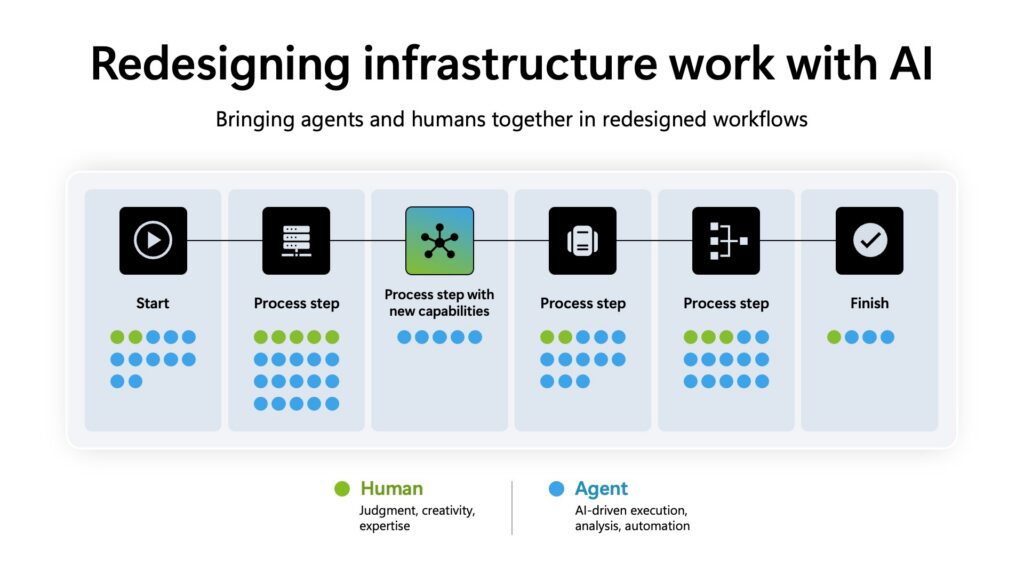
The integration of agentic AI into this framework is not about replacing human expertise; it is about providing that expertise with the right information at the right time. By applying AI tools to bridge the gaps between disconnected systems, Microsoft is moving from sequential, manual workflows to parallel, automated execution.
Chronology of a Transformation: From Fragmentation to Flow
The shift toward an AI-powered infrastructure did not happen overnight. It followed a deliberate, multi-year evolution focused on operational maturity.
1. The Foundation Phase: Establishing the Data Bedrock
Before any AI agent was deployed, Microsoft focused on the "Lean before AI" mandate. This involved mapping out end-to-end processes to identify inefficiencies. Teams spent months establishing a shared data foundation—ensuring quality, enforcing strict governance, and creating clear access controls. Without this foundation, the company recognized that applying AI would only serve to accelerate the chaos of fragmented workflows.
2. The Process Simplification Phase
Once the data was governed, teams moved to simplify the work. They eliminated redundant steps and clarified human accountability. This was crucial because, in a complex cloud environment, some decisions require the nuance of human judgment. By identifying where humans were indispensable, Microsoft could design agents that supported, rather than replaced, the experts.
3. The Implementation Phase: Scaling Intelligent Agents
With the foundation set, the company began rolling out specialized agents across planning, product data, sourcing, and logistics. This phase moved the organization from "experimentation" to "production," where AI agents started handling the heavy lifting of data reconciliation and analysis.
4. The Integration Phase: Building the Learning Loop
Currently, the focus has shifted to connecting these individual agents into a unified, multi-agent ecosystem. This creates a holistic "operating system" for the cloud, where the output of one process (like bill-of-materials generation) serves as the seamless input for the next (like capacity delivery).
The Data Behind the Efficiency
The impact of this transformation is quantifiable and, in some cases, transformative. By moving from manual research to AI-driven insights, the speed of decision-making has been radically altered.
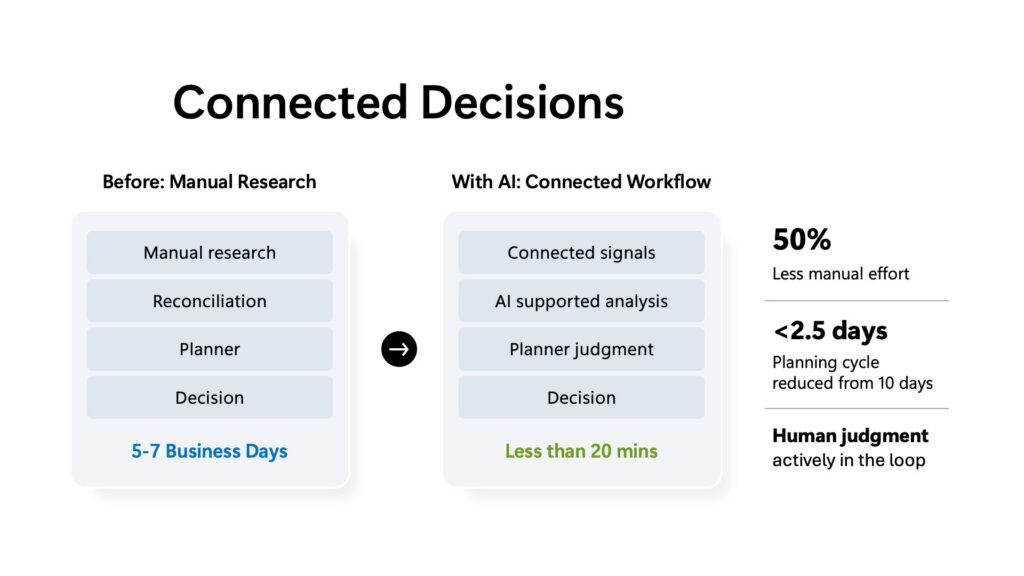
- Demand Planning: Previously, forecasting Azure’s needs involved reconciling data across multiple systems, a process that consumed five to seven business days. With multi-agent workflows, this is now often completed in less than 20 minutes. Across five monthly cycles, the team observed a 50% reduction in manual effort and a 75% reduction in cycle time.
- Fulfillment Efficiency: When rack deliveries are blocked, investigating the cause used to be a time-consuming manual effort. An intelligent assistant now aggregates blocker data and compatibility constraints, reducing investigation time by 55%.
- Reliability Metrics: Through AI-driven fleet telemetry, Microsoft has achieved a 92% reduction in disk-related virtual machine (VM) interruptions. Furthermore, repair times on out-of-service nodes have been cut by 53%. Proactive alerts for rack managers now provide up to three days of advance notice, allowing for repairs that have reduced total downtime by 40%.
Strategic Implications: Redefining Value
The implications of this strategy extend far beyond simple time savings. For the enterprise, the lesson is clear: AI transformation starts with the work, not the technology.
Redefining Success Metrics
Microsoft’s leadership emphasizes that metrics like "number of agents deployed" or "total hours saved" are insufficient. The true measure of success is whether the quality of the outcome has improved. A decision made in minutes is only valuable if it is better informed and more accurate than a decision made in days. By focusing on the "learning loop," the company ensures that every AI-assisted action generates new data that improves the next decision cycle.
The Role of Human Judgment
A recurring theme in the company’s approach is the preservation of human oversight. Whether it is in supply chain logistics or fleet maintenance, engineers remain the final authority on critical decisions. The AI provides the "connected evidence," but the human provides the "context." This symbiosis ensures that the system remains resilient against the "hallucinations" or logical errors that can plague autonomous systems.
Resilience Through Proactivity
The ability to move cloud reliability "upstream" is a major strategic advantage. By screening hardware for vulnerabilities—such as potential silent data corruption—before workloads are ever deployed, Microsoft is essentially building a self-healing infrastructure. This proactive stance protects customers from outages before they occur, effectively turning the infrastructure into a competitive differentiator.
Lessons from the "Failure" Archive
Microsoft has been transparent about the fact that this journey included setbacks. They learned early on that applying AI to a broken, fragmented process only creates "faster" fragmentation. If an AI agent completes a task in seconds, but a human must spend hours reformatting that output for the next stage of the workflow, the system has not improved.
They also learned the importance of adaptability. In a field as fast-moving as AI, becoming "attached" to a specific model or architecture is a trap. The company maintains a pragmatic rhythm: define a consequential decision, simplify the work, apply governed data, build with the people who understand the domain, and remain ready to pivot as the technology evolves.
Looking Ahead: The Future of Infrastructure
As AI continues to reshape the global economy, the infrastructure that powers it must evolve at an equal or greater pace. Microsoft’s vision for the future is not just about building the largest collection of agents, but about creating an intelligent, self-optimizing environment that learns from every component, every shipment, and every server failure.
By integrating insights across the entire hardware lifecycle, Microsoft is positioning its Azure platform not merely as a service provider, but as a sophisticated, learning operating system for the AI era. The ultimate goal is a system that grows smarter with every cycle, ensuring that as customer demands shift and hardware requirements evolve, the infrastructure is already prepared to meet them—not just with more power, but with greater intelligence.
In this new paradigm, the most valuable asset is not the silicon itself, but the "learning loop" that ensures the hardware is always working at its peak potential. As the industry looks toward the next generation of computing, Microsoft’s focus on process, governance, and human-centric AI design provides a blueprint for how to build infrastructure that is not only powerful but enduring.



