The Linguistics of Scale: How Dr. Danny Hieber Turned a Substack Newsletter into a Million-Strong Cross-Platform Empire
SAN FRANCISCO — In the beginning, there is a word. It emerges quietly within a tight-knit community, whispered or typed among a few dozen people. Slowly, incrementally, it is repeated. It catches on, multiplying hundreds, thousands, and eventually millions of times across disparate geographies and demographics. Long before anyone remembers its origin, the term becomes woven into the permanent fabric of human language.
Dr. Danny Hieber studies this exact phenomenon for a living. As a field linguist, his academic life is dedicated to understanding how language lives, breathes, and spreads. But over the last few years, Hieber has taken his academic expertise out of the archives and applied it to the digital realm. Using the very mechanics of diffusion he studies under a microscope, he has built a massive digital footprint that spans nearly every major social media network on the internet.
Hieber is the creator behind Linguistic Discovery, a weekly Substack newsletter dedicated to the science, history, and radical diversity of human language. What began as a modest publication for language enthusiasts has exploded into a cross-platform phenomenon. Today, Hieber commands a collective audience of over one million followers across Substack Notes, Threads, X (formerly Twitter), Facebook, Instagram, TikTok, and YouTube. His metrics are staggering for a niche academic topic: he boasts 320,000 followers on Instagram and 217,000 on TikTok.
Yet, perhaps more impressive than his follower count is the operational efficiency required to maintain it. Hieber is not a full-time influencer sitting in a studio churning out viral hooks. His day job is demanding and vital: he works alongside Indigenous communities globally to document, preserve, and revitalize endangered and under-documented languages. Balancing high-level fieldwork with a relentless digital media presence might sound impossible to most, but Hieber has solved the equation using a meticulous repurposing workflow and the social media management tool, Buffer.
Main Facts: The Anatomy of a Modern Content Engine
At the core of Hieber’s success is a systematic approach to content creation that treats a single long-form newsletter as an intellectual well that never runs dry. Rather than treating social media and his newsletter as separate entities, he views them as an integrated ecosystem where every asset serves multiple purposes.
The pipeline runs like clockwork:
The Anchor: Every week, Hieber writes and publishes an exhaustive edition of Linguistic Discovery.
The Extraction: Once the issue is live, he dissects it, pulling out fascinating tidbits, infographics, striking examples, direct quotes, and core linguistic concepts.
The Diversification: These elements are transformed into dozens of micro-assets tailored for specific formats: short microposts for text-heavy platforms (Substack Notes, Threads, X, Facebook), multi-slide carousels for Instagram, and high-energy short-form vertical videos for TikTok, Instagram Reels, and YouTube Shorts.
The Call-to-Action: Every single piece of derivative content is anchored by a strategic directive pointing back to the source: "If you want to learn more about [topic], check out this newsletter issue."
The Distribution: The entire batch is loaded into Buffer, scheduled out meticulously, and deployed over the coming weeks without requiring Hieber to log into the native apps daily.
Chronology: From Academic Isolation to Digital Amplification
To understand Hieber’s current dominance, it is necessary to look at how academics have historically struggled with public outreach. For decades, academic research remained trapped behind paywalls, published in dense journals read only by peers.
Phase 1: The Transition to Substack
Recognizing a hunger among the general public for accessible linguistics, Hieber launched Linguistic Discovery. Substack provided a direct line to readers who cared about grammar, etymology, and sociolinguistics without the filter of traditional media gatekeepers. However, relying solely on email subscribers limited his growth. To scale, he needed to meet audiences where they already spent their time: scrolling feeds.
Phase 2: Manual Overwhelm and the Search for Systems
As he expanded to Instagram, TikTok, X, and Threads, Hieber hit a wall familiar to many solo creators. Posting natively across five or six platforms while trying to maintain a rigorous writing schedule and a career in language revitalization led directly to the brink of burnout. Being constantly tethered to his phone to push out content, monitor metrics, and reply to comments meant his creative energy was being cannibalized by platform logistics.
Phase 3: Centralization via Buffer
The turning point came when Hieber restructured his workflow around centralized management. By utilizing Buffer as his digital distribution hub, he regained control of his schedule. Instead of posting in real-time, he batched his workload. He could write for an entire afternoon, queue up weeks of scheduled posts, and step away from the keyboard with complete peace of mind.
Supporting Data: The Metrics of Sustainable Scaling
Hieber’s strategy yields data points that illuminate the shift in how digital creators manage their workflows in an era of platform fragmentation.
Audience Reach: Over 1,000,000 total followers across all platforms.
Platform Breakdown:
Instagram: ~320,000 followers (driven by visual carousels and Reels).
TikTok: ~217,000 followers (driven by short-form educational videos).
Substack, Threads, X, Facebook, and YouTube: Hundreds of thousands more distributed across text and video formats.
Mental Health Metrics: Zero hours spent on daily doomscrolling. By routing community management—such as comment replies—through Buffer’s unified inbox, Hieber has effectively eliminated the need to open native social media applications for administrative tasks.
Official Insights: In the Creator’s Words
Hieber is remarkably candid about the psychological toll of digital creation and how infrastructure can save a creator from burnout. In interviews and operational breakdowns, he frequently highlights the behind-the-scenes reality of his publishing model.
"I think of Buffer like my content distribution center: all my content gets scheduled there, and then Buffer sends it to all my platforms, or notifies me to post," Hieber explains.
He acknowledges that not every platform allows for fully automated publishing—particularly platforms with strict manual requirements for specific media types. Yet, even in those instances, the workflow remains frictionless: "Even when Buffer can’t post directly for you because a post requires manual features, it still makes the process as quick and painless as possible by handing you everything you need to post when it notifies you—images, text, links, and other info."
For Hieber, the greatest return on investment isn’t just algorithmic growth; it is psychological liberation.
"It might seem strange to say, but Buffer has done wonders for my mental health," he admits. "It frees me from the stress of feeling chained to my content schedule, and the need to check in on my content every day… Before using Buffer, my content schedule never felt sustainable. Finally, it’s allowed me to be more consistent in my posting, which builds trust with my audience and is rewarded by the algorithms."
Regarding creative freedom, his advice to fellow writers is direct: "Buffer gives you the creative freedom to capture ideas as you have them without worrying about the logistics of scheduling and posting—just throw it in your queue and forget about it."
Implications: The Future of Niche Publishing and Substack Notes
Hieber’s trajectory points to several larger implications for writers, academics, and digital entrepreneurs navigating the current media landscape.
1. The Death of the Link-Aggregator
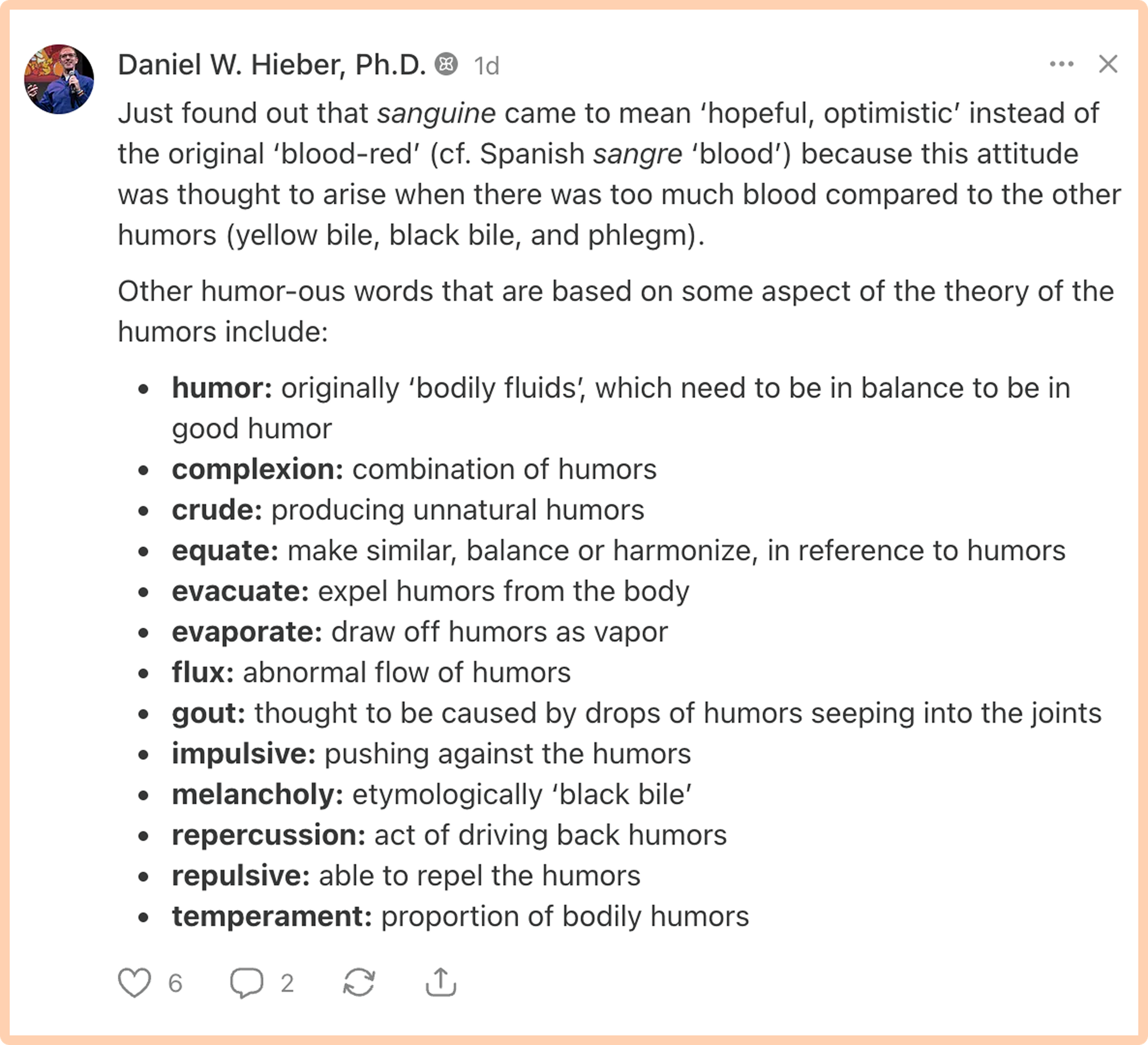
A major tactical shift in Hieber’s evolution involves his use of Substack Notes. Initially, he used Notes much like an RSS feed, sharing breaking news, academic papers, and external research links. Over time, he realized this was a misallocation of his unique value proposition.
"I realized that most of my Substack readers follow me not so much for the latest news and research, but for what I have to say about it," Hieber notes. "My strength as a writer, and the reason people value my newsletter, is my ability to explain and synthesize, not because I’m aggregating links."
By pivoting Notes away from curation and toward original, opinionated linguistic commentary—and integrating Notes directly into his Buffer scheduling queue—he deepened audience engagement. With Substack Notes now fully supported inside Buffer alongside cross-posting to X, LinkedIn, Threads, and Bluesky, creators have an unprecedented ability to funnel short-form engagement directly into subscriber conversions.
2. The Operationalization of Expertise
Hieber’s success disproves the myth that deep academic research and high-volume social media engagement are mutually exclusive. By treating content creation as a manufacturing process—extraction, transformation, and distribution—experts in esoteric fields can build mainstream audiences without compromising the rigor of their work.
3. What Lies Ahead
Hieber shows no signs of slowing down. Having mastered the rhythm of weekly newsletters and automated cross-platform distribution, he is currently in the early stages of writing a pop-linguistics book. Over the next year, his automated queues are set to absorb book-related excerpts, behind-the-scenes writing updates, and expanded conceptual breakdowns, proving that when the infrastructure of a business is automated, the human creator is free to pursue monumental creative projects.