










Main Facts: The Paradigm Shift in Digital Acquisition
Growth marketing has always been a high-stakes game of digital real estate arbitrage. The foundational rule of the discipline remains unchanged: find the next high-potential channel opportunity before the current one becomes saturated, fiercely competitive, and prohibitively expensive.
Consider the evolutionary arc of digital acquisition over the past two decades. Paid search auctions grew crowded, driving cost-per-click rates to unprecedented highs. Organic content marketing, while enduring, proved time-intensive, requiring months—if not years—of sustained effort to compound returns. Email marketing, once a direct line to consumers and decision-makers, became heavily filtered by aggressive algorithms and spam protections. In each instance, the growth teams that identified and invested in emerging levers early on captured disproportionate returns, enjoying lower customer acquisition costs (CAC) and minimal competition before these channels ultimately normalized.
Today, that critical window of opportunity is defined by AI-driven discovery and Answer Engine Optimization (AEO).
Modern buyers—ranging from software evaluators to enterprise procurement teams—are fundamentally altering their research habits. Instead of typing fragmented keywords into traditional search engines and manually navigating a labyrinth of blue links, landing pages, and gated PDFs, buyers are increasingly turning to AI-powered answer engines. They use these tools to research software categories, run detailed head-to-head vendor comparisons, and rapidly formulate opinions regarding which brands are credible industry leaders.
Brands that consistently earn citations within these AI-generated responses are successfully building brand awareness, authority, and preference long before a prospective buyer ever sets foot on a traditional corporate landing page. Crucially, the vast majority of competing brands have yet to realize this fundamental shift in how discovery occurs. For growth marketers, connecting AEO metrics directly to traditional acquisition data is no longer an experimental luxury—it is an existential requirement for capturing future demand.

Chronology: The Evolution of Search, SEO, and the Rise of AEO
To understand the urgency surrounding Answer Engine Optimization, it is helpful to trace the chronological evolution of how humans query machines for information and how digital marketers have adapted in response.
Phase 1: The Keyword Era (Early 2000s – 2010s)
In the early days of modern search engines, discovery was transactional and binary. Users typed short, keyword-stuffed queries (e.g., "best CRM software"). Marketers responded by optimizing web pages for exact-match terms, building backlinks en masse, and gaming search engine result pages (SERPs) to secure the coveted top-three ranking positions.
Phase 2: The Intent & Content Era (2015 – 2023)
As search algorithms matured with semantic search updates (such as Google’s Hummingbird and BERT), the focus shifted toward user intent and long-tail queries. Growth teams moved away from rigid keyword stuffing, adopting comprehensive content marketing strategies that answered broader educational questions. Gated content, whitepapers, and exhaustive blogs became the standard vehicles for capturing top-of-funnel traffic.
Phase 3: The Conversational & Generative AI Era (2023 – Present)
The launch and widespread adoption of generative conversational models, specialized research assistants, and integrated AI search interfaces fundamentally disrupted the search paradigm. Users stopped thinking in "search queries" and started engaging in "conversations." They asked complex, multi-layered questions: "Compare the top three CRM platforms for a mid-market SaaS company with a remote sales team, focusing on ease of integration and pricing transparency."
In this new era, traditional rankings matter far less than citations. If an answer engine synthesizes a response and explicitly recommends or references three specific vendors, those three brands capture 100% of the buyer’s immediate consideration set. Brands omitted from the AI’s synthesis effectively do not exist to that buyer.

Growth marketing teams are currently racing to codify playbooks that ensure their products are not only recommended by these models, but reliably attributed and tracked through the corporate sales funnel.
Supporting Data & Market Realities: Why AEO Cannot Be Treated as Traditional SEO
A common pitfall for organizations entering this space is treating Answer Engine Optimization as a simple rebrand of traditional Search Engine Optimization (SEO). While SEO focuses on ranking web pages based on authority signals and technical optimizations, AEO focuses on synthesizing information into citable units of knowledge that large language models (LLMs) and answer engines can easily ingest, summarize, and reference.
Market research and platform data highlight several critical realities regarding AI-referred traffic:
- Fragmented User Journeys: Not all answer engines generate equal-intent traffic. A prospective buyer discovering a brand through an exploratory query on a platform like Perplexity—where they are actively comparing feature matrices—exhibits vastly different conversion characteristics than a user who encounters a brand mention in a generalized, high-level industry summary.
- The Danger of Generic Optimization: Growth teams that fail to segment their AI-referred traffic treat AEO as a monolith. Consequently, they waste precious engineering and content resources optimizing blindly across engines, regardless of whether those specific platforms actually deliver qualified buyers.
- The Scale Imperative: Earning a sustained share of voice across a software or service category requires more than an occasional quarterly blog post. AEO-ready content demands hyper-specific, highly structured formatting that directly addresses nuanced buyer questions.
Advanced analytics tools—such as HubSpot’s AEO Brand Visibility Dashboard and citation analysis modules—have emerged to solve this data deficit. These systems allow modern growth teams to break down brand visibility by specific engine type and query category, revealing precisely which conversational prompts drive high-intent, revenue-generating traffic. Armed with this empirical data, marketers can transition away from guesswork and allocate resources efficiently.
Official Responses & Industry Perspectives: Operationalizing AI Discovery
Industry leaders and marketing technologists emphasize that the operational window for gaining an AEO advantage is rapidly narrowing. As more organizations decode the mechanics of AI citations, securing top-tier share of voice will become significantly more expensive and difficult.

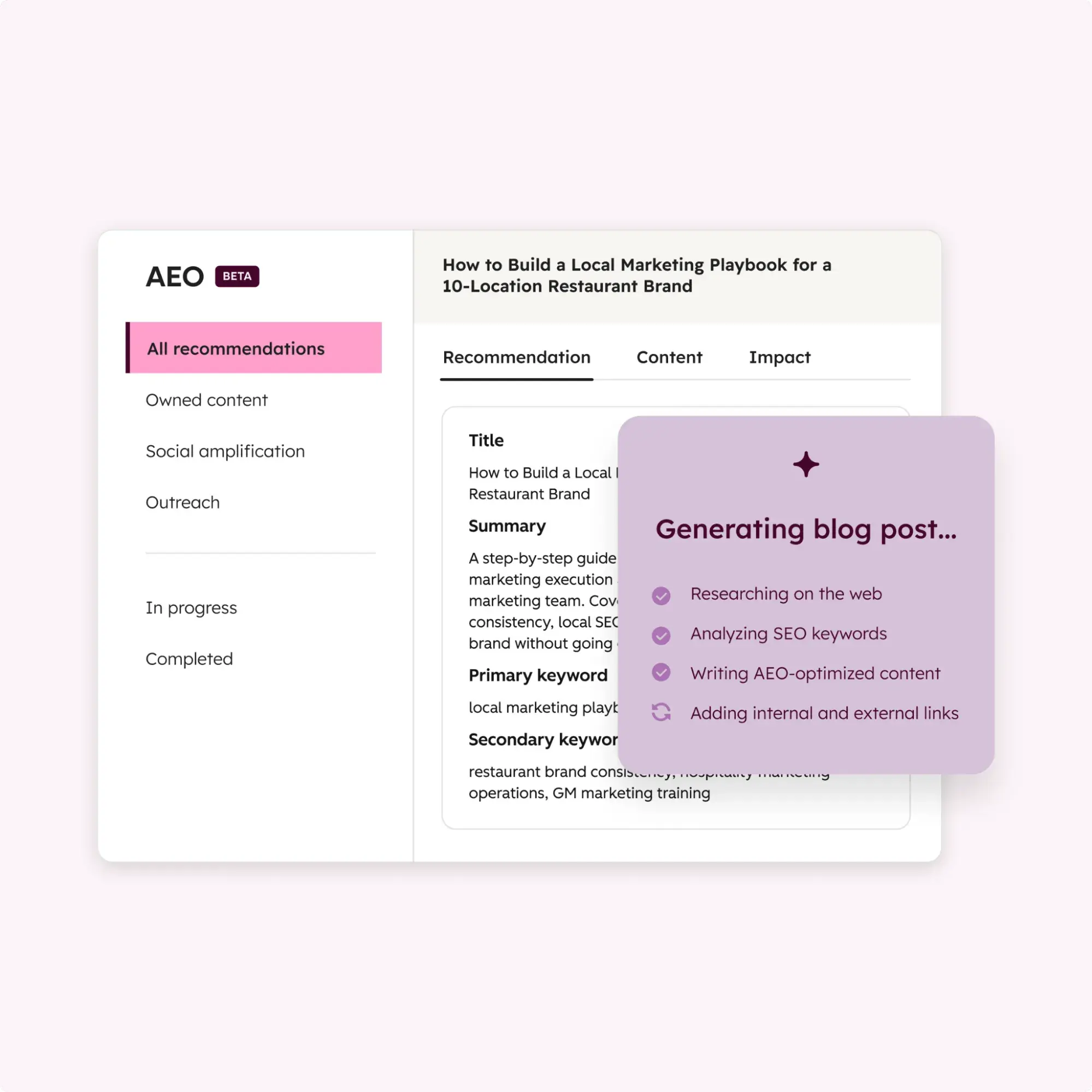
Leading CRM and marketing automation platforms are actively building infrastructure to support this transition. For instance, integrated tools like HubSpot’s Content Agent and AEO Recommendations are designed to bridge the gap between AI visibility and content creation at scale.
According to product development and growth strategy teams:
"Growth marketing is all about finding the next channel opportunity before the current one gets crowded and expensive. Right now, AI-driven discovery is that window of opportunity. Brands earning citations consistently are building awareness before buyers ever hit a landing page, and most of their competitors haven’t noticed yet."
Industry experts stress that content production for AEO must be deeply informed by Customer Relationship Management (CRM) and Ideal Customer Profile (ICP) data. Rather than relying on generic artificial intelligence prompts, modern content agents synthesize first-party customer data, real-time citation tracking, and brand guidelines to draft highly targeted, citable assets. This ensures that every piece of published material addresses specific, high-intent gaps in the market while maintaining strict adherence to brand voice and technical accuracy.
Implications: Connecting AEO Investment to Acquisition Metrics and Pipeline
For any emerging channel to secure sustained executive buy-in and long-term budgetary commitment, it must eventually prove its worth within the rigorous framework of financial accountability. Growth marketing teams live and die by core acquisition metrics:

- Cost Per Lead (CPL)
- Customer Acquisition Cost (CAC)
- Funnel Conversion Rates
- Pipeline Velocity and Deal Progression
Historically, brand awareness channels—such as top-of-funnel PR, display advertising, and broad organic content—faced the perennial challenge of "dark social" or untrackable attribution. Marketers knew the brand visibility mattered, but proving a direct line from impression to closed-won revenue was notoriously difficult.
AEO infrastructure is deliberately designed to dismantle this attribution barrier. By integrating AI visibility data directly with contact and deal records within a unified CRM data model, modern marketing teams can:
- Tag AI-Referred Contacts: Automatically identify and categorize prospects who entered the ecosystem via AI-driven discovery and answer engine citations.
- Track Funnel Progression: Monitor how AI-referred visitors move through every stage of the customer acquisition lifecycle—from initial anonymous touchpoint to Marketing Qualified Lead (MQL), Sales Qualified Lead (SQL), and ultimately closed-won deal.
- Compare Channel Efficiency: Situate AEO attribution within the exact same reporting dashboards used for paid search, paid social, and organic search. This allows CMOs and growth directors to conduct apples-to-apples comparisons of channel efficiency without having to export siloed data into external spreadsheets.
The Strategic Takeaway
The growth channel window for Answer Engine Optimization will not remain open indefinitely. Just as early adopters of paid search and programmatic advertising reaped the rewards of low competition before market maturation set in, today’s forward-thinking growth teams are establishing an insurmountable operational advantage.
By identifying high-converting answer engine channels, scaling structured content production through intelligent agents, and rigorously connecting AEO activity to bottom-line pipeline metrics, organizations can secure their position as trusted authorities in the age of conversational AI. Those that build this measurement and production infrastructure today will own the performance data and market share of tomorrow.



