










By Arun PS and Sushmita Patel
When the Government of India institutionalised the Pre-Legislative Consultation Policy (PLCP) in 2014, it was heralded as a watershed moment for Indian democracy. The policy promised a shift from a top-down, opaque legislative process to a vibrant, participatory model where civil society, stakeholders, and ordinary citizens would contribute to the nation’s legal framework. Nearly a decade later, the promise remains largely unfulfilled. Instead of a robust deliberative democracy, India is witnessing a "consultative deficit" that threatens to alienate the public from the very laws that govern their lives.
The Genesis and Intent of the PLCP
The PLCP was not an arbitrary creation; it was the culmination of years of advocacy by the National Advisory Council and the National Commission to Review the Working of the Constitution. The core objective was simple yet profound: to ensure that every proposed piece of legislation is placed in the public domain for a minimum of 30 days.
Under this mandate, ministries are required to publish the draft bill along with:
- A clear justification for the legislation.
- An assessment of its essential elements and financial implications.
- A projected impact analysis regarding fundamental rights, the environment, and the livelihoods of affected citizens.
- An explanatory note in plain language to ensure accessibility for the layperson.
The vision was that by fostering discourse across multiple stakeholders, the government would enhance the quality of parliamentary debate and ensure that human rights and social equity were at the forefront of policy making. Successful precedents like the consultations surrounding the Kerala Police Legislation and the Lokpal Bill, 2011, served as the blueprint for this initiative.
A Chronology of Non-Compliance
Despite the clear directives of 2014, the implementation of the PLCP has been, at best, inconsistent and, at worst, deliberately ignored. The transition from a representative democracy to a truly deliberative one has stalled.
The Era of "Closed-Door" Legislation
Since the policy’s inception, the legislative record has been marked by a systemic avoidance of public scrutiny. High-profile, consequential bills have been rushed through Parliament with minimal to no public consultation.

- The Muslim Women (Protection of Rights on Marriage) Bill, 2017: Described as "historic," this bill was drafted behind closed doors and denied the typical process of referral to a Parliamentary Standing Committee, stripping it of the necessary multi-partisan and public review.
- The Right to Information (Amendment) Bill, 2019: This move sought to dilute one of India’s most powerful transparency tools. When questioned, the government dismissed the need for public consultation on the grounds that the amendments involved "no social or financial costs"—a claim that stands in direct opposition to the spirit of the Right to Information Act itself.
- The Electoral Bond Scheme: Perhaps the most controversial of all, this scheme was implemented without a shred of consultation with civil society. It took a Supreme Court intervention to mandate transparency, exposing the government’s initial desire to bypass public oversight.
Data-Driven Reality: The Scale of Exclusion
The failure of the PLCP is not merely anecdotal; it is statistically verifiable. A repository created by the authors tracking bills from June 2014 to August 2019 reveals a troubling trend.
Analysis of Legislative Conduct (2014–2019)
Out of 186 bills introduced in Parliament during this period, a staggering 142—approximately 76%—saw no public consultation whatsoever. Of the 44 bills that were technically placed in the public domain, 24 failed to meet the mandatory 30-day window for feedback.
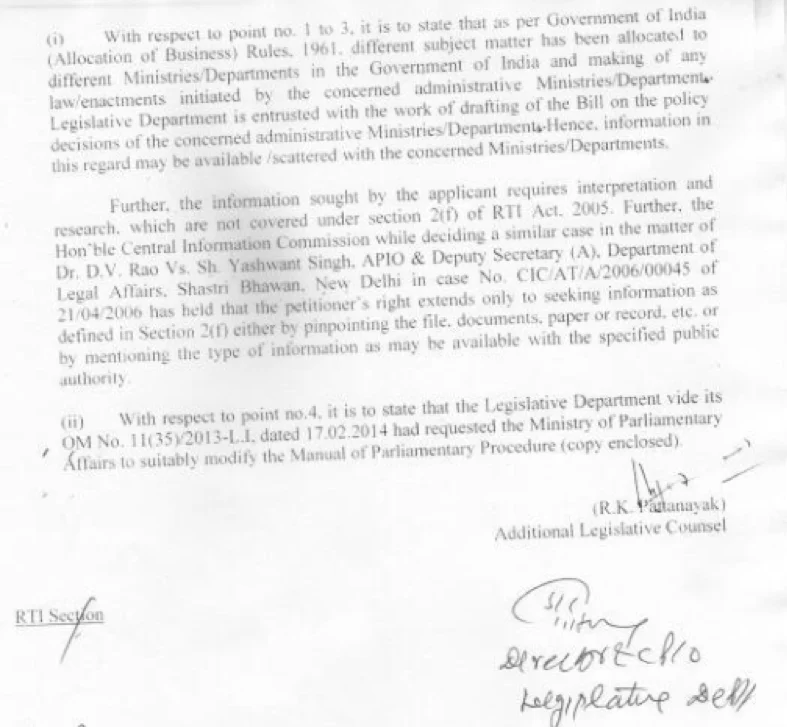
When observing the administrative side—where ministries circulate bills for comment—out of 98 bills, 38 had incomplete consultation processes, and only 55 met the 30-day deadline. Even within the government, coordination is abysmal. The Ministry of Parliamentary Affairs, for instance, ignored direct requests from the Ministry of Law and Justice to ensure the PLCP was integrated into the manual of parliamentary procedures.
The "RTI" Wall: Institutional Accountability
The authors’ attempt to track compliance via the Right to Information (RTI) Act met with a disturbing response. The Legislative Department, which holds the mandate to ensure ministry compliance, claimed it maintains no central database on PLCP implementation. Instead, they offered a vague consolation that such information might be "scattered" among individual ministries.
This response is a direct violation of the policy, which mandates the Law Ministry to act as the overseer of the process. When the government’s own regulatory body lacks a record of compliance, it signals that the PLCP is treated as a bureaucratic nuisance rather than a constitutional imperative.
Implications: Why Consultation Matters
The consequences of bypassing public discourse are far-reaching.
- Selective and Exclusionary Participation: When the government does choose to consult, it is often performative. Uploading a draft to an obscure ministry website—as seen with the Prevention of Cruelty to Animals (Regulation of Livestock Market) Rules, 2017—is not "public consultation." It is an exclusionary tactic that keeps stakeholders in the dark until it is too late to offer meaningful feedback.
- Lack of Comprehensibility: By failing to provide summaries in regional languages or plain, simple language, the government effectively bars the vast majority of the Indian populace from participating.
- Policy Flaws: Without the "social audit" provided by the public, laws are prone to structural errors, fundamental rights violations, and long-term legal challenges that clog the judiciary.
A Path Forward: Reimagining Participation
To move beyond the current deadlock, India must shift from viewing consultation as an optional courtesy to treating it as a legal right.

1. Institutionalizing Social Audits
The country requires a formal "Social Audit Legislation." This would legally obligate policymakers to consult the public and provide a mechanism to penalize officials who bypass these protocols. If a bill is introduced without proper public scrutiny, the judiciary should have the power to invalidate the law or return it for a mandatory consultation period.
2. A Digital "One-Stop" Portal
The current fragmented approach—where each ministry hosts its own drafts—is designed to fail. India should adopt a model similar to the Telecom Regulatory Authority of India (TRAI), which maintains a transparent, centralized repository for all comments and feedback. An enhanced, unified portal (an improved version of MyGov.in) could serve as a centralized hub for all policy-related discourse, allowing civil society initiatives like Civis.vote to act as bridges between the state and the citizen.
3. Procedural Reform
Amendments to the Government of India (Allocation of Business) Rules, 1961, and the Rules of Procedure and Conduct of Business in both houses of Parliament are essential. These rules must be updated to explicitly require a "Consultation Certificate" to be attached to every bill introduced in the legislature, proving that the PLCP has been followed.
Conclusion: The Gandhian Talisman
As India continues to navigate the complexities of 21st-century governance, it must not forget the foundational ethos of its democracy. On the anniversary of Mahatma Gandhi’s birth, the government should reflect on his "talisman": the principle of involving the poorest and weakest in the decision-making process.
The Pre-Legislative Consultation Policy was intended to be the mechanism to achieve this. Its current state—characterized by disregard, defiance, and exclusion—is a disservice to the millions of citizens whose lives are shaped by the stroke of a pen in Delhi. It is time to move from "government for the people" to "government with the people." Without a genuine, legally binding commitment to public consultation, the legislative process remains a hollow shell, far removed from the democratic ideals the nation claims to uphold.



