Unmasking the "Halloween Documents": How Microsoft’s Secret Strategy Backfired and Bolstered the Rise of Linux
Linux stands today as the undisputed heavyweight champion of open-source operating systems, powering everything from the world’s most powerful supercomputers and cloud infrastructure to billions of Android smartphones. Yet, its ascent to global dominance was far from guaranteed.
The open-source operating system’s road to success was paved with historic milestones—not least of which was AT&T suing the University of California, Berkeley, over a mere 186 lines of Unix code, a legal battle that inadvertently cleared the runway for Linux to flourish. However, as the nascent OS began to catch its stride in the late 1990s, it inevitably caught the attention of the reigning titan of the software industry: Microsoft.
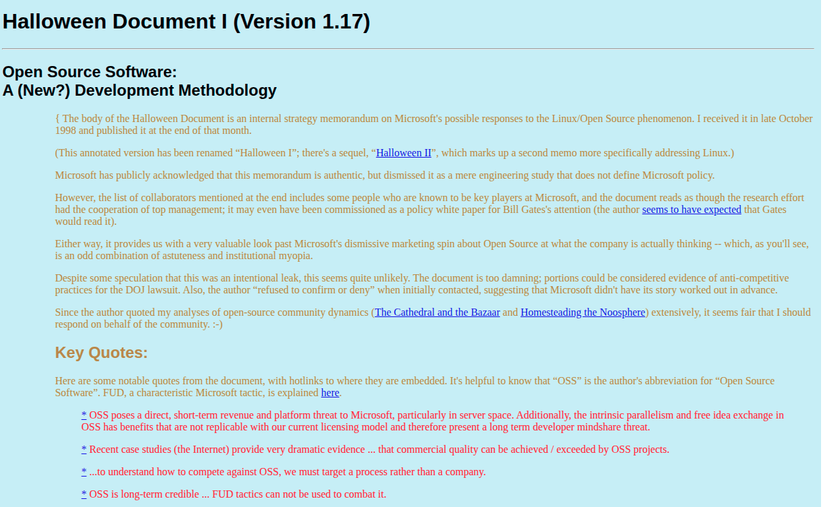
What followed was a series of confidential internal memos outlining how the Redmond giant planned to neutralize this burgeoning open-source threat. Known collectively as the "Halloween Documents," this cache of leaked corporate strategy offers a fascinating window into early software warfare. More importantly, the public disclosure of these memos achieved the exact opposite of what Microsoft intended, inadvertently galvanizing the open-source community and shaping the modern tech landscape.
Main Facts: The Anatomy of the Microsoft Memos
At their core, the Halloween Documents were a series of confidential internal strategy memos circulated among Microsoft executives and engineers in 1998. Authored primarily by Microsoft engineer Vinod Vallopillil and edited by senior leadership, the papers were designed to analyze the Linux kernel and the broader open-source software (OSS) movement to determine whether they posed a genuine commercial threat to Windows and Windows NT.
Rather than dismissing open-source software as a passing fad, the documents took the threat seriously, laying bare Microsoft’s internal vulnerabilities and outlining aggressive strategies to counter them.
The core revelations of the documents included:
Acknowledgment of Open-Source Viability: The memos conceded that open-source software possessed a unique "long-term credibility" that traditional corporate strategies could not easily shatter, primarily because source code was widely distributed and independently verifiable by millions of developers.
The Danger of Commodity Protocols: Microsoft recognized that Linux and open-source projects gained rapid traction in server environments by utilizing simple, open, and interchangeable networking protocols.
The "De-commoditization" Strategy: To stop the bleeding, Microsoft planned to attack the core strengths of OSS by embracing open protocols and subsequently extending them with proprietary features—effectively locking customers into closed systems and shutting open-source alternatives out of the market.
Chronology: From Secret Memos to Public Exposure
The Late-October 1998 Leak
The term "Halloween Documents" earned its iconic moniker because the files were brought to light at the tail end of October 1998, serving up a nasty trick-or-treat surprise for Microsoft executives.
The documents were leaked to prominent open-source advocate Eric S. Raymond by an anonymous source. Raymond, who operates the Cathedral and the Bazaar repository, quickly recognized the historic value of the leak. Rather than keeping the files under wraps, he published them online alongside his own analytical commentary, giving the world an unfiltered look at Microsoft’s playbook.
Microsoft’s Early November Response
Facing mounting public scrutiny and undeniable proof of its strategic intentions, Microsoft did not wait long to respond. In early November 1998, the company officially acknowledged authorship of the documents.
However, Microsoft’s public relations strategy attempted to downplay the significance of the memos. The company framed them not as corporate policy or a malicious roadmap for market destruction, but merely as internal "engineering analyses" exploring market competition.
Supporting Data and Strategic Analysis
Reading Between the Lines of the Halloween Documents
For technology historians, reading the Halloween Documents today provides a riveting look at how corporate boardrooms perceived the nascent open-source movement.
Some predictions within the documents look humorous in hindsight—such as the assessment that "Linux is a short/medium-term threat in servers" and "Linux is unlikely to be a threat on the desktop." These assumptions were made long before Linux secured its current enterprise dominance and prior to the creation of user-friendly desktop ecosystems. At the time, Linux was merely a seed, and Microsoft’s internal strategy aimed to identify its weak points before it could sprout.
The Limits of FUD (Fear, Uncertainty, and Doubt)
Historically, dominant tech companies leveraged "FUD"—Fear, Uncertainty, and Doubt—to cripple competitors. This tactic involved planting doubts regarding a rival product’s security, long-term support, and enterprise viability, while marketing one’s own systems as inherently secure and stable.
However, the Halloween Documents explicitly noted that traditional FUD tactics failed when applied to open-source software. As one memo section pointed out:
"Loosely applied to the vernacular of the software industry, a product/process is long-term credible if FUD tactics can not be used to combat it. OSS is Long-Term Credible. OSS systems are considered credible because the source code is available from potentially millions of places and individuals."
The Strategy: "De-Commoditize" and Conquer
Recognizing that FUD would not kill Linux, Microsoft pivoted to a more systemic approach. The memos highlighted that Linux derived its strength from commodity services and simple protocols that allowed different software vendors to interoperate seamlessly.
The strategy proposed targeting this exact strength:
"Generally, Microsoft wins by attacking the core weaknesses of OSS projects. De-commoditize protocols & applications. OSS projects have been able to gain a foothold in many server applications because of the wide utility of highly commoditized, simple protocols. By extending these protocols and developing new protocols, we can deny OSS projects entry into the market."
While the exact phrase "embrace, extend, extinguish" (EEE) does not explicitly appear in the text, the core tactic of extending open standards with proprietary features to lock competitors out closely mirrors the business strategy Microsoft executives were deploying throughout the 1990s.
Implications: How the Leak Backfired
When the Halloween Documents leaked in 1998, their impact was seismic. Far from injuring Linux, the exposure of Microsoft’s internal playbook served as an incredible stroke of fortune for the open-source community.
1. Providing the Open-Source Community a Blueprint
For the first time, open-source developers had concrete, insider intelligence revealing exactly what feared competitor Microsoft considered to be their greatest strengths—and their most vulnerable pressure points. Knowing that Microsoft intended to target open, commodity protocols allowed architects and developers to shore up those specific areas, focusing intensely on standardization, interoperability, and robust security frameworks.
2. Energizing the Developer Base
The leak galvanized the global open-source community. It transformed what might have been an isolated, grassroots hobbyist movement into a unified, defensive resistance against corporate monopolization. Developers rallied around the banner of software freedom, viewing their contributions not just as coding projects, but as a crucial defense of consumer choice and open standards.
3. A Shift in Modern Tech Dynamics
Nearly three decades after the Halloween Documents were made public, the relationship between Microsoft and Linux has evolved profoundly. In a supreme irony of corporate history, Microsoft has shifted from trying to extinguish Linux to actively embracing it. The development of the Windows Subsystem for Linux (WSL), Microsoft’s acquisition of GitHub, and its status as one of the largest corporate contributors to the Linux kernel demonstrate a complete strategic reversal.
Yet, industry experts agree: Microsoft’s olive branch to the open-source world might never have materialized if Linux had not grown strong enough to weather the storm. And it was the explosive public revelation of the Halloween Documents in 1998 that ultimately gave the open-source community the foresight, unity, and resilience needed to survive and conquer the digital age.