










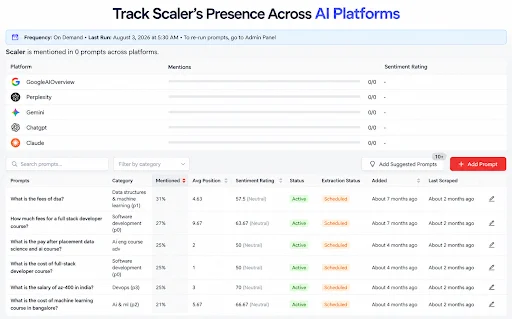
In the traditional era of search engine optimization (SEO), success was binary: you either ranked on the first page of Google, or you were invisible. Today, that paradigm has shifted entirely. We no longer search for a list of links; we ask questions, and AI models—from ChatGPT and Gemini to Perplexity and Google’s AI Overviews—provide the answers.
However, a dangerous misconception has taken hold in the marketing world: the belief that "mentioning" a brand is the same as "recommending" it. As digital intelligence evolves, brands are discovering that appearing in a model’s response is only the easy half of the battle. The harder, more lucrative task is ensuring that when an AI makes a recommendation, your brand is the one it chooses.
Social Beat, a digital growth agency, is addressing this shift with GEO Pulse, a proprietary AI visibility tool designed to move beyond simple vanity metrics and into the mechanics of intent-based recommendation.
The Illusion of Visibility: The "Mention" Fallacy
Lily Ray’s pioneering research into AI behavior has highlighted a critical flaw in current SEO strategies: the "Brand-in-List" phenomenon. A brand might appear in a list of competitors provided by an AI, but the model may systematically ignore that same brand when it transitions from listing options to providing a definitive recommendation.
For marketing teams, "Share of Citation" has become a popular metric to show on boardroom slides. Yet, it is often misleading. If a model lists ten competitors but consistently directs users to the same two providers, the brand with the "mention" is merely noise. GEO Pulse was built to solve this by focusing on the "harder half" of the equation: visibility that translates into actual buyer preference.
Chronology of the Shift: From Search Queries to Conversational Intent
The transition from traditional search to Generative Engine Optimization (GEO) has not been overnight, but its acceleration is undeniable.
- Early 2024: Brands began realizing that AI responses were cannibalizing organic traffic. Initial efforts focused on "brand tracking"—simply checking if a model knew a company existed.
- Mid-2024: The industry identified the variance problem. Studies, including those by SparkToro and Gumshoe.ai, revealed that identical prompts run across different sessions yielded wildly different brand recommendations.
- Late 2024–2025: The realization hit that models were increasingly sensitive to "source authority." Agencies began pivoting from keyword stuffing to authority-building through PR and community signals.
- 2026 and Beyond: The current era is defined by the "Action Layer." With Google Search Console now integrating AI performance data, simple tracking dashboards have become commodities. The focus has moved to technical architecture and content precision.
Supporting Data: The Anatomy of a Campaign
To understand why GEO requires a more sophisticated approach than traditional SEO, one must look at how models synthesize information. Social Beat’s methodology relies on a rigorous data pipeline:
- The Prompt Universe: Instead of relying on keyword tools—which provide estimated, often inaccurate volume data—Social Beat builds its prompt lists from the "Ground Truth" of client data: support chats, call center queries, and real-world discussions on platforms like Reddit, Quora, and LinkedIn.
- The Variance Filter: Because AI models are non-deterministic, a single query tells you nothing. GEO Pulse runs hundreds of buyer-intent prompts multiple times a day, averaging results over a 7-10 day window. This provides a "confidence band," ensuring that the data reported represents a recurring pattern rather than a one-off glitch.
- Scale: Currently, the platform processes over 10,000 active prompts across 500+ categories, having analyzed nearly half a million brand mentions.
Two Case Studies: Divergent Paths to Visibility
Social Beat’s work with diverse clients underscores that there is no "one-size-fits-all" GEO strategy.
Case A: The Restricted Category (Mental Health)
In industries like mental health, paid advertising is heavily restricted or entirely prohibited on AI surfaces. For one provider, organic citation was the only viable growth lever. By restructuring site content to be more "extractable" for AI models and targeting high-authority community forums for PR placements, the brand saw:
- 61% increase in conversions with zero paid media spend.
- 86% rise in AI surface impressions.
- A "Quality over Quantity" shift: While click-through rates dropped from 3.06% to 2.37%, the intent behind those clicks was higher, leading to better conversion rates.
Case B: The Technical Architecture Problem (Global Consultancy)
A global technology firm faced a different issue: their site structure was invisible to AI crawlers. By cleaning up duplicate pages, fixing broken links, and implementing a "hub-and-spoke" architecture, the brand ensured the AI had a clear "source of truth" to reference. The result was a 55% increase in AI Overview keywords within three months and a 54% rise in organic visits over six months.
Implications: The Future of the Dashboard
As the industry matures, the value of simple tracking tools is plummeting. On August 31, 2026, Google began providing native AI performance reporting within Search Console. This effectively commoditized the "counting" aspect of GEO.
"Any product whose entire pitch is ‘we count your citations’ has a shorter shelf life than its pricing deck suggests," the researchers at Social Beat note. The future of GEO is not in reporting, but in actionability.
The Regulatory Risk
One of the most pressing implications is the accuracy of AI-generated information. Models frequently hallucinate pricing, coverage, or eligibility criteria. In regions like India, where the Digital Personal Data Protection (DPDP) Act and consumer protection rules are stringent, "the AI said it" is not a valid legal defense. Brands must now treat AI-provided information as a regulatory touchpoint, necessitating rigorous "fact-checking" cycles within their GEO strategy.
The "Rented" Nature of AI Traffic
Visibility in AI is rented, not owned. When a model updates its underlying logic—such as the August 8th update to ChatGPT, which saw massive drops in Reddit and arXiv citations—brands relying on a single channel for visibility were decimated. A robust GEO strategy must therefore be diversified across multiple models (Gemini, Perplexity, Claude, etc.) and focus on foundational brand authority rather than "gaming" a specific algorithm.
Conclusion: Asking the Right Questions
The era of the "visibility dashboard" is coming to a close. Brands that rely on third-party tools to simply tell them "you were mentioned" are missing the bigger picture.
To thrive in the age of Generative Engine Optimization, stakeholders must move beyond the vanity of the mention and interrogate the AI:
- Who is the model recommending when it ignores us?
- What specific factual errors is the model propagating about our brand?
- How does a change in the default model version impact our bottom line?
The competitive advantage no longer lies in being the first result in a list; it lies in being the trusted source that the AI consistently chooses to represent. As India continues to solidify its place as a top-three market for AI adoption, the ability to localize this visibility—into Hindi, Tamil, and Marathi—will become the ultimate differentiator for domestic and international brands alike.
Frequently Asked Questions (FAQ)
What is the core difference between GEO and traditional SEO?
Traditional SEO optimizes for a ranked list of links, focusing on click-throughs from a search engine result page. GEO (Generative Engine Optimization) optimizes for a conversational answer, focusing on the brand’s ability to be recommended and cited as an authority by an AI model.
Why does GEO Pulse run prompts over a 10-day window?
AI models are inherently probabilistic. A single prompt can return a different result based on server load, cache, or model updates. By running prompts repeatedly, GEO Pulse filters out "noise" and identifies statistically significant patterns in brand mentions.
Does GEO Pulse replace the need for an agency?
GEO Pulse is a tool designed to guide action. While the data provides the roadmap, the execution—PR, technical site architecture, and content creation—requires the strategic intervention that only an experienced agency can provide.
How does regional language support change the landscape?
In markets like India, a significant portion of user queries are conducted in vernacular languages. A dashboard that only tracks English-language citations is effectively ignoring a massive, high-intent segment of the consumer base. Regional retrieval is critical for accurate brand visibility.
What is the "Action Layer" in GEO?
The Action Layer refers to the strategic, tangible changes made to a brand’s digital footprint—such as modifying site structure, securing PR mentions, or refining content—based on the specific insights provided by the visibility tool. It is the bridge between knowing the problem and solving it.



