Global Milestones — In a historic milestone for the world’s most popular Content Management System, Yoast SEO has officially surpassed one billion cumulative downloads on the official WordPress plugin directory. According to reports from the French WordPress authority WPMarmite, this achievement makes Yoast SEO the first-ever extension in WordPress history to cross the elusive ten-digit download threshold.
The monumental news was publicly broken on September 16, by Brad Williams, co-founder of the prominent WebDevStudios agency and a veteran figure within the global WordPress community. Williams took to X (formerly Twitter) to congratulate the past and present teams who have built, maintained, and supported the SEO powerhouse over its decade-and-a-half-long lifespan.
This unprecedented benchmark highlights not only the enduring dominance of a foundational tool but also the shifting dynamics of the modern WordPress ecosystem, where veteran software competes against agile newcomers in an increasingly crowded marketplace.
1. Main Facts: Decoding the Billion-Download Milestone
To understand the scale of one billion downloads, analysts must separate raw marketing statistics from everyday reality. The WordPress.org directory counts every single time a piece of software is downloaded—including every minor update, major version patch, and automated staging environment deployment across millions of sites. A mature plugin with a frequent release cycle naturally accumulates download numbers at an exponential rate, even if its base of active websites grows at a steadier, more linear pace.
Nevertheless, the milestone reflects remarkable longevity. Born in 2010 under the guidance of Dutch developer Joost de Valk—whose first name directly inspired the brand name "Yoast"—the plugin has weathered countless algorithmic shifts by search engine giants. Following its acquisition by Newfold Digital in 2021, the tool has continued to scale its operations. Sixteen years after its initial commit, Yoast SEO remains the default installation for countless agencies, developers, and hobbyists setting up a fresh WordPress instance.
When compared against other titans in the repository using data aggregated by WP-Rankings, Yoast stands completely alone at the summit:
- Yoast SEO: ~1,000,000,000 downloads
- Elementor (Page Builder): ~892,000,000 downloads
- WooCommerce (E-commerce): ~464,000,000 downloads
- Contact Form 7, Akismet, and WPForms: Round out the upper echelon of the historical download charts.
Whether page-builder giant Elementor will eventually catch up to the one-billion mark depends entirely on its continued update frequency and sustained market expansion, leaving no guaranteed timeline for a challenger to claim the crown.
2. Chronology: The 16-Year Evolution of an SEO Giant
The journey from a simple developer project to a billion-download juggernaut spans more than a decade and a half of web development history:
- 2010 (The Genesis): Joost de Valk releases the initial version of the plugin, originally known as WordPress SEO by Yoast. At a time when WordPress was transitioning from a simple blogging platform to a full-fledged CMS, the tool consolidated fragmented SEO tasks—like XML sitemaps, meta descriptions, and title templates—into a single, user-friendly interface.
- Mid-2010s (Rapid Adoption): As search engine optimization became critical for digital marketing, Yoast established the standard "traffic light" scoring system (red, orange, green) for readability and keyword optimization, educating an entire generation of content creators.
- 2021 (The Acquisition): Newfold Digital acquires Yoast, integrating the product into its extensive portfolio of web hosting and service brands, providing the plugin with deeper enterprise backing and expanded internationalization resources.
- 2026 (The Billion-Download Era): The plugin reaches version 28.5 (requiring modern server environments such as WordPress 6.9 and PHP 7.4+), culminating in the September announcement confirming the historic one-billion download barrier.
3. Supporting Data: Active Installations vs. Cumulative Downloads
While one billion downloads capture headlines, platform usage requires a different set of metrics. WordPress.org caps its public visibility for active installations once a plugin clears ten million sites, routinely displaying "More than 10 million active installations" on the official repository.
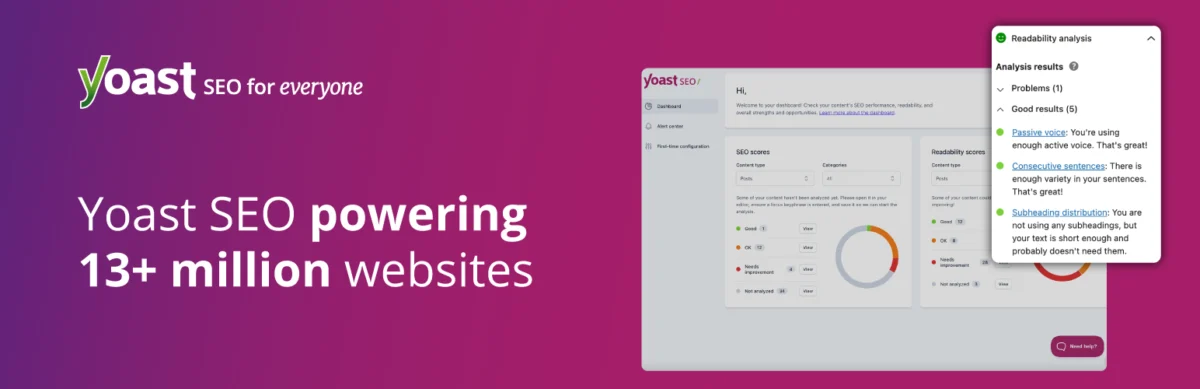
Internal data provided by Yoast paints a slightly more precise picture, estimating its true active footprint at over 13 million live websites as of late summer. Additional metrics from the official repository underline its massive community footprint:
- User Reviews: Nearly 28,000 reviews.
- Average Rating: A stellar 4.8 out of 5 stars.
- Localization: Fully translated into 59 different languages globally.
What the Numbers Do Not Tell Us
As industry analysts like WPMarmite point out, download counters and active installation figures serve primarily as macro-level communication tools. They do not automatically correlate with the search engine rankings of the websites utilizing them, nor do they reflect real-time user sentiment regarding modern interface bloat or feature paywalls. Instead, the billion downloads represent an irreplaceable network effect—a deep-rooted ecosystem forged over years of recommendations by web hosting companies, development agencies, and SEO educators.
4. Official Responses and Industry Reactions
The announcement generated widespread recognition across the global WordPress community, highlighting the collaborative nature of open-source software maintenance.
"Congratulations to everyone who has helped build and maintain Yoast SEO over all these years. Reaching one billion downloads is an extraordinary milestone that cements its place in WordPress history."
— Brad Williams, Co-founder of WebDevStudios
Representatives from Yoast and its parent company Newfold Digital emphasized that reaching this scale is a testament to the thousands of contributors, translators, testers, and support agents who have touched the codebase over the past 16 years. The focus moving forward centers on maintaining performance standards, integrating modern AI-assisted content optimization features, and adapting to shifting core web vitals requirements mandated by search engines.
5. Implications: The Modern SEO Plugin Marketplace
Yoast’s monumental milestone occurs in a landscape vastly more competitive than the one it dominated a decade ago. Today, users have access to a robust array of alternative tools that challenge Yoast’s historic supremacy by reshaping the value proposition of free versus premium features.
The Rise of Rank Math and Competitors
- Rank Math: Serves as Yoast’s most aggressive competitor, boasting over 4 million active installations and an identical 4.8-star average rating. Rank Math captured significant market share by including advanced features in its free tier—such as built-in redirection management and robust schema markup options—that competing plugins typically lock behind paywalls.
- SEOPress: A French-born alternative that has steadily expanded its global footprint, appealing to agencies seeking white-label capabilities and lightweight performance.
- Slim SEO: Caters to minimalist developers and site owners who prefer a "set-and-forget" approach with zero configuration screens.
Choosing the Right Tool
For developers and site owners currently evaluating their tech stack, relying purely on download counts is no longer recommended. Modern decision-making weighs more critical factors:
- Feature Distribution: What does the free tier offer compared to paid upgrades?
- Performance Overhead: How much code does the plugin add to front-end page loads and database queries?
- Compatibility: How cleanly does the extension integrate with existing themes, page builders (like Elementor or Gutenberg), and e-commerce setups (like WooCommerce)?
- Project Requirements: Does the site require specialized modules, such as local SEO, multilingual support, or news sitemaps?
While Yoast, Rank Math, and SEOPress easily cover the fundamentals of on-page optimization, the real differentiator lies in user workflow preferences and pricing structures for advanced features. Furthermore, site owners migrating away from Yoast must exercise caution: simply deactivating the plugin leaves behind custom database tables and meta keys, requiring a manual cleanup process to keep databases lean.
Frequently Asked Questions
How many total downloads does Yoast SEO have?
Yoast SEO has officially surpassed 1,000,000,000 (one billion) cumulative downloads on the official WordPress.org repository, becoming the first plugin in history to achieve this milestone.
How many active websites currently use Yoast SEO?
While the WordPress.org plugin directory caps its public indicator at "more than 10 million active installations," internal impact reports from Yoast estimate their true active footprint exceeds 13 million live sites.
What is the primary competitor to Yoast SEO?
Rank Math is widely considered the primary competitor, boasting over 4 million active installations and a 4.8 out of 5-star rating, largely driven by offering advanced features (like redirections and schema) in its free version. Other notable alternatives include SEOPress and Slim SEO.
Which plugin trails Yoast in total historical downloads?
According to WP-Rankings data, Elementor sits in second place with approximately 892 million downloads, followed by WooCommerce with roughly 464 million downloads.
Sources: Brad Williams via X, WPMarmite, and WordPress.org official directory data.