










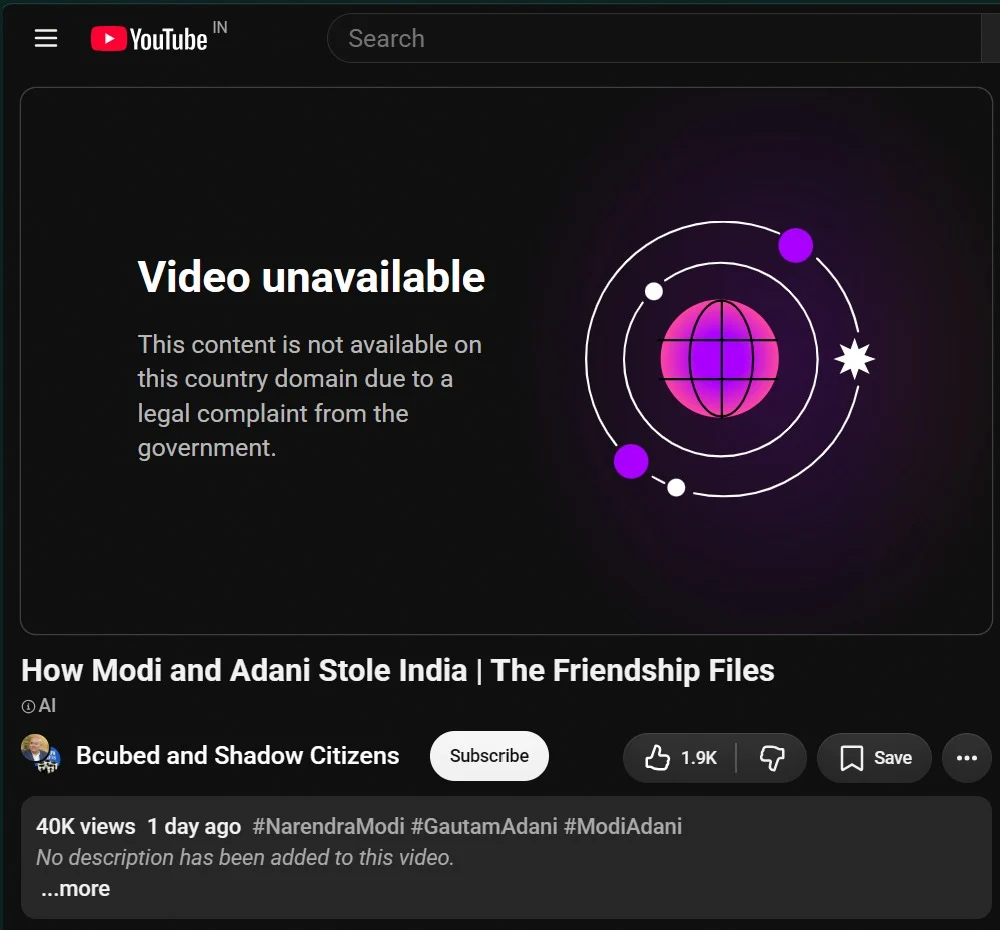
NEW DELHI — Video-sharing platform YouTube has restricted access within India to a high-profile video essay titled "How Modi and Adani Stole India | The Friendship Files," authored by Hotmail co-founder Sabeer Bhatia. The ten-minute documentary-style feature, which critically examines the political and economic ties between Indian Prime Minister Narendra Modi and billionaire industrialist Gautam Adani, was rendered invisible to domestic viewers following what the platform cited as a legal complaint lodged by an unidentified government entity.
The swift suppression of the video, which occurred within days of its October 9 release, highlights an intensifying environment of digital censorship in the world’s largest democracy. While the move has effectively choked the video’s mainstream distribution channels within national borders, it has simultaneously triggered a widespread digital workaround, transforming the banned asset into a viral symbol of resistance against state-backed media controls.
Main Facts: The Takedown and Circumvention
Uploaded initially on October 9, the video struggled to gain immediate algorithmic traction, accumulating a modest 45,000 views before YouTube’s content moderation teams intervened. Users attempting to access the URL from within India are now greeted with a standardized platform notice stating: "This content is not available on this country domain due to a legal complaint from a government entity."
YouTube’s transparency notices indicate that the content was blocked only "after review," though the tech giant has consistently declined to name the specific government ministry, agency, or statutory body that initiated the complaint, nor has it disclosed the exact legal provisions invoked under Indian information technology laws.
Despite the domestic blackout, the video remains fully accessible to Indian users employing Virtual Private Networks (VPNs). Furthermore, the creator, Sabeer Bhatia, actively preempted total erasure by decentralizing the content. Bhatia posted the full video directly to his X (formerly Twitter) account—where it rapidly surpassed 1.8 million views—and distributed alternative viewing links via Google Drive and iCloud.
The digital defiance quickly cascaded across political lines. Prominent opposition figures, including Member of Parliament Mahua Moitra, shared mirror copies of the video essay across social media platforms, ensuring that the content remained accessible to the domestic public despite institutional roadblocks.
Chronology of Content Suppression and Legal Interventions
The blocking of Bhatia’s video is not an isolated incident; rather, it forms a significant chapter in a long-standing pattern of legal and administrative pressure exerted against critics of the Modi administration and the Adani Group. A retrospective look at recent enforcement actions reveals a systematic tightening of digital discourse:
- 2017 – The EPW Precedent: Academic multidisciplinary publication Economic and Political Weekly (EPW) removed a critical research article following a legal notice from Adani Power. The controversy prompted the resignation of then-editor Paranjoy Guha Thakurta.
- February 2023 – Wikipedia Manipulation Allegations: The Signpost, an online community newspaper covering Wikipedia, reported that paid employees of the Adani Group may have systematically altered Wikipedia entries to provide a favorable, "non-neutral PR" spin on the conglomerate’s history and controversies.
- September 2025 – MIB Takedown Directives: The Ministry of Information and Broadcasting (MIB) issued formal directives to 12 online-first news publishers and independent journalists—including Ravish Kumar, Abhisar Sharma, Dhruv Rathee, The Wire, and Newslaundry—ordering the removal of videos and articles alleged to be defamatory toward the Adani Group. This administrative order was later set aside by a Delhi court.
- February 2026 – Criminal Defamation Sentencing: Independent Indian journalist Ravi Nair was sentenced to one year in prison and fined Rs 5,000 in a criminal defamation suit brought by Adani Enterprises Limited (AEL).
- August 2026 – Gujarat Police IT Act Utilization: Independent journalist Aditi Agarwal uncovered court submissions made by X to the Karnataka High Court, revealing that the Gujarat Police had repeatedly invoked the Information Technology (IT) Act to force the platform to scrub posts critical of Modi and Adani.
- October 2026 – Sabeer Bhatia’s Video Blocked: YouTube restricts access to "How Modi and Adani Stole India" in India following a government-backed legal complaint.
Supporting Data: The Mechanics of State-Backed Censorship
Recent disclosures in judicial proceedings have shed light on the technical and legal mechanisms used by law enforcement agencies to purge critical commentary online. In the case involving X’s legal challenge against the controversial Sahyog Portal in the Karnataka High Court, platform disclosures demonstrated how regional police forces utilize statutory IT rules to suppress environmental and political critiques.

A notable example brought to light by journalist Aditi Agarwal involved a Gujarat Police takedown notice targeting a satirical post about deforestation and corporate influence. The targeted post featured a cartoon depicting Gautam Adani sitting atop Prime Minister Modi’s shoulders, directing state policy regarding environmental clearances.
The accompanying text criticized the Adani Group’s receipt of Stage-I mining approvals in the ecologically sensitive Hasdeo Forest of Chhattisgarh—a project slated to clear nearly 4.48 lakh trees. The police notice justified the takedown by claiming that excerpts and clips were circulated with "malicious intent to mislead the public and propagate false narratives." X complied with the order under duress, though platform representatives argued before the court that the directive effectively censored legitimate, newsworthy journalism regarding environmental degradation.
Official Responses and Stakeholder Positions
As of press time, neither the Ministry of Information and Broadcasting nor representatives for the Adani Group have issued formal statements regarding the specific legal complaint lodged against Sabeer Bhatia’s video essay.
Tech platforms operating within India, including YouTube and X, find themselves caught in an increasingly difficult compliance landscape. Under India’s Information Technology (Intermediary Guidelines and Digital Media Ethics Code) Rules, platforms face stringent liability waivers only if they comply expeditiously with government takedown orders, which are frequently issued under confidentiality provisions that prevent platforms from publicly identifying the complainant.
Civil liberties organizations and digital rights advocates have repeatedly criticized this opaque framework, arguing that the lack of transparency prevents creators from mounting effective legal defenses. By shrouging takedown requests in administrative secrecy, critics argue, the government effectively outsources censorship to private corporations while insulating itself from judicial accountability.
Implications for Free Speech and Digital Democracy in India
The suppression of Sabeer Bhatia’s video essay carries profound implications for the future of digital expression, investigative journalism, and political discourse in India.
- The Chilling Effect on Tech Entrepreneurs and Public Figures: When high-profile figures with global technological credentials—such as Hotmail co-founder Sabeer Bhatia—face institutional censorship for producing critical commentary, it sends an unmistakable warning to ordinary citizens and lesser-known journalists. The message is clear: critique of the nexus between high political office and corporate monopoly capital carries severe systemic risks.
- The Limits of Institutional Censorship in a Borderless Digital Age: The incident demonstrates the growing inefficacy of traditional geographic blocking in the internet era. Because decentralized platforms, VPNs, and peer-to-peer file sharing allow banned content to circulate widely across secondary channels (such as X, Google Drive, and encrypted messaging apps), state-ordered takedowns often achieve the opposite of their intended effect, bestowing "Streisand effect" notoriety upon the suppressed material.
- Judicial Pushback vs. Executive Overreach: While lower and high courts—such as the Delhi Court’s ruling setting aside MIB defamation orders and ongoing scrutiny in the Karnataka High Court—occasionally offer legal remedies against executive overreach, the protracted nature of Indian litigation means that timely speech is often permanently damaged before relief can be secured.
Ultimately, the Bhatia video controversy reinforces concerns that the digital sphere in India is undergoing a structural contraction, where public accountability journalism concerning the highest echelons of power is systematically categorized as a legal hazard rather than a protected democratic right.



